January 18th, 2011 · 2 Comments
Our Edwards fiesta draws to a close now. I’d like to leave with an intriguing note for the Forteans out there: in 1915, Theodore Dreiser threw a party for Edgar Lee Masters. Fort attended; and Bobby Edwards entertained on his ukulele. A photographer from the New York World was also there; I may have to scroll through some microfilm and dig it up.
And I’ll add this clip from an article called “Tribute to a Troubadour,” written by Allen Churchill for the Greenwich Village Lantern in 1960.
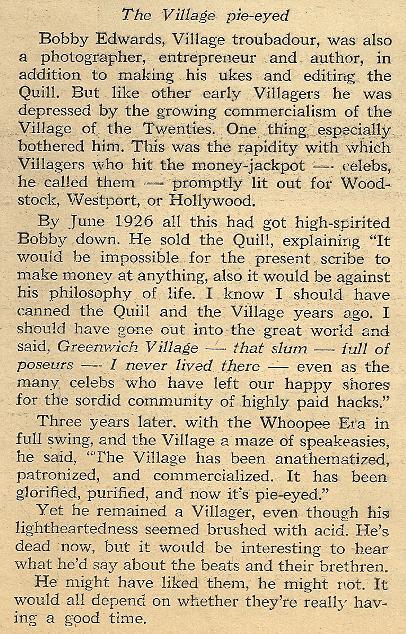
And, finally, remember Edwards’ watchword: “Eternal Villageance is the price of liberty!”
(Posted by Doug Skinner)
Tags: Bobby Edwards · Ukulele
January 17th, 2011 · 2 Comments


The Quill was one of the Village’s more successful little magazines. It debuted on June 30, 1917, owned and edited by Arthur Moss. Edwards was a regular contributor from the beginning; in 1921, he took it over, and ran it until 1926.
There are a number of issues of The Quill archived on the internet. The images above show some of Edwards’ typical contributions prior to his own editorship. The first (from the first issue) portrays him with his beloved cat, Dirty Joe — who, it should be explained, owed his name to a black smudge on his face, not to faulty hygiene. The second is a specimen of Edwards’ column. The third is one of the ads he ran for his various enterprises. The mention of “Movie Actor” is intriguing: several movies were filmed in the Village in the ‘teens and ‘twenties, and reportedly used local personalities for atmosphere. I suspect Edwards was one of them. Maybe footage of the picturesque troubadour will surface.
Edwards was, above all, enamored of the Village. His entertaining “Story of Greenwich Village” rambled through at least 20 issues of The Quill, starting in 1923. He promised that it was “compiled from most original sources and written comprehensible to both morons and other artistic folk.” It can be found here.
(Posted by Doug Skinner)
Tags: Bobby Edwards · Ukulele
January 16th, 2011 · 1 Comment

Since Edwards in his Village heyday was described as a former illustrator, I’ve been curious about that earlier career. After a little rummaging, I think I found something. A “Robert Edwards” illustrated a book by Marion Hill, Harmony House, in Boston in 1910. Is it the same Edwards? I don’t know, but I think so: the time and place are right; and the signature looks the same.
It does look different from his usual ink sketches; but I presume he could be more polished for the sake of the fee. He was certainly capable of more detailed renderings. Here, for example, is another of his illustrated songs.
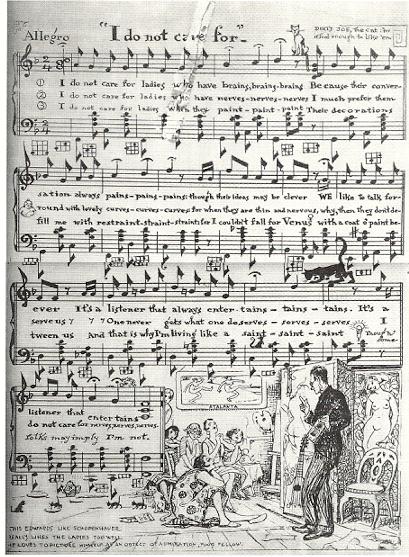
Please note the different version of the self-portrait that you admired in an earlier post (#4). I also call to your attention his cat Dirty Joe (himself a notable Village character) in the upper right corner, the ukulele chords, and the guitar. Did Edwards make guitars as well?
Edwards also did advertising art on occasion. According to John Reed’s magnificent ode to Village life, “The Day in Bohemia” (1912):
BOB EDWARDS, when he needs some other togs,
Draws pictures for the clothing catalogues.
Reed’s rollicking poem can be read here; Edwards makes another appearance later:
Bring on your wine, bring on your raviola,
Here’s EDWARDS and his kitten, — let us troll a
Catch that will ring from Cos Cob to Ecola!
(Posted by Doug Skinner)
Tags: Bobby Edwards · Ukulele
January 15th, 2011 · 1 Comment
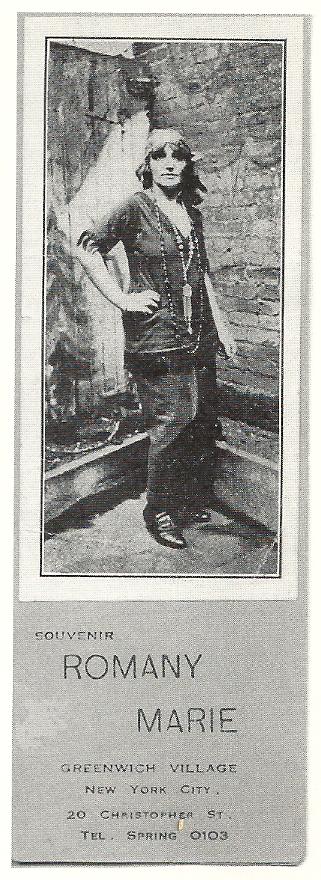
Romany Marie (Marie Marchand), whose Gypsy-themed tavern was a popular hangout for decades, reminisced about Bobby Edwards in a long interview with Robert Schulman (for his book Romany Marie: The Queen of Greenwich Village, 2006).
She quotes several Edwards songs, including this charming snippet:
We are holy Christian martyrs
We don’t shave or clean our faces
When we sit in public places
We are so holy that we are sure
That our morals are secure.
Halitosis, halitosis,
Holy Hallelujah.
She recalls his studio:
“He lived for years and years on the first floor of an old building on McDougal Street. You couldn’t get into the place, he had everything there. He did photography, he composed music, he wrote, he did everything. People used to go in there just out of curiosity, to look at all this accumulation. And there is where he composed his songs.”
And she reveals that one of those songs was based on a waitress who worked in her tavern. Bodenheim quoted a bit of it in New York Madness (see the earlier post here); here’s more:
I know a girl
I’d like to whirl,
I’d like to hurl
Into the river one day,
She’s a pest,
Don’t give us no rest,
Always asking for pay.
She’s the belle of Hubert’s Cafe-tit-teria
Down on Sheridan Square
Where the nuts and the bums
With the sex hysteria
Patiently give her the air.
She hasn’t a home,
A place of her own,
She domiciles everywhere,
And her name, if you ask it,
Is Lizzie Mossbasket,
The belle of Sheridan Square.
This seems a bit harsh, but as Marie ruefully recalls, “She was very aggressive… She wasn’t coordinated with her wildness.”
(Posted by Doug Skinner)
Tags: Bobby Edwards · Ukulele
January 14th, 2011 · 1 Comment

Edwards was featured a couple of times in Theatre Magazine in the ‘teens. We see him here in the August 1919 issue, rehearsing for “Greenwich Village Nights” — which soon changed its name to “Greenwich Village Follies,” thereby enraging Flo Ziegfeld.
The August 1917 issue carried an article called “The Renaissance of Greenwich Village,” by one Ada Patterson. She seems quite taken with our troubadour:
“But perhaps the village’s most picturesque figure is ‘Bobbie’ Edwards, ‘the Irving Berlin of Greenwich Village.’ A tall, pale, young man, Bobbie Edwards wears the garb of an average New Yorker, but to Polly’s, to the Dutch Oven, the Black Cat, and to other restaurants typical of ‘Village’ life, he goes to sing his songs. Once an illustrator, he has dropped the crayon for the score. He accompanies his songs upon an instrument which he himself makes, in his studio in South Washington Square, and which he adorns in brilliant colors, the greens and reds and purples of the impressionistic school.
“‘Be sure to save your cigar boxes for Bobbie Edwards,’ may be heard any night in many restaurants of New York’s Montmartre.
“Presently the pale young man walks to the desk of the cigar counter and with smile and bow collects the empty receptacles of the weed. He will carry them to his studio and rapidly fashion them into replicas of the Hawaiian musical instrument, which, lighter toned than the cigar guitar, still resembles it.”
So that’s where those cigar boxes came from! Another Village celebrity, Romany Marie, used to accuse him of buying the ukes from a manufacturer, and then simply painting them. But we’ll hear from her tomorrow.
Incidentally, Edwards was also active in the little theater movement, not just in restaurants and revues. He acted in productions of the Washington Square Players and the Provincetown Players. For Harry Kemp’s Poet’s Theater (which lasted from 1925 all the way to 1926), he wrote a play called “Paraloxyn”; and composed music for Kemp’s comedy “The Game Called Kiss.”
(Posted by Doug Skinner)
Tags: Bobby Edwards · Ukulele
January 13th, 2011 · 1 Comment
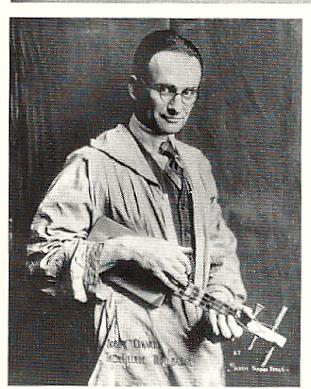
This postcard, by Jesse Tarbox Beals, was sold in the Village to fans of “The Village Troubadour.” I suppose that’s the “rustic shirting” Woollcott mentioned in the review I cited earlier. And it serves as a suitable illustration for another description of Edwards at work — although, in this excerpt, we find him not playing his uke.
Mary Carolyn Davies acted in the Provincetown Players with Edwards. And she also wrote a novel, The Husband Test, which was published in 1921. Her characters encounter Bobby in Chapter Ten:
“A lanky man with tortoise shell glasses, which gave him a whimsical, arresting appearance, had come in, carrying a ukulele painted in village colors with a startling cat, and a sort of mixed up totem pole effect.
“‘Good! It’s Bobby Edwards!’ explained a Spanish-looking novelist opposite Bettina.
“‘He makes them out of cigar boxes,’ he added, seeing her eyes on the cat.
“‘Have you heard Bobby Edwards sing?’ Nessa asked her.
“‘He never really says anything shocking in his songs, but he always looks as if he were on the verge of it. So people sit about hoping. For hours.’
“The room had grown silent. Hoping.
“But Bobby Edwards seemed unaware of the presence of anyone save the two or three cronies about him.
“He raised the ukulele casually.
“The room caught its breath.
“He laid it down again.
“The room sighed sadly.
“‘Oh, why doesn’t someone make him!’ Betty was savage with desire.
“‘You can’t make him do anything,’ said the novelist dolefully. ‘He’s an artist.'”
(Posted by Doug Skinner)
Tags: Bobby Edwards · Ukulele
January 12th, 2011 · 2 Comments
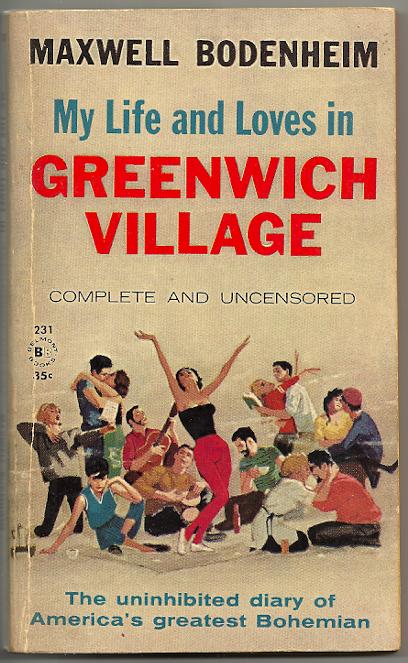
We had a look earlier at Bodenheim’s fictional portrayal of Edwards. There’s a more flattering assessment in this putative memoir from 1954, published soon after Bodenheim’s murder. Since the book was actually written by Samuel Roth and David George Kin, from Bodenheim’s unfinished notes, it’s hard to say who’s responsible for what follows.
At any rate, the book opens with two pages of Bobby:
“During the middle and late twenties in Greenwich Village, many unique characters flourished. Among them was jaunty, bald, string-bean Bobby Edwards and his cigar-box ukeleles which he made and painted in gaudy abstract designs. When he was not being impish or professionally clowning, Bobby had a personality so shy that it almost flirted with diffidence. His alcoholic imbibing was limited to a very occasional glass of beer or wine.”
After a few anecdotes about Edwards’ verbal sparring with hecklers and other Villagers, and an excerpt from his song “The Sultan’s Wives,” the portrait concludes with his response to an admiring (and drunk) young woman, who had staggered onstage to paw him.
“‘Thanks a million,’ Bobby replied. ‘I’d like to tell you how I feel toward you too, darling, but I could only make such a confession privately.’
“‘Privately? Why, honey?’
“‘Because the words I would use regarding the exhibition that you’re putting on would be so sore and off color that I couldn’t possibly say them in front of an audience,’ Bobby replied, with his invariable, nicely-balanced and coolly self-possessed grin.
“The tuxedo-clad escort of the girl, who had followed her and was watching close behind with clenched fists, relaxed and hauled his tipsy lady off the floor and back to their table.
“It must not be surmised that Bobby had spoken as he did from any fear of the close-by male. Men who were deceived by Bobby’s subdued manners and gentlemanly poise and strove to insult, push, or annoy him, promptly felt the hefty sting of his right uppercut or left jab.”
(Posted by Doug Skinner)
Tags: Bobby Edwards · Ukulele
January 11th, 2011 · 2 Comments
Another of Edwards’ signature songs was a brief ditty called “One O’Clock.” According to Ralph Bartholomew’s Souvenir Book of Greenwich Village (1920), it became somewhat of a tradition:
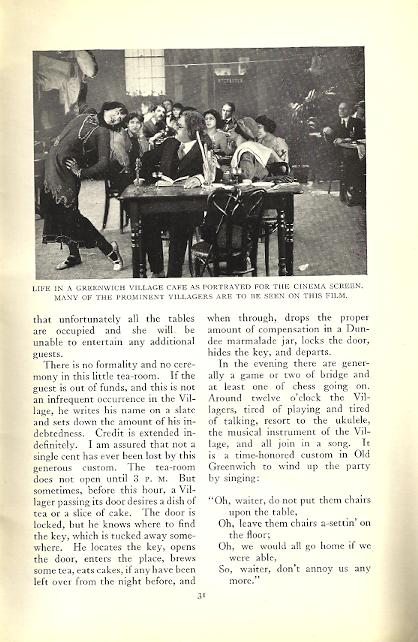
And here is Edwards’ embellished manuscript of his composition:
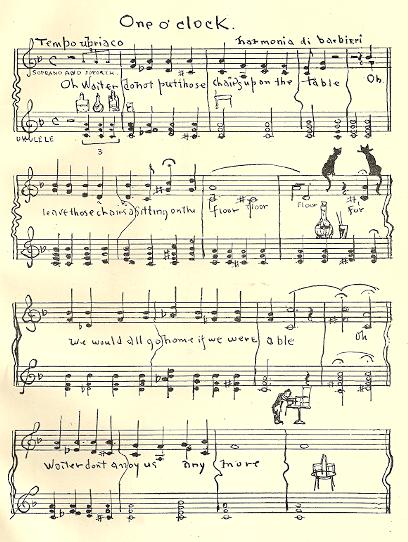
And, for good measure, here’s a clip of Carmen Borgia and me performing it at a Ukulele Cabaret. We tried to give it that full 1 am flavor.
(Posted by Doug Skinner)
Tags: Bobby Edwards · Ukulele
January 10th, 2011 · Comments Off on Bobby Edwards, the Troubadour of Greenwich Village (6)
Clement Wood contributed two booklets about Greenwich Village to the long-running series of Little Blue Books published by Haldeman-Julius. The first, Bohemian Life in N.Y.’s Greenwich Village (1926), describes several of the area’s personalities, mostly in rather peevish style. He’s none too keen on Edwards, but, as he admits, it may be his own fault.
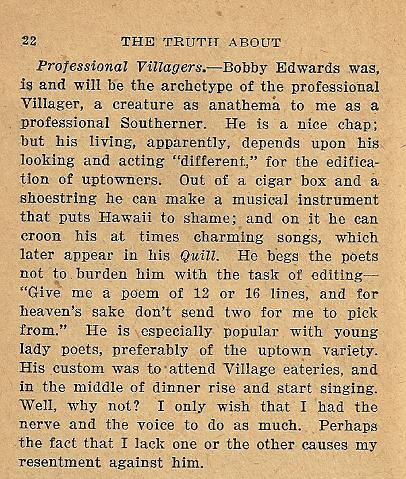
(Posted by Doug Skinner)
Tags: Bobby Edwards · Ukulele
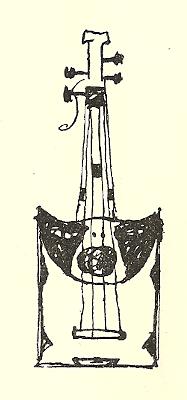
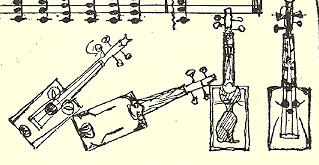
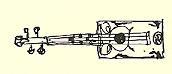
Edwards not only played cigar box ukes; he made and sold them. His first efforts, I believe, were created for a production number in a revue. They were brightly painted (the Edwards color sense was always loud); and, judging from contemporary accounts, sounded pretty good.
I’ve often wondered if any of those instruments survive. So far, I’ve found nothing. Meanwhile, here are some of his designs. He often decorated his scores and drawings with uke sketches; he even put one on the front cover of The Quill. The ones following are from his 1917 Song Book.
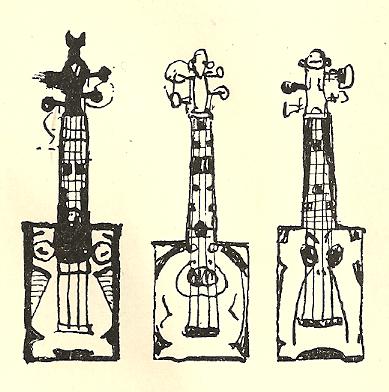
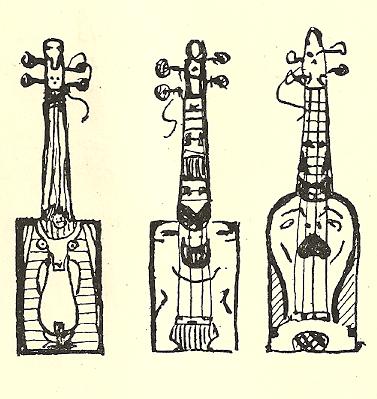
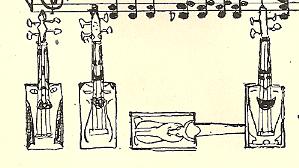
(Posted by Doug Skinner)
Tags: Bobby Edwards · Ukulele
