January 8th, 2011 · 1 Comment
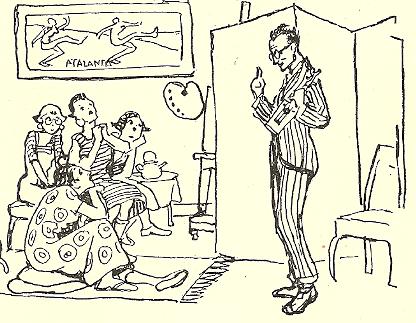
In 1922, Edwards appeared in the revue “A Fantastic Fricassee.” Alexander Woollcott, then drama critic for the New York Times, singled him out as one of the highlights:
“An enchanting little marionette show and some diverting lyrics by one Robert Edwards, said to be the Greenwich Village cut-up — those two items constitute the oases in the proceedings instituted last evening at the Greenwich Village Theatre…
“Mr. Edwards, faithful to the village in that he carries a ukulele and wears a bit of rustic shirting, has several charming songs. There is one done in the manner of an Arabian lament which runs something like this:
“The Sultan’s wives
Have got the hives
Oh, Allah, be merciful!
The Sultan’s laundress
Has the jaundice,
Oh, Allah, be reasonable!
“And then he had another elegiac piece. It avers that he wearies of ‘Greenwich Village flappers in their dirty batik wrappers,’ and is sung in memory of a ‘sweetie from Tahiti.'”
This production, by the way, was also noted for featuring the young Jeanette MacDonald; and for being prevented from appearing before the inmates at Sing Sing, due its underdressed dance numbers.
A few years before that, Edwards performed in the first edition of the “Greenwich Village Follies,” which went on to become more commercial (and to have less and less to do with the Village) in its later incarnations. Again, the Times (this time an anonymous critic) gave particular attention to Edwards (7/16/19):
“There were several specialty numbers that made a hit last night. Cecil Cunningham was on twice with songs, and Bobby Edwards, who may be described as the real Greenwich Villager in the ‘Greenwich Village Follies,’ made musical comments aided by a well-tamed toy guitar. Each had a hard time getting off the stage.”
I assume that the last sentence meant that Edwards was called back for encores, not he overstayed his welcome. And note that the representative of the paper of record couldn’t identify a cigar-box uke; it was ever thus.
Edwards was the M.C. in this show; his big number was “Why Be an Industrial Slave When You Can Be Crazy?”
(Posted by Doug Skinner. The self-portrait with adoring fans is from his 1917 Song Book.)
Tags: Bobby Edwards · Ukulele
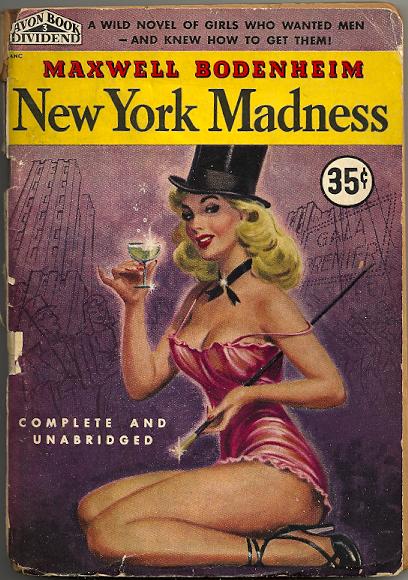
Edwards shows up as a character in this rackety 1933 novel by that other (and considerably darker) Village personality, Maxwell Bodenheim. Despite the fictional name Bodenheim bestows on our troubadour, this may be an accurate description of Edwards at work. The lyrics, at any rate, are lifted from genuine Edwards songs.
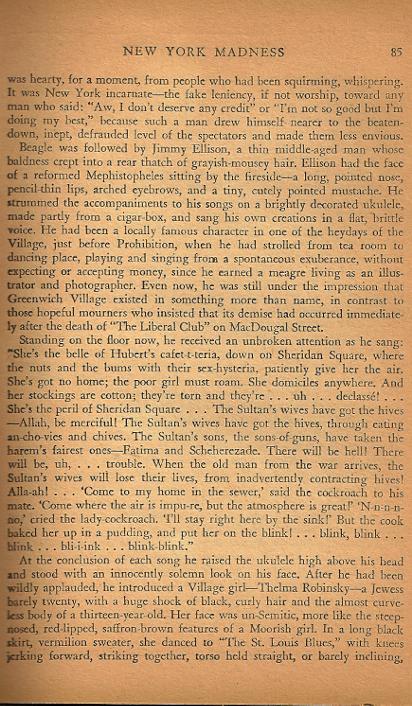
(Posted by Doug Skinner)
Tags: Bobby Edwards · Ukulele
January 6th, 2011 · 1 Comment
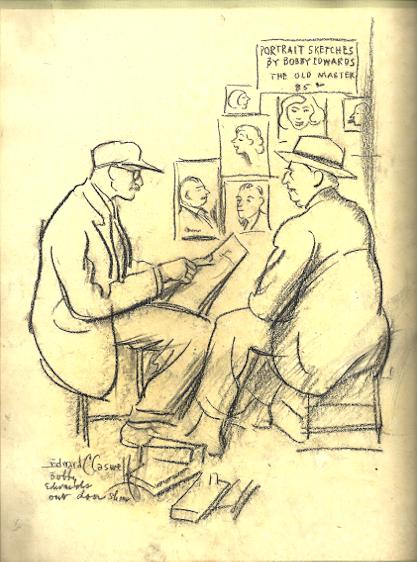
Much to my surprise, I found this charcoal sketch at the flea market last weekend. The artist, Edward C. Caswell, frequently sketched Village subjects. Edwards is seen here as a sidewalk sketch artist at an outdoor art show. A note accompanied it: “This was drawn in Macdougal Alley and Macdougal St. Bobby had just told me to get back a little as I might be in the way of possible sitters. When I remarked that he could raise the price, he replied that he would rather make portraits at 85c than none for 1.00!”
The sketch is undated, but my uneducated guess is that it’s from sometime in the ’30s.
(Posted by Doug Skinner)
Tags: Bobby Edwards · Ephemera · Ukulele
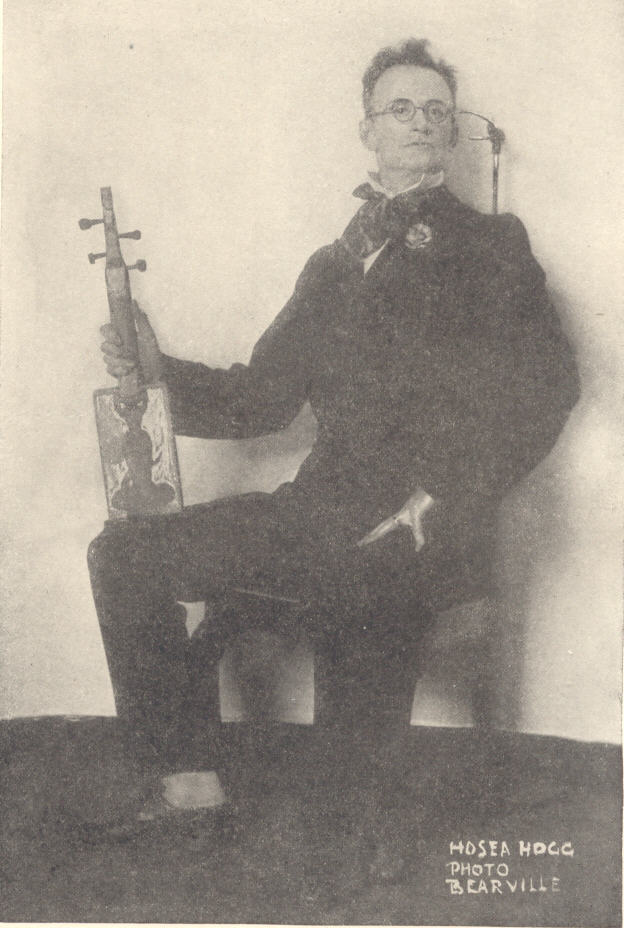
I’ve long been interested in the career of Bobby Edwards, who played and made ukuleles in Greenwich Village in the ‘teens and ‘twenties, and established himself as one of the Village’s most conspicuous and colorful personalities.
I haven’t been able to dig up much biographical information. I know that he was born in Buffalo in 1879, and died in New York City in 1948. He graduated from Harvard in 1901, and attended Chase Art School; and worked for a while as an illustrator. He then settled in the Village to pursue a merry, disorganized career as a sometime artist, performer and writer — and full-time Bohemian. He advertised himself as “Maker of the Ukalyptos, Second Cousin of the Ukulele. Painting, Poetry, Movie Acting, Music, Singing, Illustrating and General Art Work Neatly Done. Also Contracts Taken to Make Restaurants Famous. Terms for Singing at Parties on Application. Also Portrait Photography.”
He edited the quintessential Village magazine, The Quill (from which the above promotion was taken), and filled its pages with verses, songs, gossip, and photos of his cats romping through his famously cluttered studio. He also contributed to The Masses, Broadway Brevities, and other periodicals.
But he was best known for his performances in clubs and revues, where he sang his comic songs, strumming a brightly painted cigar box uke. He not only made the uke himself, but turned out others to sell to tourists.
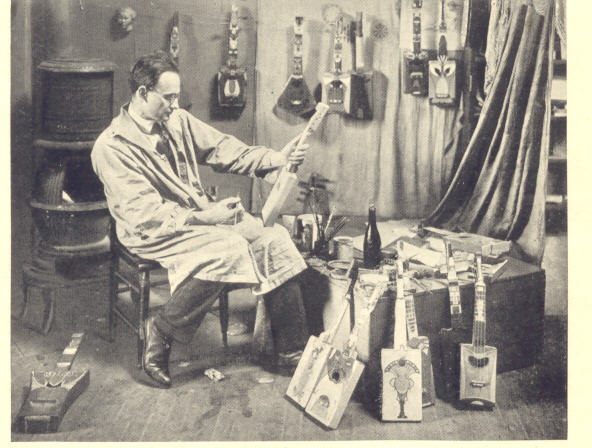
His signature tune was “The Greenwich Village Epic,” a sprawling satire which apparently everyone then living in the Village added to. (I posted all the verses I could find, as well as the official Edwards history of it, back here on 3/30/10.)
He was a somewhat controversial figure: many entrenched Villagers were serious artists, and bridled at his frivolity, and at his promotion of the Village as a Boho playground.
In the next few posts, I’ll air some of the material I’ve collected on him. Ukulele and Village history buffs, watch this space!
(Posted by Doug Skinner. The first photo is taken from The Song Book of Robert Edwards (1917); the second from Souvenir Book of Greenwich Village (by Ralph Bartholomew, 1920).)
Tags: Bobby Edwards · Ukulele
December 31st, 2010 · 1 Comment
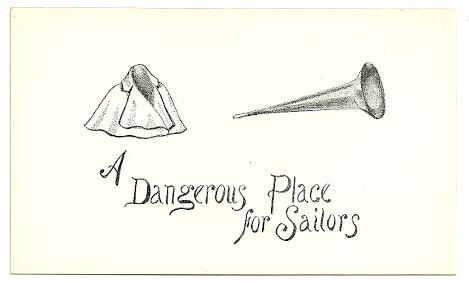
Parker Brothers published “Hidden Titles”; as usual, there’s no date. It contains thirty cards, “representing many different geographical titles in pictures.” I like its flamboyant lettering and deft charcoal sketches.
(Posted by Doug Skinner)
Tags: Card Games · Ephemera · Liminal Graphics
December 31st, 2010 · 1 Comment
2-D glasses
“Symmetry” and “cemetery” are fitting homonyms: what is more moribund than the mirrored bilateral?
Coin new words; otherwise, you’re just cooking with leftovers.
a single signal
The best way to be offensive is to be strongly defensive.
I cannot recall my christening;
I suppose I wasn’t listening.
bad bon bons: mauvais mauvais
With animation, you don’t have to look at actors.
Since the map is not the territory, let us treat it as independent, with no pretense at representation. Maps are beautiful, as long as you don’t expect them to guide you.
a starling named Stella
Horses must get somewhat addled,
Once they’re bridled, shod, and saddled.
(Posted by Doug Skinner)
Tags: Education
December 23rd, 2010 · 2 Comments
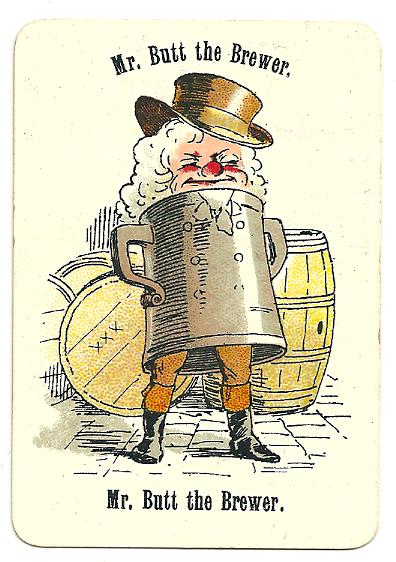
“Cheery Families” was published by Thomas de la Rue & Co, in London. There were thirteen families in the deck; all headed by contented tradesmen like Mr. Butt. I suspect brewers would be barred from a children’s game nowadays.
(Posted by Doug Skinner. Thanks to Angela Alverson.)
Tags: Card Games · Ephemera · Liminal Graphics
December 22nd, 2010 · 1 Comment
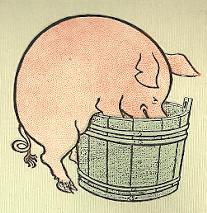
Observation is obfuscation.
The umbrella protects rain from humans.
musk scum
a broadcaster’s pleonasm: “constitutional rights according to the Constitution”
Birds of a feather fight together.
cartons of cartoons
A drawing is less successful the more it resembles its subject; fiction the more it resembles fact.
white noise from a wet nose
To gauge the social acceptability of your behavior, simply imagine how the characters on a TV sitcom would respond to it.
Music need not be aural: it can be a musical drawing, an unperformable score, imprecise instructions.
When my work makes no sensation,
That’s my proper compensation.
When my work makes little sense,
That’s the reader’s recompense.
(Posted by Doug Skinner. Drawing by Edgar Kellar.)
Tags: Education
December 16th, 2010 · 2 Comments
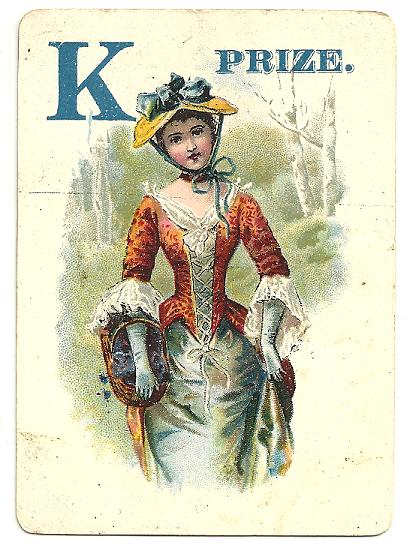
We have here an old, isolated card; I don’t know to what game it once belonged.
(Posted by Doug Skinner)
Tags: Card Games · Ephemera · Liminal Graphics
December 14th, 2010 · 1 Comment
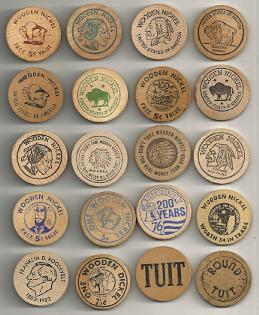
Wooden nickels serve many functions in our society: souvenirs, coupons, business cards, promotional items. The graphic design is usually based on some stylization of a nickel. For some reason, the older Indian or buffalo nickel is preferred. I offer here a variety of designs, including a dime and “dickel.” The “round tuit” is meant to serve as an icebreaker: the recipient has finally gotten a “round tuit.”
(Posted by Doug Skinner.)
Tags: Liminal Graphics
