(Posted by Doug Skinner)

(Posted by Doug Skinner)
→ 4 CommentsTags: Literature
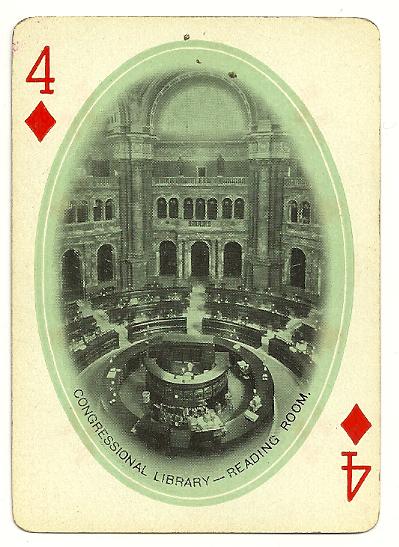
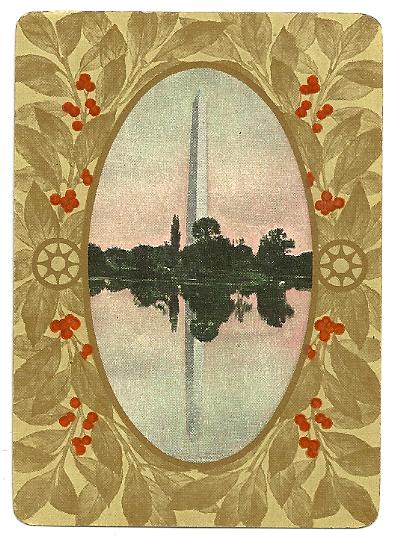
The U.S. Playing Card Company published these “Nation’s Capitol Souvenir Playing Cards” in 1909. Photos of places of interest were overlaid with pastel tints: blue for hearts, green for diamonds, and pink for spades and clubs. The Joker was Dupont Circle.
The backs are unusually lovely:
(Posted by Doug Skinner)
→ 2 CommentsTags: Card Games · Ephemera · Liminal Graphics
The “King James Version” of the Bible gives every indication of a garbled text. Some words are omitted (for example, that curious hapax legomenon, επιουσιος, in the Pater Noster); some words seem to be approximations or guesswork (particularly the names of animals and musical instruments). Much of it simply makes little sense.
We encounter similar problems in the Shackspearian canon, the other great literary corpus of the period. Some passages, especially in the earlier quartos, appear to be faulty transcriptions of an oral source. We now know that Shakspeare was more of a producer and director than writer; and that he generated playscripts by engaging a scribe to notate the improvisations of the actors (still the preferred method of theatrical creation). If we predicate a similar procedure for James I’s team of scholars, we can produce a speculative restoration of a section of the text, interpreting it as a faulty transcription of a dictation. I’ve chosen Psalm 23 for this attempt.
The version that I give below differs in many respects from the KJV. In particular, it presents a subtly different relationship between the narrator and the “Lord.”
I must emphasize that, although this restoration is speculative, its homophony is significant. Jung, in his studies on word association, affirmed that phonic associations were the most basic. And his great precursor, Jean-Pierre Brisset, elaborated this principle: “There exists in the word a number of Laws, previously unknown, of which the most important is that a sound, or a succession of identical, intelligible, and lucid sounds, can express different things, by a modification in the way these names or words are written or understood. All ideas that are enunciated with similar sounds have the same origin, and all refer, in essence, to the same object… This is the key that opens the books of the word.” (From La Science de Dieu, 1900, my translation.) Brisset emphasized the theological importance of this method of exegesis in his revised edition of 1913, Les Origines Humaines (again, in my translation): “The sword of fire that guarded the path to the tree of life is called the pun, the play on words… God chose those things in the world that are the most foolish, and the most despised, to annihilate those things that are.”
Readers of Raymond Roussel will recognize the theoretical rationale for the famous procédé. Sound and sense are linked; words with similar sounds have similar meanings, often revealing fresh, sometimes surprising, interpretations.
The Lord is my jester; he’s full of taunt.
He mocketh me with low clownish impostures: he seateth me astride the spilled water.
He ignoreth my calls: he leadeth me to inspire derisiveness, for a jape’s sake.
Say, I could waltz down the alleyway unshaken by doubt, like a paralegal: but thou art witty; thy rudeness and chaff they target me.
Thou preparest me troubles to foil me for the pleasance of mine enemies: thou anointest my rug with oil; I slip, falleth over.
Surely goads without mercy shall swallow up all the joys of my life, and I am drenched by the hose of the Lord forever.
(Posted by Doug Skinner)
→ 1 CommentTags: Education · Language · Literature
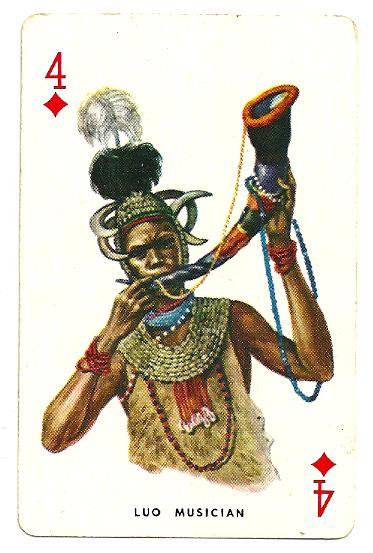
Kilimanjaro Productions published this African-themed deck in 1979. I like its lush, formal illustrations.
(Posted by Doug Skinner)
→ 1 CommentTags: Card Games · Ephemera · Liminal Graphics
Doug Skinner, one of your Ullage Group personalities, will present new picture stories on another edition of “Carousel,” due to be unveiled at Dixon Place on February 16. More info can be scrutinized at the Dixon Place website.
Mr. Skinner will also be performing his inimitable compositions with violist David Gold at Jalopy on March 12. More details will follow.
Further unfashionable Ullage Group events are in the pipeline. Don’t despair.
(Posted by Doug Skinner)
→ 2 CommentsTags: Bulletins
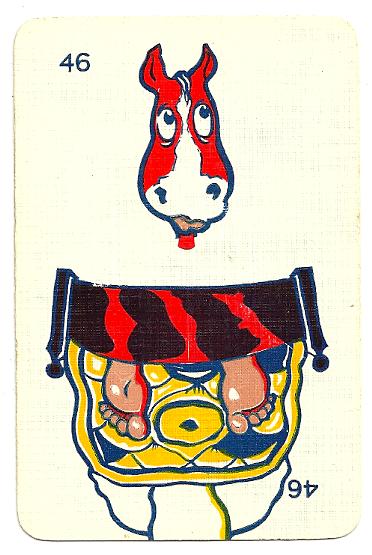
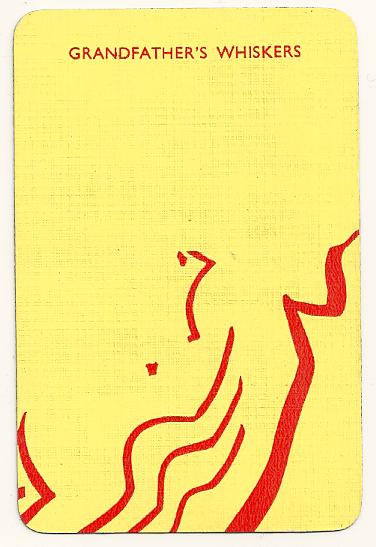
“Grandfather’s Whiskers,” from John Waddington Ltd. (of Leeds and London) promised “3 games in 1.” You could match the heads and bodies; you could connect incongruous heads and bodies for “over one thousand humorous figure combinations”; or you could work the “jig-type puzzles” on the backs of the cards.
(Posted by Doug Skinner. Thanks to Angela Alverson.)
Comments Off on Children’s Card Games (125)Tags: Card Games · Ephemera · Liminal Graphics
the metric fork: ten tines
If you feel the need to barf,
Hit the sidewalk, not your scarf.
tea-flavored coffee
a lenticular dollar bill, so Washington can change expression
falling awake
Since newspapers and napkins are both disposable, why not combine them into one product?
Stop watching the stopwatch!
to discourage moths, a sweater made of moth wings
restaurant chairs fitted with whoopie cushions, to spare actual farters embarrassment
to insure privacy, a door that can’t be opened
the voodoo doll wax museum: stick pins in hated celebrities
(Posted by Doug Skinner)
→ 2 CommentsTags: Education
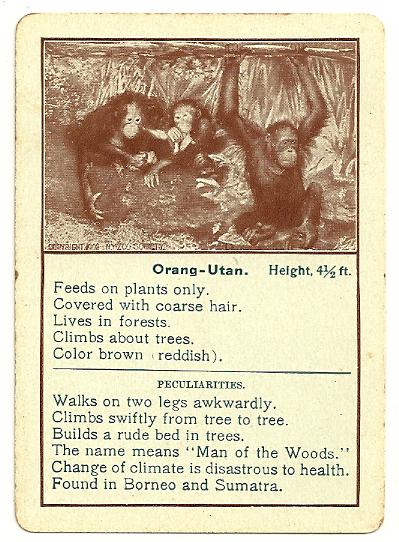
“Wild Animals” — “For School and Home Play” — was created in 1903 by Louis M. Schiel, Principal of the 23rd District School in Cincinnati, for The Cincinnati Game Company, and published by Parker Brothers. It came with a 16-page booklet, describing its many educational uses.
(Posted by Doug Skinner)
→ 1 CommentTags: Card Games · Ephemera · Liminal Graphics
We found a toxin!
Sound the tocsin!
It’s always disturbing to see a pigeon pecking at fried chicken.
a parrot mimicking a man mimicking a parrot
coins shaped like puzzle pieces, so you can assemble them to make a dollar
At the diner, a waiter asked a customer what kind of cheese he wanted on his cheeseburger. “What do you mean, what kind of cheese?” the man snapped. “Regular cheese!”
a Phillips head hammer
You said, “This isn’t a game!” You lose!
for the blind who can’t afford a guide dog: a cane that barks
shoes that dispense bread crumbs, so you won’t get lost
The Rapture already happened; nobody made the cut.
Stay away from all that’s trendy,
If you want to be my friendy.
(Posted by Doug Skinner)
→ 1 CommentTags: Education
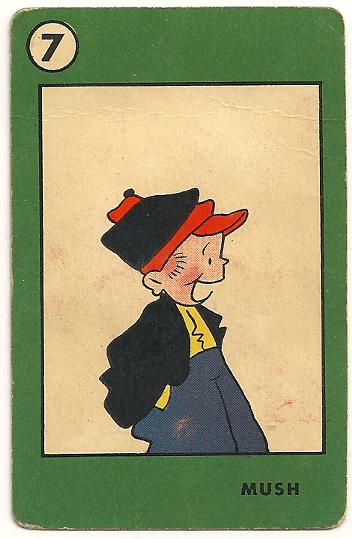
“All Star Comics,” a 1934 creation from Whitman and the King Features Syndicate, featured characters from a number of comic strips: “Krazy Kat,” “Dumb Dora,” “The Katzenjammer Kids,” “Little Annie Rooney,” and “Just Kids.” This is Mush Stebbins, from “Just Kids.”
(Posted by Doug Skinner)
→ 2 CommentsTags: Card Games · Ephemera · Liminal Graphics