July 5th, 2008 · Comments Off on Big and Little (1)
We here at the Ullage Group are intrigued by the extremes of literature. For that reason, we’ll occasionally raise a toast to an exceptional example. In this series, those will be works that are unusually short or long.
The long poem is an unpopular form these days. Long movies and TV serials do well. Novels have expanded: popular fiction, once ruled by punchy pulps, now tends to the epic; even kids inhale huge Harry Potter tomes. But something about the long poem makes readers scatter. This is odd, since it’s one of the oldest and most enduring of genres. It must be a phase we’re going through.
So: let’s celebrate one. Pop the cork, and lift that ullage to La Seine, by Raymond Roussel.
The extraordinary life and work of Roussel are celebrated elsewhere; scour the www if you’re curious. I’ll just mention that he was a wealthy eccentric who devoted his life to writing eight incomparable books, which he published himself.
Rousselians have long had to content ourselves with gaping, bug-eyed, at those eight marvels. But that changed in 1989, with the discovery of a cache of manuscripts, including several previously unknown works — among them La Seine, published in 1994.
Here we go.
La Seine, probably written 1900-1903, is a four-act play in verse. The first act is fairly conventional: a husband and wife are seen at home, apparently content; when the wife exits, the mistress enters, and persuades the man to leave his wife for her; and the act closes with the kid coming home and chattering about school, oblivious to his now broken home. It’s familiar fare, and handled in 600 lines of competent alexandrines. But something is amiss: before the child’s final scene, there is an interlude in which no less than seventeen art students are seen through an open door upstage, descending the stairs and discussing subjects for paintings. They have nothing to do with the rest of the action, and will not be seen again.
The second act is unlike anything I’ve ever read. The man and mistress (Raoul and Jeanne) sit in the audience of the Moulin Rouge, and bill and coo and chat. Around them, other patrons eat, drink, gossip, flirt, recount dreams and plots of plays, dance, and make small talk. There are around 400 of these minor characters; nothing really happens; and it goes on for close to 5000 lines (300 pages). The third act is essentially the same, except at the Bois de Boulogne, and is only 1000 lines. The fourth act is brief: Jeanne has run off; Raoul is inconsolable, and finally jumps into the Seine. Again, Parisians pass, talking about other things.
Is it boring? It is; but boring in the same way as relaxing at a cafe and people-watching — except that everyone is speaking in rhymed couplets, which is strange. I find it boring in a peaceful and refreshing way; and for some reason, disturbingly beautiful.
Near the end of Act Three (line 6335), a character named Gloziou makes his first and final appearance; and quotes to another, Montès, a maxim which I’ll translate here to wrap up:
Man only needs to give himself one goal:
That’s beauty; whether reached by way of lute,
Or pen, or brush, is of no great concern,
Provided he create it once, at least,
For that’s the door to happiness and peace.
Once again, to Roussel.
(Posted by Doug Skinner)
Tags: Eccentrics · Literature
I’m pleased to reveal that I have a four-pager in a new comics anthology, “TYPHON #1,” edited by Danny Hellman. The book is 192 pages long; it’s all in color; it’s eye-popping; it has a splendid cover by Bob Sikoryak. My contribution, “Walter and Benny Hunt the Elusive Batworm,” is a gripping cryptozoological adventure. Here’s the first panel, wherein our heroes start their trek:
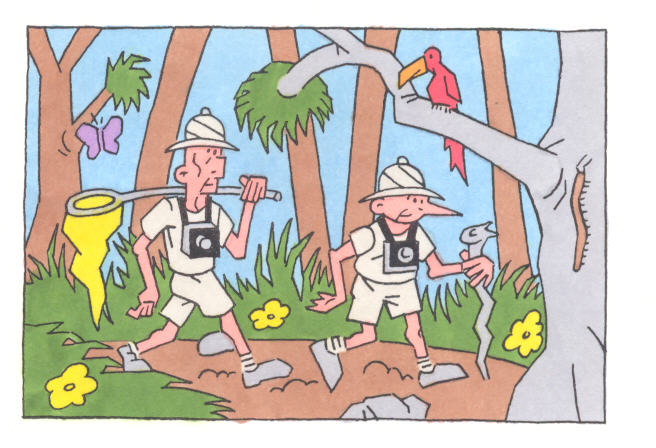
More information can be found here.
(Posted by Doug Skinner)
Tags: Bulletins
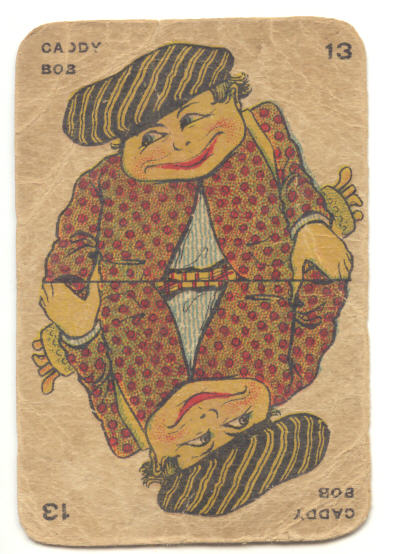
I can’t help you with this one; I found it loose, among miscellaneous ephemera, at a flea market. Who is this smirking urchin? Is he really a good example for the little ones? Why do I suspect that this caddy business is a front for something shadier?
(Posted by Doug Skinner)
Tags: Card Games · Ephemera
(We conclude here a short story by Paul Vibert, translated by Doug Skinner.)
I can repeat the celebrated procedure of the rats’ father, a prosthetic graft, and so join together two elephants, or two whales; then, when the graft has taken, all I need do is cut a small incision for communication; and as I have taken, of course, animals that have been treated with violet rays, I then possess a truly comfortable little apartment.
The second procedure is even simpler, for it foregoes the aforementioned prosthetic graft. All that is needed is to choose among the animals those infant phenomena that occur from time to time, Siamese twins (to use the traditional term). Communication through the membrane that joins the two stomachs is then not difficult to establish, and recalls the familiar “concertina” joint between railroad cars.
Finally, for the sake of the ladies, I will add that water and other waste can be evacuated naturally through the pyloric valve into the intestines; and that this ingenious plan of discharging everything into the sewer has the further advantage of nourishing the animal, which then need no longer eat with its mouth, and can keep its stomach free and clean.
You can easily train the animal with caresses; and it will let you come and go at will through its esophagus, by opening its pretty pink mouth, which is like the antechamber to your apartment, leading to the corridor of the esophagus.
With two conjoined or Siamese animals, you also have the option of two entrances: one for the family, and one for the servants!
Is that not practical and amazing?
In this way, rapidly and safely, at no expense, and with no fear of drafts, you can travel throughout the world by land or sea, thoroughly warm and snug.
Here then is the flesh and bone house of my dreams, which I am now working to realize.
(Posted by Doug Skinner. The reference to the “rats’ father” is a mystery to me. Any ideas?)
Tags: Animals · Literature
June 24th, 2008 · Comments Off on Houses of Flesh and Bone (2)
(We present here the second part of a short story by Paul Vibert, translated by Doug Skinner. Please read the first part for your greater enjoyment.)
Obviously, there can be no question of a spacious apartment, but simply a small lodging, warm and convenient. It could be relocated at will; and man would thus solve the problem of the portable house, and make himself the equal of the snail and the turtle.
Attend for a moment, and you will soon see that my plan could easily be realized. Be it understood that if I wished to travel overground, I would establish my little residence in an elephant’s stomach, where there is room, and not its belly — which would be absurd, as it is filled with interminable corridors and intestines. And I would move into the stomach of a whale, if I planned to undertake a voyage by sea.
In the latter case, I would then have a little submarine of flesh and bone, just like good old Jonah — see the Bible, page etc. — nothing could be simpler. But here the benevolent reader stops me with a triumphant and peremptory gesture, saying:
— Excuse me, but I don’t see how you would have room to live in those creatures, even snugly, particularly if you had a family, with a wife and mother-in-law, not to mention the kids.
— Don’t be impatient; for I have solved that problem, and this is precisely my point of pride. To begin with, I place my young elephant in a greenhouse-stable, or my young whale into a basin-aquarium, and submit them to the well-known effects of violet rays; and after six months, I have a pachyderm, or whale, five or six times larger than its ordinary congeners; and I therefore have in its stomach a comfortable little apartment for the entire family. But I realize that it would be disagreeable for everyone to live and sleep in the same room; or that you may have a mother-in-law who insists on a salon. I have a solution to that as well — two solutions, in fact, equally elegant.
(Posted by Doug Skinner. To be concluded.)
Tags: Animals · Literature
June 23rd, 2008 · Comments Off on Houses of Flesh and Bone (1)
(We have a serial for you this week: a short story by Paul Vibert, carved into three portions, so you won’t get sick by eating it all at once.
I know almost nothing about Vibert, except that he wrote stories in the 1890’s, often based on scientific fantasy. His curious tales can sometimes be found in anthologies; which is, you guessed it, where I found this one.
I’ve tried to render his digressive style in suitable English, and fought the itch to nip and tuck. And I don’t suggest you acually follow his suggestions, but offer them only as feats of a disgusting imagination.)
HOUSES OF FLESH AND BONE
Jonah’s whale and the elephant on the Place de la Bastille.
On the effect of violet rays upon fauna. A new and curious application.
Even the stupidest legends of all theogonies originally had some purpose; so I must confess that, in my youth, the unpleasant ordeal undergone by Jonah, one of the twelve lesser Jewish prophets, if I am not mistaken, held quite a lively interest for me.
For I, with the vivid imagination of a child, thought that this more or less legendary tale, which dates to the ninth century BC, or so I am told, had happened only yesterday; and I liked to close my eyes and relive in my mind the time that fine man had spent in the stomach — for the belly seemed an impossibility — of that great marine mammal: the whale, to give it its proper name. But enough; I proceed.
Was he comfortable, could he sit down, didn’t it smell bad, could he breathe and see clearly at times through the tunnel of the esophagus? So many questions of vital interest to me!
Of course, deep down, it was all speculation, and a bit just for fun; for I had been too well educated to believe such foolishness. But fun it was, for my young imagination — a fit subject for a cerebral pastime, and not devoid of charm.
In later years, I regretted having entered the world too late to see the great white elephant (!) of the Place de la Bastille. When it was demolished, millions of rats escaped and spread throughout Paris, thus proving that it too had been inhabited in its interior, just like Jonah’s whale.
All of these ideas had long chased about my brain, a bit muddled and muted by the passage of time — that tall thin gentleman, to quote Émile de Girardin, if I am not mistaken — when a series of discoveries, events, and newspaper articles came to my attention, and galvanized those old memories; leading me to hope that I might find a solution, and finally possess a house of flesh and bone.
The idea is audacious; is it possible?
I am beginning to believe, quite seriously, that it is; although obviously much remains to be done in this order of ideas.
(Posted by Doug Skinner. To be continued.)
Tags: Animals · Literature
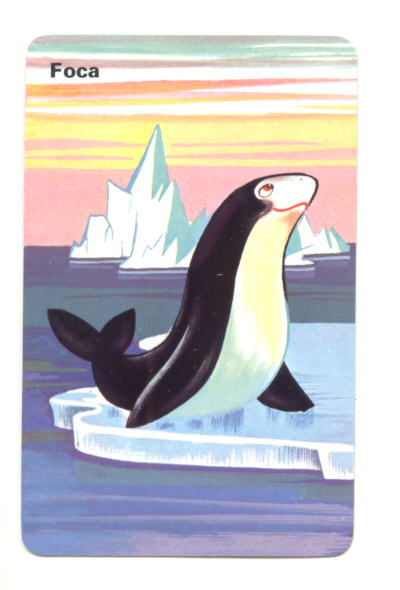
“Parejas del Mundo” was published by Naipes Heraclio Fournier, Vitoria, Spain. Animals and people of different lands are to be paired; our cheery seal will soon meet an Eskimo.

Is that a spear, Señor Esquimal? I suspect this pair will not become amigos.
(Posted by Doug Skinner, with thanks to Gail Freund)
Tags: Card Games · Ephemera
June 20th, 2008 · Comments Off on Pantuso
Several years ago, an unusual character was leaving packets of his outpourings around Manhattan. He was apparently never discovered by the Outsider Art establishment; so I did a slide show about him, which I showed in a number of places around New York. It was also picked up by a website called “Word,” which is now no more. But it’s been archived here, if you like that sort of thing.
(Posted by Doug Skinner)
Tags: Eccentrics · Literature
June 20th, 2008 · Comments Off on Translation
Translation is the ullage of literature. It’s never too respectable, although many fine writers have done it. Baudelaire probably improved Poe. I regret that Tristan Tzara never finished his version of Marlowe’s Faustus.
It is, alas, impossible: you just can’t move meaning from one tongue to another; lexical fields are loose fits, syntax won’t transpose. All you can do is paraphrase, really, and try to color between the lines.
I was struggling recently to translate that troubled Renaissance magus, Tommaso Campanella (more on this later, probably). His rough, surprising verse doesn’t slide easily into our flat English phonemes.
But I found solace in a passage from Diderot, in his smutty whatsit The Indiscreet Jewels. My translation follows:
— With a bit of meditation I shall succeed, My Lord, replied Bloculocus, but I shall reserve these delicate phenomena for the time when I can offer to the public my translation of Philoxenes, for which I beseech Your Majesty’s permission.
— Quite willingly, said Mangogul; but who is this Philoxenes?
— Prince, answered Bloculocus, he was a Greek author who had a great understanding of the subject of dreams.
— Do you know Greek, then?
— I, My Lord? Not a bit.
— Did you not tell me that you were translating Philoxenes, and that he wrote in Greek?
— Yes, My Lord, but one need not understand a language to translate it, since one only translates for people who do not know it at all.
— That is marvelous, said the sultan; translate Greek without knowing it, then, Bloculocus; I give you my word that I shall not tell a soul, and that I shall not esteem you the less for it.
(Posted by Doug Skinner. My translations of Xavier Forneret can be found in Strange Attractor Journal Three; info on my translation of Giovanni Battista Nazari’s Three Dreams can be found here and there.)
Tags: Literature
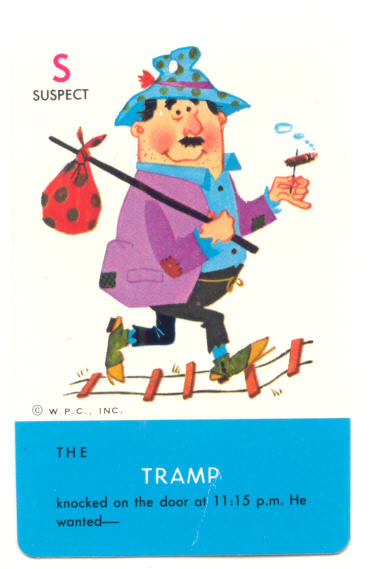
Whitman released this detective game, “Who Is the Thief?”, in 1966. The players were instructed to pair suspects and witnesses, including this jaunty bum, to find the jewel thief.
(Posted by Doug Skinner)
Tags: Card Games · Ephemera
