June 20th, 2008 · Comments Off on Pantuso
Several years ago, an unusual character was leaving packets of his outpourings around Manhattan. He was apparently never discovered by the Outsider Art establishment; so I did a slide show about him, which I showed in a number of places around New York. It was also picked up by a website called “Word,” which is now no more. But it’s been archived here, if you like that sort of thing.
(Posted by Doug Skinner)
Tags: Eccentrics · Literature
June 20th, 2008 · Comments Off on Translation
Translation is the ullage of literature. It’s never too respectable, although many fine writers have done it. Baudelaire probably improved Poe. I regret that Tristan Tzara never finished his version of Marlowe’s Faustus.
It is, alas, impossible: you just can’t move meaning from one tongue to another; lexical fields are loose fits, syntax won’t transpose. All you can do is paraphrase, really, and try to color between the lines.
I was struggling recently to translate that troubled Renaissance magus, Tommaso Campanella (more on this later, probably). His rough, surprising verse doesn’t slide easily into our flat English phonemes.
But I found solace in a passage from Diderot, in his smutty whatsit The Indiscreet Jewels. My translation follows:
— With a bit of meditation I shall succeed, My Lord, replied Bloculocus, but I shall reserve these delicate phenomena for the time when I can offer to the public my translation of Philoxenes, for which I beseech Your Majesty’s permission.
— Quite willingly, said Mangogul; but who is this Philoxenes?
— Prince, answered Bloculocus, he was a Greek author who had a great understanding of the subject of dreams.
— Do you know Greek, then?
— I, My Lord? Not a bit.
— Did you not tell me that you were translating Philoxenes, and that he wrote in Greek?
— Yes, My Lord, but one need not understand a language to translate it, since one only translates for people who do not know it at all.
— That is marvelous, said the sultan; translate Greek without knowing it, then, Bloculocus; I give you my word that I shall not tell a soul, and that I shall not esteem you the less for it.
(Posted by Doug Skinner. My translations of Xavier Forneret can be found in Strange Attractor Journal Three; info on my translation of Giovanni Battista Nazari’s Three Dreams can be found here and there.)
Tags: Literature
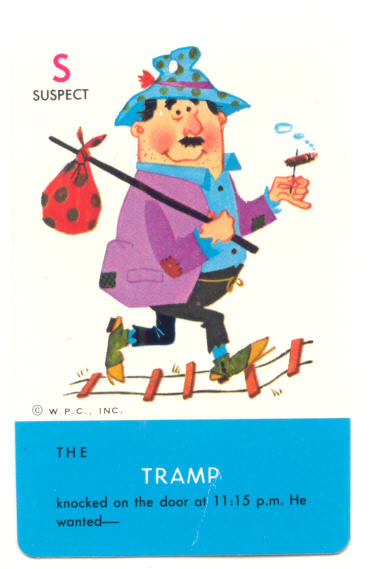
Whitman released this detective game, “Who Is the Thief?”, in 1966. The players were instructed to pair suspects and witnesses, including this jaunty bum, to find the jewel thief.
(Posted by Doug Skinner)
Tags: Card Games · Ephemera
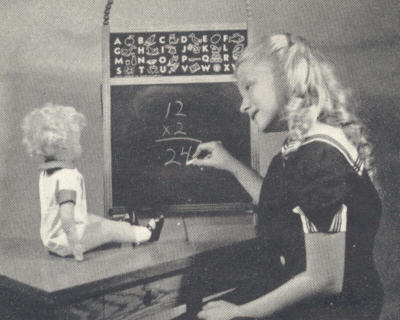
Our seemingly interminable presidential campaign rattles on. Perhaps you’ve noticed. But don’t fret: I won’t add to the gab about the candidates.
I would only like to remark that millions of dollars are collected and spent in the process. We often worry about the source of those millions, and take pains that no one udder be milked too much, so that our public servants will remain incorruptible. We seem less concerned with how those millions are spent.
Our government is an odd hybrid: part oligarchy, part republic (with a few sprinkles of theocracy and synarchy for spice). It’s mostly an oligarchy, efficiently rigged to operate for and by the wealthy, but elections are still crucial to it. After all, cheap labor without representation would be tyranny, wouldn’t it?
And so it is that the millionaires who run for office must solicit millions for their campaigns. As far as I can tell, these funds are spent mostly on promotion: consultants, advertising, and travel.
Given our current problems, economic and otherwise, is that really the best use of those millions? Are those really the best places in our economy for the influx? And, incidentally, do we really need all those carbon footprints, as candidates jet from photo-op to photo-op?
No, of course not. I suggest, then, that those millions be put into escrow, and a tally kept on a website. Citizens can then follow the contest, and vote for whoever racks up the most dollars. After the winner is installed as spiritual pooh-bah, the money can be spent on the deficit, disaster relief, our crumbling infrastructure, and other expenses formerly covered by the federal government.
I’m sure there will be objections to this plan; that some citizens won’t find it flashy enough. Thanks to YouTube, however, candidates can still air sex scandals, spout scripture, bear false witness, and cut up in all the usual ways that jollify voters and spark contributions. We may have to tighten our belts, but our eyes can remain glazed. It’s worth a try. After all, millions are at stake.
(Posted by Doug Skinner)
Tags: Suggestions
June 8th, 2008 · Comments Off on Slatter’s Court, Davis CA
Slatter’s Court was once a motor court on the old Lincoln Highway, serving travellers who passed through Davis, California and needed a place to rest their weary heads.

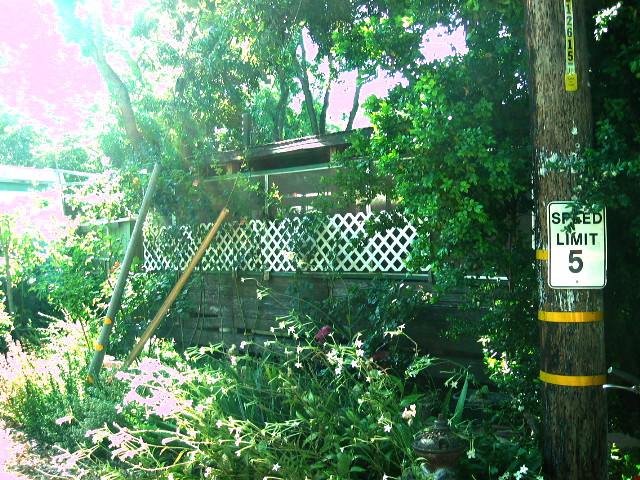
Along its winding lanes, a handful of well-ensconced mobile homes and trailers are nestled among tiny clapboard and stucco cottages (which range from a single room to deluxe two-bedroom suites). The relatively mild Central Valley winters make for fairly comfortable shack-living, and even in the blistering-hot summers, the air cools down nicely after dark.
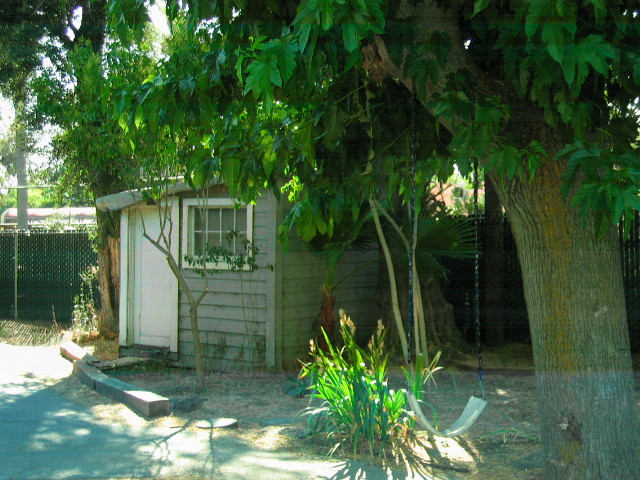

The people who live in Slatter’s Court include long-time Davis residents, cash-strapped students, artists, families, and opossums. (Over the years, several of my friends have passed through there as well.) Despite the trains that frequently rumble past the back fence, it’s a quiet, sleepy little hamlet on the other side of the tracks, and probably still exists only because it was bypassed long ago by Interstate 80, Davis’s modern suburban thoroughfares, and the Information Superhighway.
(posted by Lisa Hirschfield)
Tags: Memories · Places
June 7th, 2008 · Comments Off on Too Homely to Live
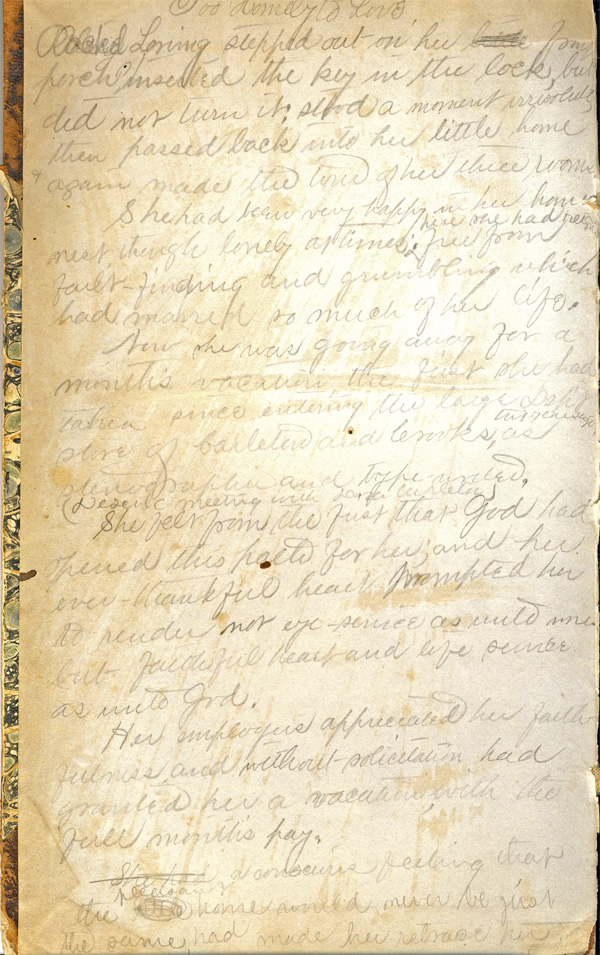
Sometime after many debits, credits, and payments in trade and cash for dry goods and groceries were recorded in an 1857 ledger book, one of the early residents of Georgetown Township in Ottowa County, Michigan, made thrifty use of it in pursuit of her literary ambitions.*
Beautiful ink script chronicling purchases of shoes, flour, candy, and Castile soap shares space with the first penciled chapters of a novel entitled Too Homely to Live. Rachel Loring, the (presumed) protagonist, is employed as a stenographer and “type-writer” at a large department store — that must have been a real step up from the Georgetown Township general store.
Because the now-obsolete typewriter did not become commercially available until the 1870s, the author must have begun writing sometime after that.
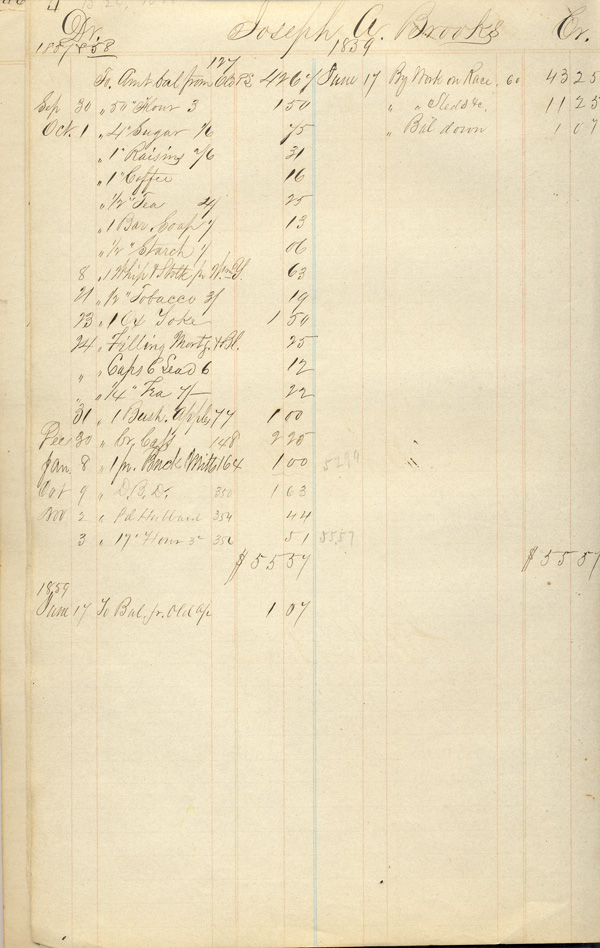
Was she also the author of the original entries? Was she a daughter, sister, wife, or widow? Did she dream of working, like her character, in the big city? (In this case, probably Grand Rapids.)
The handwriting is not dissimilar, but back then, good penmanship was something everyone could strive for.
*Considered in its mid-19th century historical context, the style and subject matter suggest to me that the author is a woman.
(posted by Lisa Hirschfield)
Tags: Dead Media · Ephemera · Memories
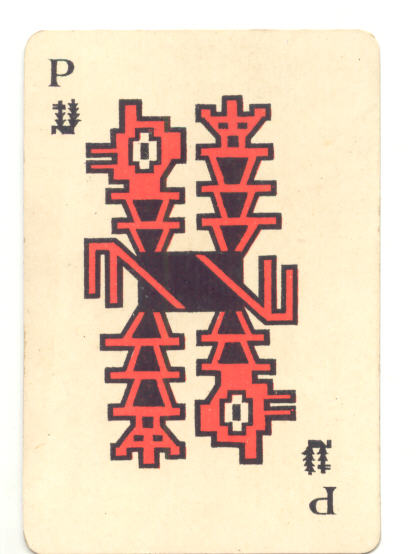
“Spoof, the Cheer-Up Game” was published in 1916 by Milton Bradley. According to the rules booklet, the images on the cards “represent excellent examples of early Peruvian art, as practiced by the Inca Indians.”
(Posted by Doug Skinner)
Tags: Card Games · Ephemera
June 5th, 2008 · Comments Off on Bulletin (2)
The current issue of “Fate” (June 2008) contains my literary outburst “Fort and Those Damned Books of His.” In it, I link Charles Fort to Pyrrhonism and ‘pataphysics, celebrate his eccentric style, and thread together other words to debunk the dogma that he was a credulous crank. The occasion is the release of Jim Steinmeyer’s excellent new biography of Fort: he too contributed an article, and, wonder of wonders, Fort himself appears for the first time on a “Fate” cover. The current issue of “Fortean Times,” while we’re on the subject, also contains a couple of Steinmeyer articles on Fort, as well as a history of “Fate” by Jerome Clark. Dear old “Fate” is now sixty years old; lift your ullage in a toast.
My long-time collaborator, Michael Smith, has a large and entertaining retrospective, “Mike’s World,” at the Institute of Contemporary Art at the University of Pennsylvania, in Philadelphia. Included is that puppet stage the two of us dragged around in the ’90s, as well as a monitor showing Doug & Mike bits. When I was there, the security guard was dancing to the Mr. Woodie song. Maybe she’ll dance with you.
(Posted by Doug Skinner)
Tags: 'pataphysics · Bulletins
During a dark night — both literal and figurative — I came across this passage, which I now translate:
“Those who say that life is no more than an assemblage of misfortunes must find life itself a misfortune. If it is, then death is a blessing. People do not write such things when they have good health, purses full of gold, and contentment in their souls, having just had their Cecilias or Marinas in their arms, and sure of others to follow. They are a race of pessimists; who must live only among beggarly philosophers and rascally or atrabilious theologians. If pleasure exists, and if we can only enjoy it while alive, then life is a blessing. There are also misfortunes; I know all too well. But the very existence of these misfortunes proves that the good carries greater weight. I am infinitely happy when I find myself in a dark room, and see light through a window that faces a vast horizon.”
That’s Casanova, from his memoirs. Thank you, Casanova, for the pick-me-up.
(Posted by Doug Skinner)
Tags: Literature · The Ineffable
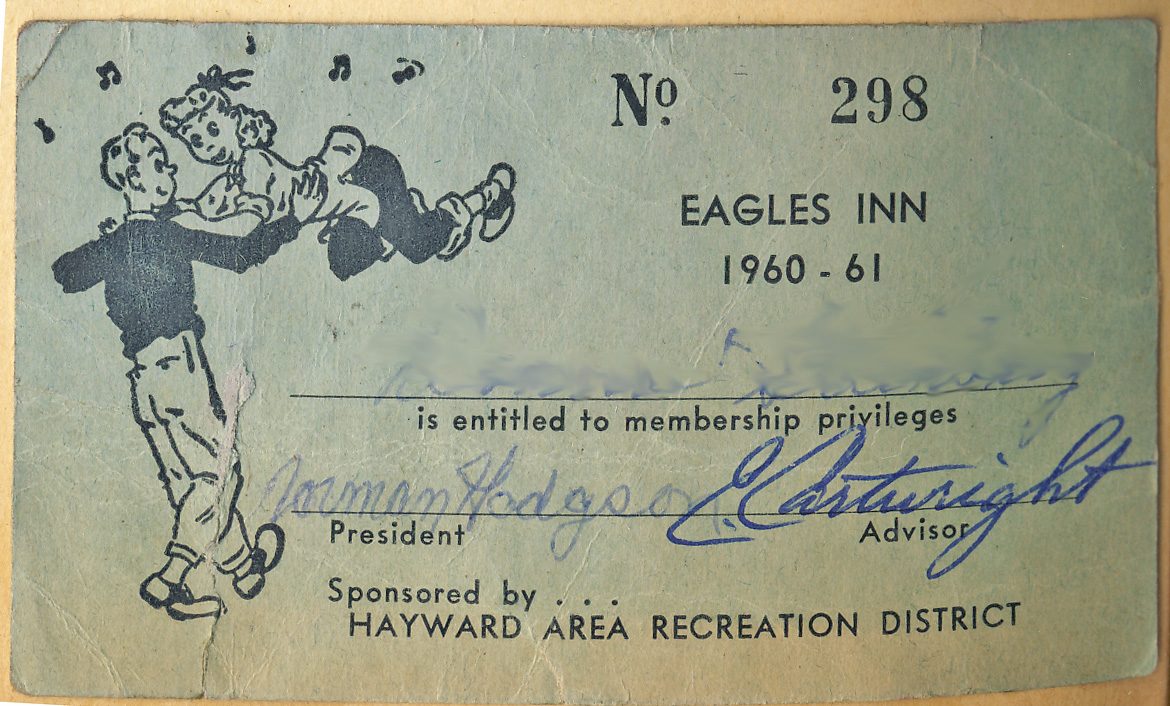
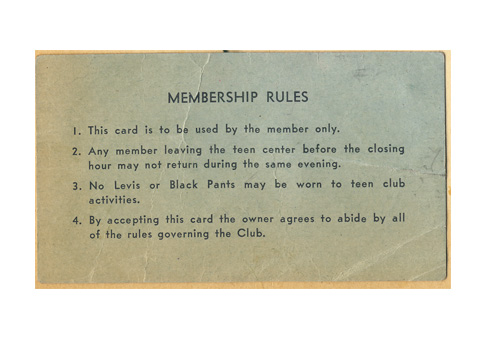
I recently indulged in an old childhood pleasure — looking through my mother’s own childhood scrapbook. Its contents are both long-familiar and long-forgotten. But each time I reacquaint myself with the birthday cards, Brownie badges, telegrams, and programs from many Glee Club recitals, something “new” stands out. Just like memory, we see what we need to see, and are blind to what we can’t use. Is this the ullage?
For some reason (to which I am also blind) my mother’s Eagle’s Inn teen club membership card caught my eye. Could it really be that, in the days of backyard bomb shelters and “duck and cover” drills, equally unspeakable dangers lurked within Levi’s dungarees and Black Pants?
Perhaps so.
(Posted by Lisa Hirschfield)
Tags: Clubs and Associations · Ephemera · Memories
