December 4th, 2008 · 4 Comments
Although we have crossed the Thanksgiving abyss, there are more holidays ahead; and, all too often, turkey dinners will be a part of them.
I gave up such nonsense long ago; but I realize that those of you who still eat meat and celebrate holidays may long for some variety. And so I offer the following surprising suggestion, lifted from a 1921 booklet from the U.S. Playing Card Company, How to Entertain at Cards.
The Ullage Group has a continuing interest in past menus and recipes, and what they reveal about our changing mores. Here we can see, all too clearly, that tastes in socializing have drifted as well. I suspect that few of us throw parties like this nowadays; and that if we did, our guests would be puzzled and uncomfortable. Some might even place a discreet call to Adult Protective Services. Caveat, then. I post it here for its sociological interest.
A Turkey Card Party
Ask guests to a turkey supper, followed by cards. Have a miniature barn yard in the center of the table, with papier-mâché turkeys eating kernels of corn which are scattered on the cloth. Turkey candy boxes make combination favors and place cards. When the food is served the guests are surprised to find that they are not to eat turkey, but food that a turkey would enjoy. Cream of corn soup, fried oysters, corn bread, egg and lettuce salad, and big bunches of malaga grapes are a suitable menu. A corn popper, holders used in eating sweet corn, a carving knife, and for booby a bottle of “Corn Cure” suggest prizes for the game.
(Posted by Doug Skinner)
Tags: Animals · Belief Systems · Dietary Mores · Diversions
November 28th, 2008 · 4 Comments
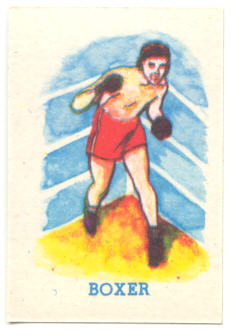
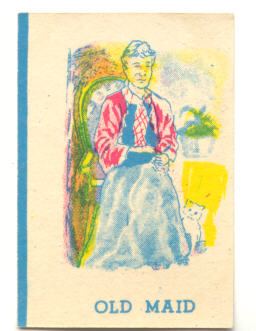
Our next “Old Maid” is a cheaply produced deck, simply marked as “Made in Hong Kong.” Some version of it can still be found in dollar stores, among the toys sold as party favors.
And here’s the Old Maid.
(Posted by Doug Skinner)
Tags: Card Games · Ephemera
November 26th, 2008 · 2 Comments
(I delivered something like the following at an event called “Bigfoot Night,” curated by Kevin Maher and Meg Sweeney Lawless, at the Sci Fi Screening Room in NYC, 11/17/08.) [Read more →]
Tags: Animals · Belief Systems · Education · Forteana · Music
November 21st, 2008 · 4 Comments
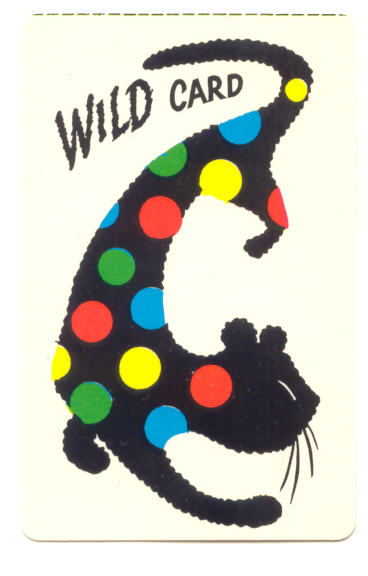
We have some bold graphics here from “Spots and Stripes,” a variation on dominoes, put out sometime in the ’50s by Arrco. Players matched patterns of spots and stripes; a few spotted and striped animals acted as wild cards.
(Posted by Doug Skinner)
Tags: Card Games · Ephemera
November 21st, 2008 · Comments Off on A Micronation Postscript
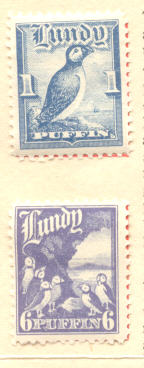
The story of Lundy is familiar to all micronation buffs: a small island off the coast of England, declared a sovereign nation by its owner, Martin Harman, in 1925. But it’s good to see its lovely stamps, issued in that unique denomination, the Puffin.
(Posted by Doug Skinner)
Tags: Animals · Places · Politics
November 21st, 2008 · 1 Comment
In 1923, the USSR was established; the earworm “Yes, we have no bananas” was released; Firestone began selling inflatable tires; a ‘talkie’ made its first public debut; New York revoked Prohibition; insulin became widely available; the Walt Disney Company was founded; the first planetarium opened in Munich; the first electric shaver was patented (by Jacob Schick), as was the first electric traffic signal; the first transatlantic voice radio broadcast was made; the KKK destroyed the town of Rosewood, Florida; Mount Aetna erupted; Yankee Stadium was opened for business; Hitler mounted a failed coup d’etat; and Sarah Bernhardt died.
Also, it was the last time anyone saw a pygmy tarsier.

Until this summer.
Read more from the horse’s mouth – the recent announcement on Texas A&M’s website – or peruse the article on CNN.com for a more animatronic-centric take …
(posted by Lisa Hirschfield)
Tags: Ancient History · Animals · Bulletins · Education · Places
November 17th, 2008 · 3 Comments
November 16 marked the beginning of National Geography Awareness Week. Whether “national” indicates an emphasis on native geographical awareness, or is meant to suggest that we as a nation need to brush up on world geography, is unclear. Without getting too theoretical, I’d like to point out that geography is a social construct. Unlike geology, geography conventionally describes a spatio-temporal sphere (as it were) of landmasses, landscapes, populations, and natural phenomena; defines nations and borders therein; draws maps and revises atlases thereof; and thereby provokes territorial disputes.

And without getting too technical as to what does or does not constitute a landmass, I’d like to call attention to some lesser-known geographical entities.
Micronations rarely achieve international legitimacy, although for one day in 1958 the UN hoisted the flag of The Nation of Celestial Space and let it wave alongside those of the UN member states.

The Republic of Rose Island, situated off the Adriatic coast of Italy from 1968 until it was dynamited a year later by the Italian government, issued its own money and postage, and declared Esperanto its national language. Many people are familiar with the Principality of Sealand, another platform-based nation, in the North Sea.
Some micronations insist on historical legitimacy despite being virtual, or exiled within other nations, like the Duchy of Bohemia (currently located in Nevada). Others stake larger claims, such as entire continents. Antarcticland was founded in 1821 and, like most micronations, has established legal, legislative, and postal systems; it also boasts its own national anthem and an Olympic Committee. Citizenship applications are currently available.
Micronations seemed to pop up like mushrooms in the 1960’s and 70s. Modern experiments in medieval fiefdom or the nation-state taken to their logical extreme, these entities were often founded upon libertarian principles — especially regarding taxes, which in most cases remain un-levied. As demonstrated by Thomas More’s Utopia, however, the exercise of progressive values such as life, liberty, and the pursuit of happiness commonly depends upon rather totalitarian or otherwise illiberal conditions. More often than not, and sadly, the best intentions of micronationality beget imperialistic aspirations, economic mismanagement at the deepest levels of government, the commodification of cultural patrimony, and a notable distaste for freedom of speech.
My favorite micronations are neither virtual nor geographical: real in their own way, apolitical, and very beautiful, they were brought to life by the philatelic imagination of the late Donald Evans.
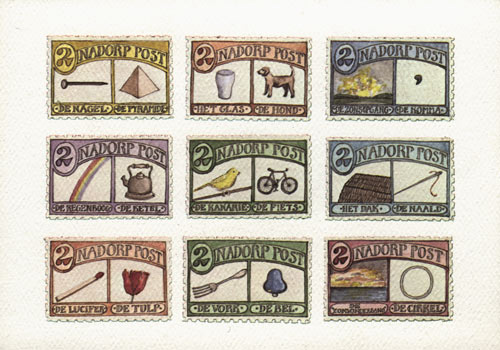
(posted by Lisa Hirschfield)
Tags: Belief Systems · Eccentrics · Places · Politics
November 13th, 2008 · 3 Comments
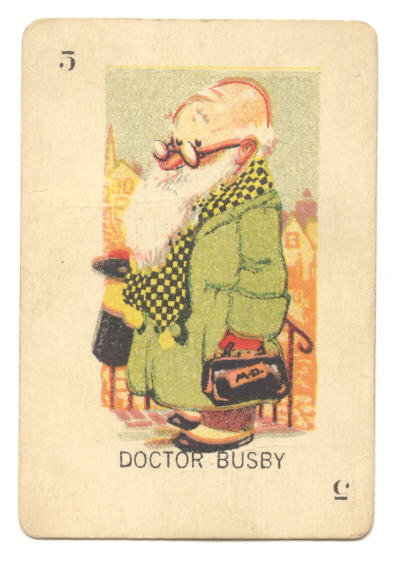
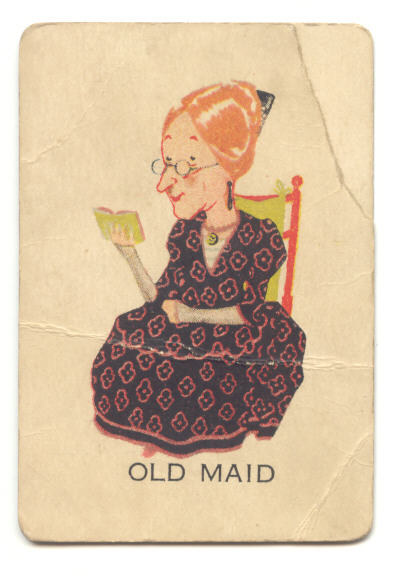
This Old Maid, published by Milton Bradley (again, the date is scrupulously concealed, but it’s an old one) is notable for a guest appearance by the famous Dr. Busby. “Dr. Busby” was one of the more popular card games of the 19th century; and, like “Old Maid,” went through many editions. Some of the artwork in this “Old Maid” appears to have been simply re-used from the older game.
And here’s the Old Maid.
(Posted by Doug Skinner)
Tags: Card Games · Ephemera
November 13th, 2008 · 3 Comments
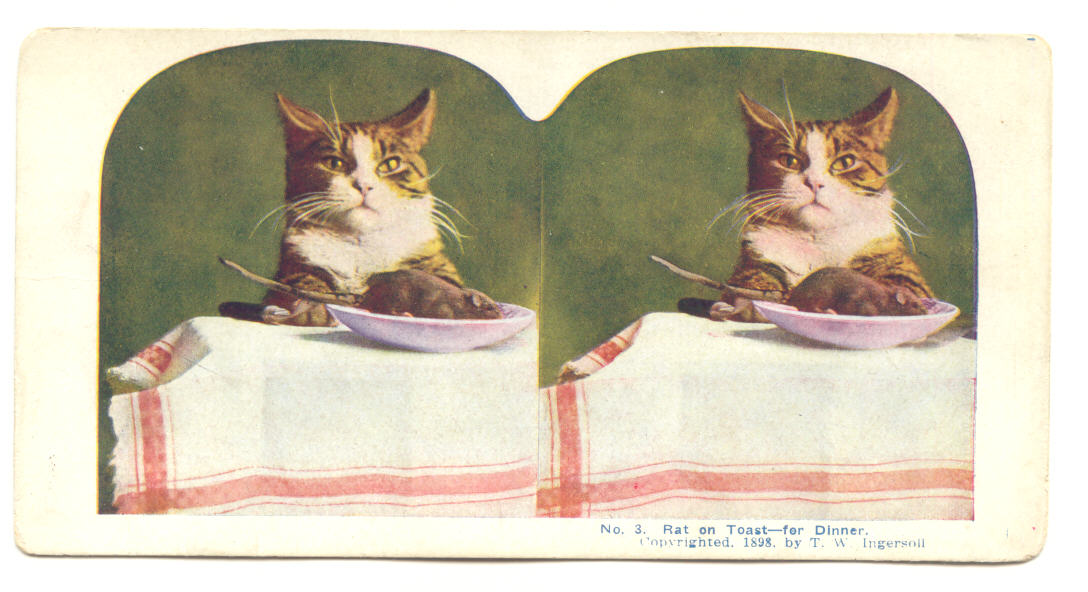
Let me add this image to my earlier remarks on cat food. The caption reads “Rat on Toast — for Dinner.”
(Posted by Doug Skinner)
Tags: Animals · Dietary Mores · Stereoscopy
November 13th, 2008 · 1 Comment
The sonnet is a neglected form these days. Verse of all stripes is unpopular — at least under that name, although it still defines popular music. It’s all in the branding, I suppose.
And current taste often brands the sonnet as precious, artificial, or old-fashioned. Fair enough; although you could tar most American entertainment genres with the same handy brush. Hollywood movies goosestep to the most rigid formulas human perversity could devise, but our fellow citizens still sit spellbound.
Sonnets are short enough to be punchy, but long enough to develop a thought. They’re usually fourteen lines, but don’t have to be. They lend themselves to many meters and rhyme patterns. And to much variety, too: smooth artifice (Petrarch), lyrical intensity (Shakespeare), smut (Aretino), heresy (Campanella) — name your poison.
And, of course, to that constant fave, scatological blasphemy. The following specimen, by Edmond Haraucourt, first perfumed the air in 1883. Haraucourt was one of the original Hydropathes; he was a busy character.
For my translation, I chose the unfashionable option of keeping meter and rhyme. This takes some paraphrase, but is, in some ways, truer to the original.
Incidentally, one of the virtues of the following is that it offers an alternative account of man’s origins. I hope the atheists among you will excuse this dip into deism.
Philosophie: Sonnet honteux
L’anus profond de Dieu s’ouvre sur le Néant,
Et, noir, s’épanouit sous la garde d’un ange.
Assis au bord des cieux qui chantent sa louange,
Dieu fait l’homme, excrément de son ventre géant.
Pleins d’espoir, nous roulons vers le sphincter béant
Notre bol primitif de lumière et de fange;
Et, las de triturer l’indigeste mélange,
Le Créateur pensif nous pousse en maugréant.
Un être naît: salut! Et l’homme fend l’espace
Dans la rapidité d’une chute qui passe:
Corps déjà disparu sitôt qu’il apparaît.
C’est la Vie: on s’y jette, éperdu, puis on tombe:
Et l’Orgue intestinal souffle un adieu distrait
Sur ce vase de nuit qu’on appelle la tombe.
Philosophy: A Shameful Sonnet
God’s anus opens to the void of space:
Though dark, it shines beneath an angel’s gaze.
God squats beside the skies that hymn his praise,
And from his gut excretes the human race.
A hopeful bolus, slime and spirit both,
We roll toward the sphincter, keen to pass.
Grown weary of our undigested mass,
Our pensive Maker drops us with an oath.
A being’s born: hello! we cleave the air,
And disappear as soon as we were there,
As swiftly as a cataract we fell.
That’s life: we’re here, then plummet to our doom;
And then the rectal Organ breathes farewell
Upon the chamber pot we call the tomb.
(Posted by Doug Skinner)
Tags: Belief Systems · Education · Literature · Symbols · The Ineffable
