January 9th, 2009 · 1 Comment
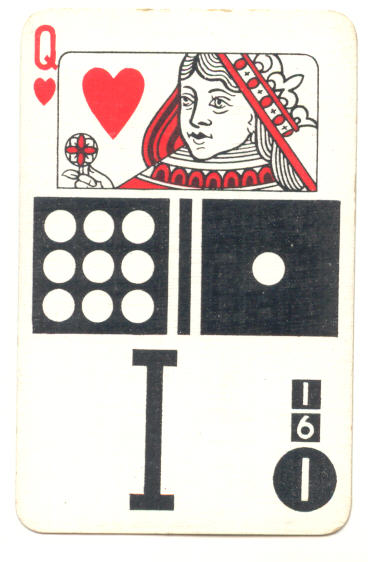
“Lecardo” was published in London; no date, and no publisher listed except “Lecardo.” The idea, as you can see, was to combine standard playing cards, dominoes, and a word building game all in one deck. According to the rules pamphlet, however, the object was not simply to offer a versatile deck; but to invent a game that combined whist, dominoes, and a crossword puzzle. The rules are complicated. This may not have been a card game for children, really; it may have aimed for a more specialized niche in the card market. At any rate, the designer did well, considering the amount of information that had to fit on each card.
(Posted by Doug Skinner)
Tags: Card Games · Ephemera
English has no names for the toes. Each finger has a name; the fifth has at least three: little, pinky, and auricular. But the toes are anonymous.
English isn’t alone in this; most languages see no reason to name toes. The only exception I know of is Swedish, which, thanks to a nursery rhyme, lists Lilltåa, Tåtilla, Kroknoso, Tillerosa, and Stortimpen.
The usual explanation is that toes don’t need names, since we don’t discuss them individually. We deploy them as a team. That may be; but other body parts we seldom discuss have names: the philtrum, for example.
Besides, some specialists could use more precise terms: chiropodists, podiatrists, fetishists, reflexologists. Spiritualists may practice toe-cracking, like the Fox sisters; escapologists may practice toe-knotting, like Houdini.
I offer, then, these names for the toes, for whoever needs or wants them. Like most names, they identify rather than describe, but I’ve tried to give them a suitable gravitas and panache. They are, starting with the largest: oxnard, secretaire, clapmatch, jess, and matey.
Who knows? Maybe they’ll prove useful.
(Posted by Doug Skinner)
Tags: Education · Suggestions
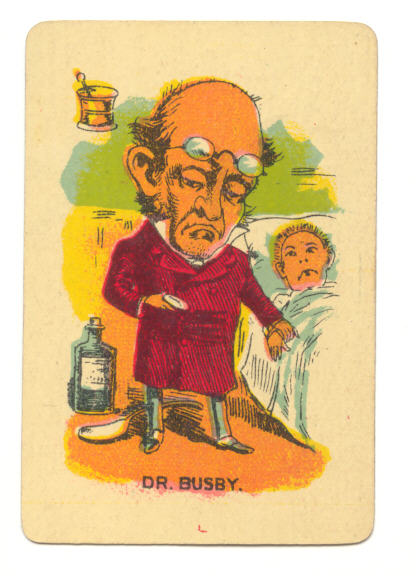
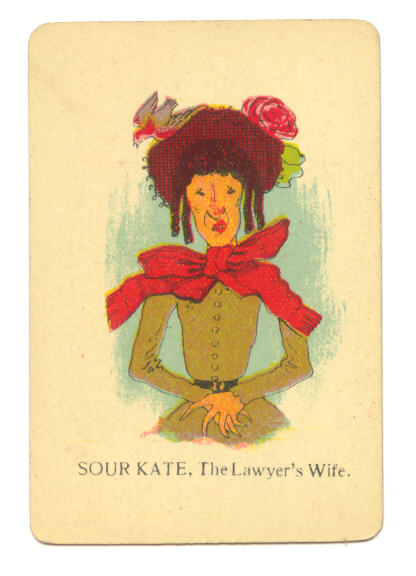
Here we have a few images from a 1905 Milton Bradley edition of “Dr. Busby.” As you may recall, he popped up earlier, making a guest appearance in an “Old Maid” deck (#33 in our survey, posted 11/13/08). Like “Old Maid,” there were many editions; this Dr. Busby is certainly a more dour practitioner than the last.
“Dr. Busby” is, I understand, one of the first children’s games published in the US. It was invented by Anne Abbott in 1843; Ms. Abbott is also credited with a children’s book, Doctor Busby and his Neighbors, and with various other games, including that old favorite, “Authors.”
There was a historical Dr. Busby: Richard Busby, headmaster of Westminster in the 17th century, mentioned by Pope in the “Dunciad.” Since that Busby was known mostly for beating and molesting his students, I do hope this is a different one.
The object of the game was to match up families: the four members of Dr. Busby’s household, and the families of his various servants and retainers. Most of the early editions were 20 cards; this later version has swollen to 40. 20 of the cards are obviously from the same hand, such as this picture of Dr. Busby’s fishmonger:
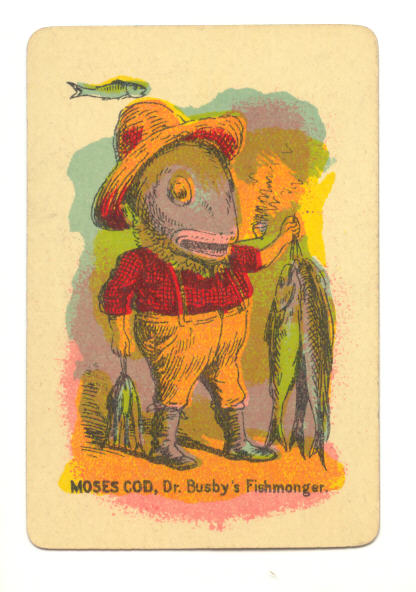
The other 20 are a mish-mash of cruder cuts, like this one:
(Posted by Doug Skinner)
Tags: Card Games · Ephemera
January 2nd, 2009 · Comments Off on Janus
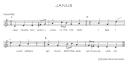
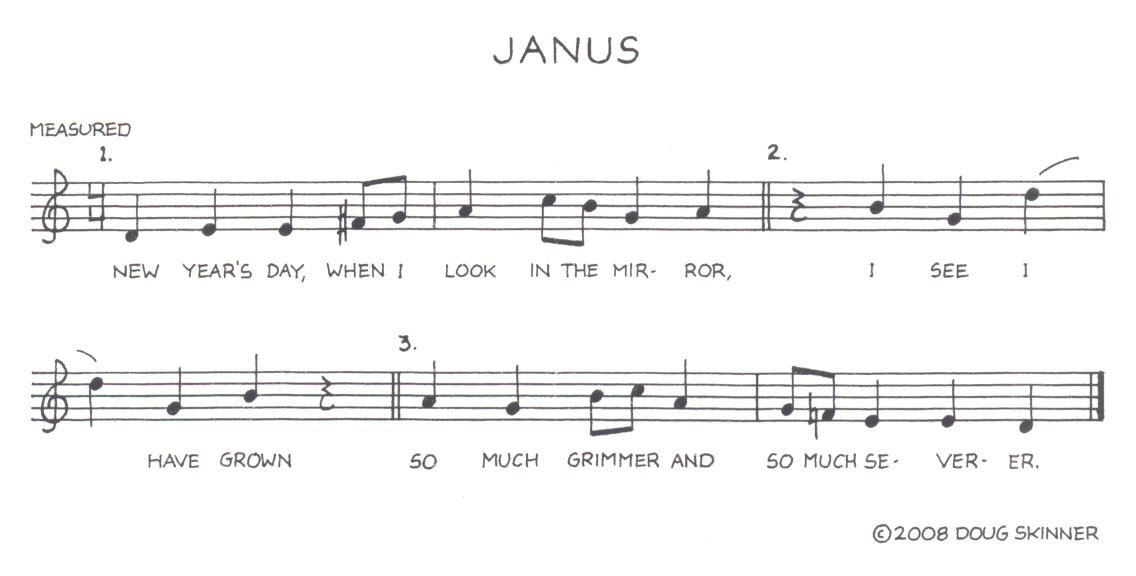
Happy New Year. It’s cold here. We offer you a round to sing as you shiver.
Here is old man Janus, the double-faced gatekeeper, gazing in the mirror and realizing how much colder he’s grown. Given the subject, I’ve set it as a crab canon (that is, palindromic) — except for that flickering between F sharp and F natural.
Please click to enlarge; more info on crab canons will follow.
(Posted by Doug Skinner)
Tags: Music · Symbols
December 29th, 2008 · 1 Comment
As a postscript to our survey of “Old Maid,” I’d like to add these alternate rules. They’re tucked into a 1945 deck (a later edition of the one we posted here as #25, back on 9/18/08). I assume somebody at the company bridled at the stigmatization of the Old Maid, and so decided to make her the most desirable card, rather than the least.
BACHELOR GIRL GAME
NOTE: Rules for playing the conventional Old Maid Game will be found on one of the cards in the deck. The following rules are for another and more modern Old Maid Game, “Bachelor Girl,” to be played with the same cards.
Game may be played by two to eight players. If 2-3 or 4 are playing, deal six cards to each player. If 5-6-7 or 8 are playing, deal five to each. After dealing, place the remainder of the deck face down in the center of the table.
The dealer plays first. If two cards in your hand match, place them face up in front of you, then place another face up, and draw one from the deck.
The player at your left plays next and so on. When it is your turn to play, if you haven’t a pair that match in your hand but others have laid down cards which match ones held in your hand, you take their cards and lay them with yours in front of you. The Old Maid or Bachelor Girl card is wild and you may take another player’s card and match it with the Bachelor Girl if you have it in your hand. Anyone may take Bachelor Girl by putting the other matching card down in its place.
If a player lays down a card and some one else has the matching card in front of them, the player first noticing the error may take both cards and add them to the cards already in front of them.
When a player lays down the last card in his hand he does not draw from the deck since in laying down the final card in his hand he has won the hand and all the other players give the winner the cards remaining in their hands.
To add your score you count five for each pair in front of you and one for each single card. If the winner of the hand gets Bachelor Girl from one of the other players it adds ten points to his score.
The player getting 100 points first is the winner of the game.
(Posted by Doug Skinner)
Tags: Card Games · Ephemera
December 27th, 2008 · 3 Comments
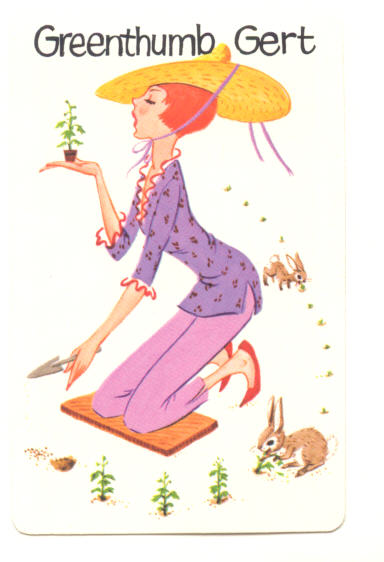
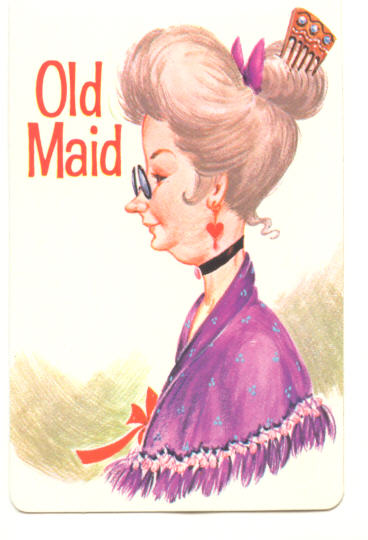
We close the year with a final “Old Maid” (at least for a while). This one’s from Whitman: no date or copyright, as is traditional. And a fine breezy design, I think.
Here’s the Old Maid:
(Posted by Doug Skinner)
Tags: Card Games · Ephemera
December 27th, 2008 · 1 Comment
Henri Salvador, the great Guyanese singer/songwriter, died this year (back in February), and we never marked his passing here. I wanted to salute him, briefly, before this dismal year evaporated for good.
He had a long and active career in Europe and South America, but never crossed that baffling cultural divide to win much of an audience in the U.S. (although he apparently did appear on the “Ed Sullivan Show”).
There’s much to say about him: the early tropical tunes that Jobim cited as a crucial influence; the many collaborations with that incomparable provocateur, Boris Vian; the impressive arsenal of vocal styles, including an inspired gallery of funny voices; the surprising comeback in his eighties, still in great voice. You can find more by rooting through the www or YouTube.
But here, I wanted to mention that he was also a connoisseur of modernist music and literature, and a member of the ‘Pataphysical College. I wanted to recommend Stanley Chapman’s translation of “‘Pataphysics? What’s That?”, a 1959 radio dialogue with Vian, published in 2006 by the London Institute of ‘Pataphysics. And, above all, I wanted to translate this cheery repudiation of artistic purity:
“I am in favor of all cross-breeding of ideas, all mingling of opinions. To achieve great works, all copulations are allowed, from country to country, even the most reprehensible.”
(Posted by Doug Skinner)
Tags: 'pataphysics · Literature · Music
December 20th, 2008 · 5 Comments
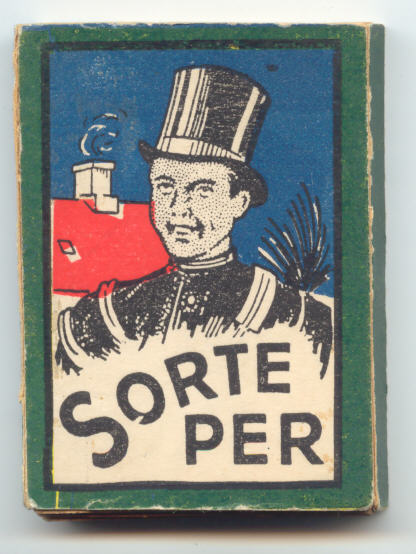
And here’s another specimen of “Black Peter”: a Danish one this time. In this one, players match black and white sketches of couples from different countries. I’ve chosen to post the cover this time, since I thought you’d like a splash of color.
(Posted by Doug Skinner)
Tags: Card Games · Ephemera
December 20th, 2008 · 3 Comments
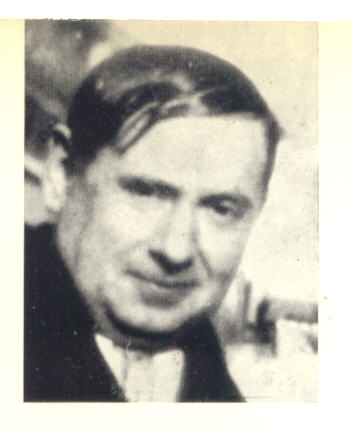
I’d like to add a couple of images to my earlier post about Cami, particularly since he’s now so obscure, and since so few images are available. The first is a photo of the man himself, taken from a 1964 anthology of his work:
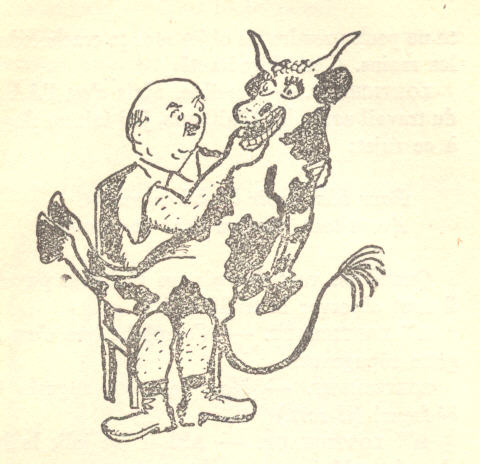
And the second is one of his cheerfully naive illustrations, taken from a rare copy of his novel Les Nouveaux Paysans (The New Peasants). Here we see a conscientious farmer examining the teeth of one of his cattle.
(Posted by Doug Skinner)
Tags: Literature
December 20th, 2008 · 2 Comments
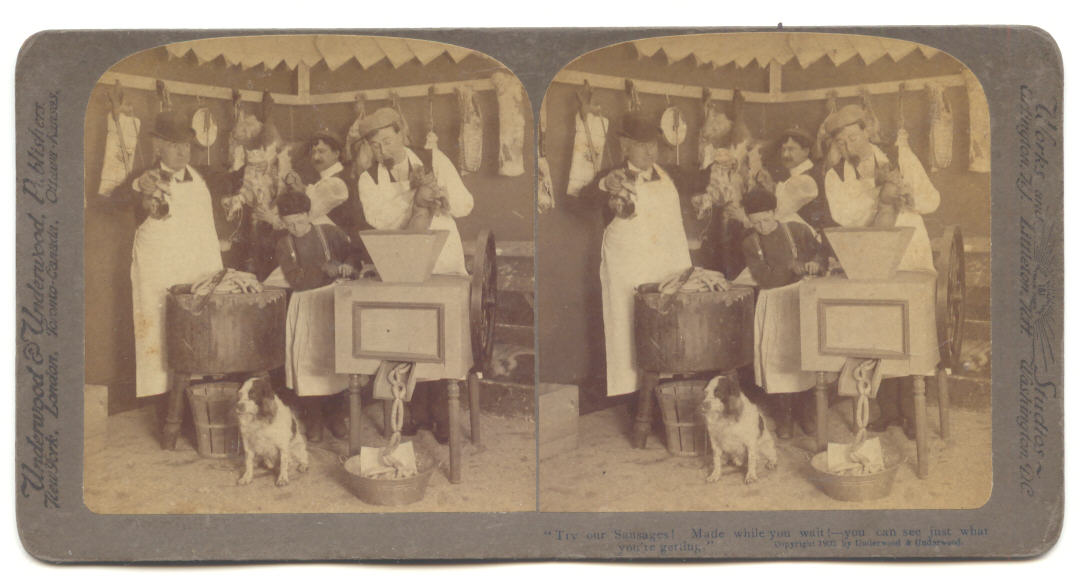
To our earlier post (10/21/08), illustrating the classic axiom, we add this variant. It’s from 1902, from Underwood & Underwood; the caption reads “Try our sausages! Made while you wait!– you can see just what you’re getting!”
(Posted by Doug Skinner)
Tags: Animals · Belief Systems · Politics · Stereoscopy · Symbols