February 14th, 2009 · 1 Comment
[It’s the Darwin bicentennial; it’s time to party like primates. I’ll tip my bit into the punchbowl by serializing, sip by sip, a talk I gave at the 2006 “Fortean Times” UnCon and the 2007 INFO (International Fortean Organization) FortFest. It’s mostly about the confused interbreeding of evolution and American culture. I’ll update it a bit as I post it; it was originally dangled forth in the full fracas of the culture wars of that time. I will touch on the Scopes trial, its reworking as “Inherit the Wind,” the puzzling story of the brontosaurus, and the evolution of the caveman cartoon. Happy birthday, Charles!]
People are still squabbling over Darwin. Both Creationists and Evolutionists wax passionate on the subject — even though many in both camps have never gone near a book by the old man. He’s fought over in schools; he’s a plank in partisan politics. Inherit the Wind even popped up anew on Broadway.
So much of this furor has bupkis to do with Darwin, or even with biology. I wanted to figure out for myself what it was about. I originally unloaded the following remarks at the “Fortean Times” UnCon in London, where I was tag-teamed with Ian Simmons, who spoke on the dubious science of the “Intelligent Design” movement. He had the science angle covered, so I concentrated on the culture of the controversy.
But it’s helpful and refreshing, here at the outset, to savor some of the popular confusion about Darwin.
One is that he thumped his tub for atheism and a universe of randomness. He wasn’t a theologian; he was a biologist — and wrote on the origin of species, not the origin of life. And far from saying nature worked by chance, he stressed that it boasted predictable laws. He had enough homework cut out trying to understand those laws, and didn’t bother with speculations on first causes.
Nor did he say that all was ruled by competition. Organisms both compete and cooperate to survive: bees work together, sort of, to build hives; species aplenty benefit by interaction. Unfortunately, natural selection is often mixed up with Social Darwinism, with the idea that human behavior works by the same laws as speciation. Obviously, it doesn’t; and biologists pooh-poohed that idea long ago.
Another crucial point is that we simply can’t define what a species is. Each plant and animal has different genes; and the lines we draw between one species and another; between species and sub-species, sub-species and variety, one individual and another, is fluid and arbitrary. Nature joyfully breeds away, constantly varying and adapting; and hybrids between species, or even genera, are sometimes fertile — and there are varying degrees of fertility, too. As Charles Fort put it, we like to draw a circle in the ocean, and insist that the waves inside the circle are different from the ones outside. Nature is more interested in the breeding than in the classification.
(Posted by Doug Skinner; more to follow.)
Tags: Ancient History · Animals · Belief Systems · Education · Forteana · Literature · Misconceptions
February 8th, 2009 · 6 Comments
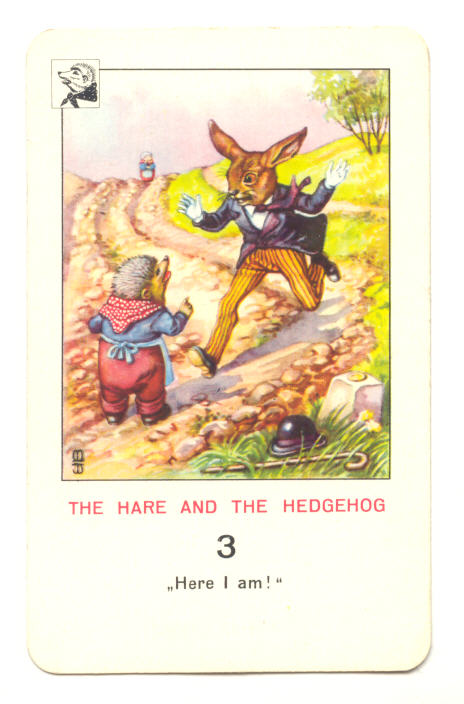
We have another example of a game based on folktales; this one, “Fairy Tale Families,” was published by Piatnik, in Vienna. The deck includes such old favorites as Red Riding Hood and Cinderella; I’ve chosen an image from this less familiar Grimms’ tale.
(Posted by Doug Skinner)
Tags: Card Games · Ephemera
February 1st, 2009 · 2 Comments
Our last digital update set me to wondering: why haven’t our hi-tek overlords marketed electronic tampons? The consumer-congregants have already been trained to crave phones that take photos. Surely there must be some way to sell them tampons rigged with needless gizmos. Perhaps sound chips could play soothing melodies, motivational slogans, or Bible verses, to ease the customers through their monthly cramps. Those who prefer to smile through their tears might be tickled by comic catchphrases or cartoon sound effects. Tyro menstruators could receive instruction or advice without having to read a text or speak with another human. And in the UK, recordings of Prince Charles reciting poetry or bits of old “Goon Show” scripts would rake in the quid.
I’m too busy here to pursue this. But I estimate it would take only a few months to teach the consumer-congregants that only losers buy dowdy old non-electronic tampons. So all of you enterprising youngsters, remember the timeless adage of product development: “Find a need and fill it.” Get to work, and make your keepers proud.
(Posted by Doug Skinner)
Tags: Suggestions · Technology
January 30th, 2009 · 2 Comments
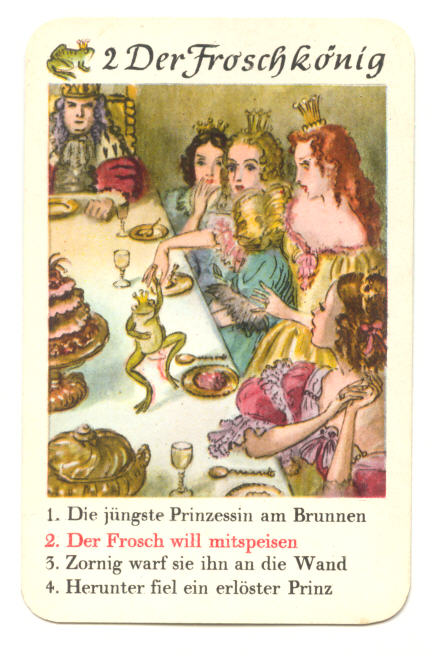
The Ariston company, in Detmold (Germany), was responsible for “Märchenquartett” (“Fairy Tale Quartet”), one of many games that requires its players to assemble four scenes from a folktale. I’ve chosen a lively vignette from that perennial favorite, “The Frog King.” His Majesty is obviously the life of the party.
(Posted by Doug Skinner)
Tags: Card Games · Ephemera
January 30th, 2009 · 1 Comment
Somewhere in my stash of percussion instruments and noisemakers is an old novelty item: a battery-operated phone bell. The idea was to hide it in your jacket, so people would think you had a phone in your pocket. The surprise and merriment that followed would make you less unpopular.
Today, of course, everyone has a cell phone tucked in a pocket. Well, almost everyone.
Our new president yearns for the joys of cell phone and email, but must do without for security reasons. The digital gizmos, though handy-dandy, hooray, cannot be made private. Some of you may recall that those upper crust loveydoves, Charles and Camilla, discovered that their frank chats on the mobile could be enjoyed by tampon fanciers everywhere. Obama has learned from their example, and knows that he’d better stick to the land line when calling the Windsors. He does still have his Blackberry, at least for now. His security team is a bit anxious about it.
You and I are not in positions of power, so it doesn’t matter if our conversations or communications are kept private. Only mockable fuddy-duddies still use paper mail or land lines. Right?
(Posted by Doug Skinner)
Tags: Technology
January 24th, 2009 · 6 Comments

One of our members, Dr. Mamie Caton, found this photo tucked into a book in a hotel room in Peru. Does anyone know where it comes from? Is it a mural? A sidewalk painting? Why have these particular elements been brought together in this way? Any information would be appreciated.
(Posted by Doug Skinner)
Tags: Mysteries
January 23rd, 2009 · Comments Off on Children’s Card Games (43)
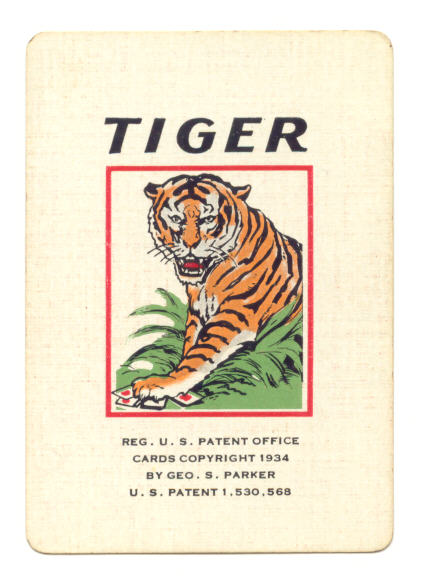
Parker Brothers published “Make-a-Million” in 1934. The rules take up 8 pages of small type; once you’ve mastered them, though, you’ll enjoy “simplicity, novelty, and excitement!”
The Tiger is a wild card in the game. It may be a holdover from the once popular game of faro, which, for some reason, was always associated with tigers: to play faro was to “buck the tiger.”
(Posted by Doug Skinner)
Tags: Card Games · Ephemera
January 23rd, 2009 · Comments Off on The Digital Backlash (2)
Digital know-how has spawned crackerjack gizmos, oh boy; but we must note growing disenchantment. The scaffolding we’ve erected is getting rickety.
The center, for example, often no longer holds, and mere chaos is loosed upon the post office. When I stopped by the other day, all the credit and debit card gizmos were down, so all transactions had to be cash. Fortunately, the computers were still ticking, since even the smallest sale now requires one. They were sluggish, though, so the line was slow. The coin-operated stamp machines have been removed, replaced by machines that vend in bulk by credit card, so the only choice was to join the lengthening line, and hope the computers didn’t sputter out entirely. Or to do as I did, and buy stamps at the newsstand down the block.
(Posted by Doug Skinner)
Tags: Technology
January 16th, 2009 · 3 Comments
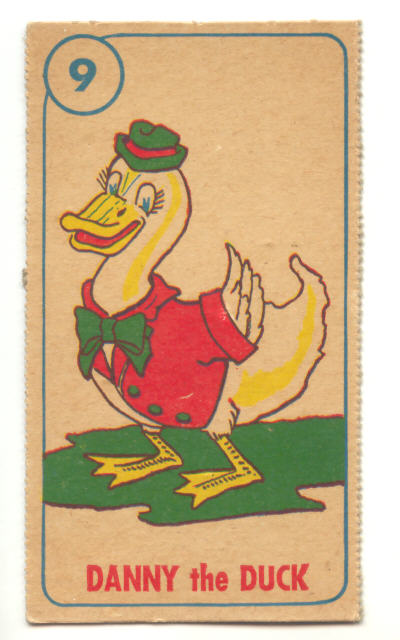
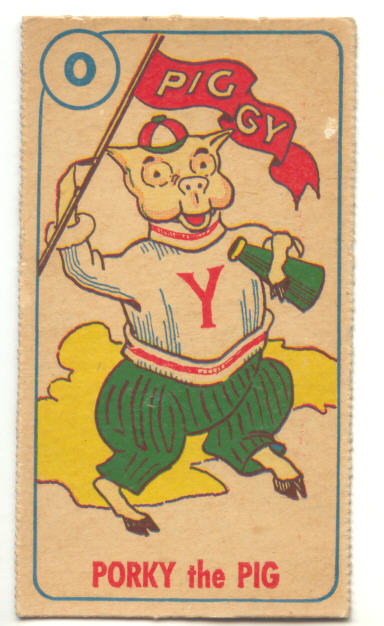
“Piggy” is even more of a foundling than most: it’s crudely printed on cheap cardboard, and carries no date, copyright, or publisher. It’s another variant on “Old Maid”; players collect pairs of such cheerful creations as Danny here, and try not to end up with Piggy. Nobody wants to end up with Piggy.
(Posted by Doug Skinner)
Tags: Card Games · Ephemera
January 16th, 2009 · Comments Off on Casanova and the Spooklight
It was, perhaps, near the end of August, 1743, that Casanova encountered, of all things, a spooklight. I say “perhaps” because scholars on the Casanova beat have found some hiccups in his chronology. At any rate, he left this intriguing description in his memoirs (Volume 1, Chapter 8). These odd lights — earth lights, will o’ the wisps, ignes fatui — have a long history, and have been variously explained by science and folklore. Casanova’s description is one of the earliest I’ve seen; and, thanks to his intelligence and curiosity, still worth reading. My translation (taken from the 1960 edition of his original manuscript) goes something like this:
An hour after leaving Châteauneuf, headed for Rome, the wind being calm and the sky serene, I observed, at ten steps to my right, a pyramidal flame, one cubit high and four to five feet above the ground, which accompanied me. It stopped when I stopped, and when there were trees by the road, I lost sight of it; but I saw it again when I had passed them. I approached it several times; but the more I approached, the more it receded. I tried to retrace my steps, and then no longer saw it, but when I turned around it reappeared at the same place. It did not disappear until the break of day.
What a marvel it would seem to the superstitious and the ignorant, if I had witnesses to this fact, and earned a great fortune once I had reached Rome! History is filled with bagatelles of this kind; and the world is filled with heads that still make a great fuss over them, despite the enlightenment that the sciences are supposed to have brought to the human mind. I must, however, tell the truth: that despite my knowledge of physics, the sight of that little meteor persisted in giving me strange ideas. I had the prudence not to mention it to anyone. I arrived in Rome with seven paoli [an Italian coin] in my pocket.
He had another sighting in 1748. This passage is from the end of Volume 2, Chapter 11:
Having returned to the balcony, I saw shadows coming and going in the courtyard. They could only have been thick and humid masses of air; and as for the pyramids of fire that I saw floating over the countryside, that was a phenomenon I knew well. I let the others believe that they were spirits guarding treasures. All throughout southern Italy, the country is filled with will o’ the wisps that people take for devils. From that comes the term Spirito folletto.
(Posted by Doug Skinner)
Tags: Belief Systems · Forteana · Literature
