January 30th, 2009 · 2 Comments
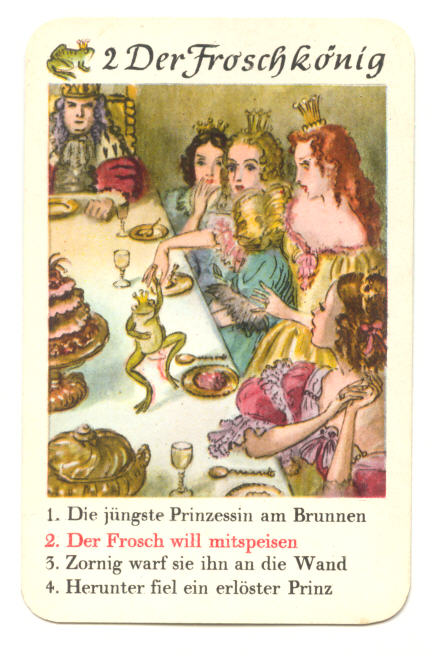
The Ariston company, in Detmold (Germany), was responsible for “Märchenquartett” (“Fairy Tale Quartet”), one of many games that requires its players to assemble four scenes from a folktale. I’ve chosen a lively vignette from that perennial favorite, “The Frog King.” His Majesty is obviously the life of the party.
(Posted by Doug Skinner)
Tags: Card Games · Ephemera
January 30th, 2009 · 1 Comment
Somewhere in my stash of percussion instruments and noisemakers is an old novelty item: a battery-operated phone bell. The idea was to hide it in your jacket, so people would think you had a phone in your pocket. The surprise and merriment that followed would make you less unpopular.
Today, of course, everyone has a cell phone tucked in a pocket. Well, almost everyone.
Our new president yearns for the joys of cell phone and email, but must do without for security reasons. The digital gizmos, though handy-dandy, hooray, cannot be made private. Some of you may recall that those upper crust loveydoves, Charles and Camilla, discovered that their frank chats on the mobile could be enjoyed by tampon fanciers everywhere. Obama has learned from their example, and knows that he’d better stick to the land line when calling the Windsors. He does still have his Blackberry, at least for now. His security team is a bit anxious about it.
You and I are not in positions of power, so it doesn’t matter if our conversations or communications are kept private. Only mockable fuddy-duddies still use paper mail or land lines. Right?
(Posted by Doug Skinner)
Tags: Technology
January 24th, 2009 · 6 Comments

One of our members, Dr. Mamie Caton, found this photo tucked into a book in a hotel room in Peru. Does anyone know where it comes from? Is it a mural? A sidewalk painting? Why have these particular elements been brought together in this way? Any information would be appreciated.
(Posted by Doug Skinner)
Tags: Mysteries
January 23rd, 2009 · Comments Off on Children’s Card Games (43)
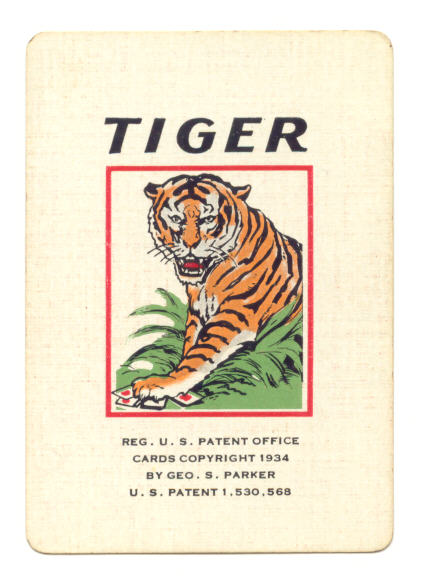
Parker Brothers published “Make-a-Million” in 1934. The rules take up 8 pages of small type; once you’ve mastered them, though, you’ll enjoy “simplicity, novelty, and excitement!”
The Tiger is a wild card in the game. It may be a holdover from the once popular game of faro, which, for some reason, was always associated with tigers: to play faro was to “buck the tiger.”
(Posted by Doug Skinner)
Tags: Card Games · Ephemera
January 23rd, 2009 · Comments Off on The Digital Backlash (2)
Digital know-how has spawned crackerjack gizmos, oh boy; but we must note growing disenchantment. The scaffolding we’ve erected is getting rickety.
The center, for example, often no longer holds, and mere chaos is loosed upon the post office. When I stopped by the other day, all the credit and debit card gizmos were down, so all transactions had to be cash. Fortunately, the computers were still ticking, since even the smallest sale now requires one. They were sluggish, though, so the line was slow. The coin-operated stamp machines have been removed, replaced by machines that vend in bulk by credit card, so the only choice was to join the lengthening line, and hope the computers didn’t sputter out entirely. Or to do as I did, and buy stamps at the newsstand down the block.
(Posted by Doug Skinner)
Tags: Technology
January 16th, 2009 · 3 Comments
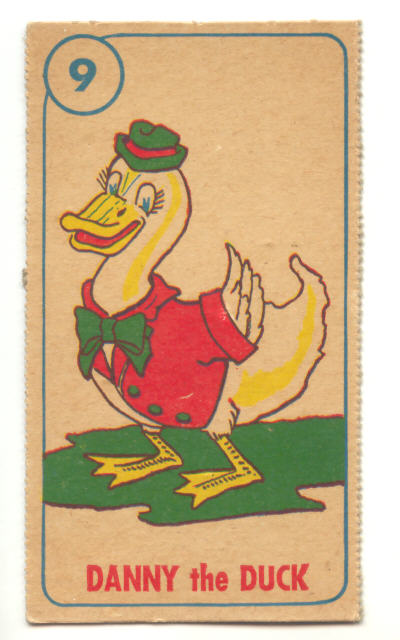
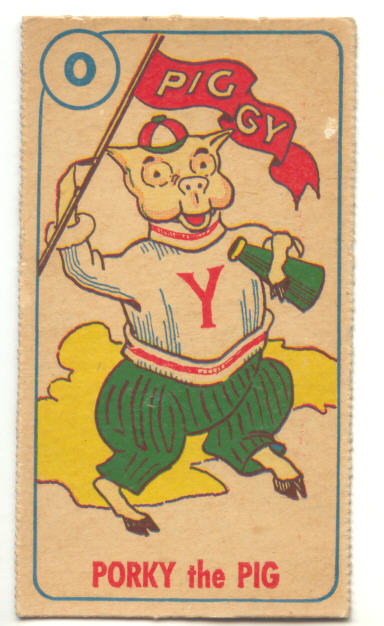
“Piggy” is even more of a foundling than most: it’s crudely printed on cheap cardboard, and carries no date, copyright, or publisher. It’s another variant on “Old Maid”; players collect pairs of such cheerful creations as Danny here, and try not to end up with Piggy. Nobody wants to end up with Piggy.
(Posted by Doug Skinner)
Tags: Card Games · Ephemera
January 16th, 2009 · Comments Off on Casanova and the Spooklight
It was, perhaps, near the end of August, 1743, that Casanova encountered, of all things, a spooklight. I say “perhaps” because scholars on the Casanova beat have found some hiccups in his chronology. At any rate, he left this intriguing description in his memoirs (Volume 1, Chapter 8). These odd lights — earth lights, will o’ the wisps, ignes fatui — have a long history, and have been variously explained by science and folklore. Casanova’s description is one of the earliest I’ve seen; and, thanks to his intelligence and curiosity, still worth reading. My translation (taken from the 1960 edition of his original manuscript) goes something like this:
An hour after leaving Châteauneuf, headed for Rome, the wind being calm and the sky serene, I observed, at ten steps to my right, a pyramidal flame, one cubit high and four to five feet above the ground, which accompanied me. It stopped when I stopped, and when there were trees by the road, I lost sight of it; but I saw it again when I had passed them. I approached it several times; but the more I approached, the more it receded. I tried to retrace my steps, and then no longer saw it, but when I turned around it reappeared at the same place. It did not disappear until the break of day.
What a marvel it would seem to the superstitious and the ignorant, if I had witnesses to this fact, and earned a great fortune once I had reached Rome! History is filled with bagatelles of this kind; and the world is filled with heads that still make a great fuss over them, despite the enlightenment that the sciences are supposed to have brought to the human mind. I must, however, tell the truth: that despite my knowledge of physics, the sight of that little meteor persisted in giving me strange ideas. I had the prudence not to mention it to anyone. I arrived in Rome with seven paoli [an Italian coin] in my pocket.
He had another sighting in 1748. This passage is from the end of Volume 2, Chapter 11:
Having returned to the balcony, I saw shadows coming and going in the courtyard. They could only have been thick and humid masses of air; and as for the pyramids of fire that I saw floating over the countryside, that was a phenomenon I knew well. I let the others believe that they were spirits guarding treasures. All throughout southern Italy, the country is filled with will o’ the wisps that people take for devils. From that comes the term Spirito folletto.
(Posted by Doug Skinner)
Tags: Belief Systems · Forteana · Literature
January 9th, 2009 · 1 Comment
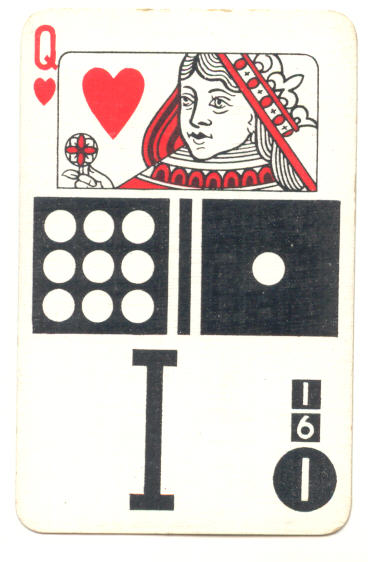
“Lecardo” was published in London; no date, and no publisher listed except “Lecardo.” The idea, as you can see, was to combine standard playing cards, dominoes, and a word building game all in one deck. According to the rules pamphlet, however, the object was not simply to offer a versatile deck; but to invent a game that combined whist, dominoes, and a crossword puzzle. The rules are complicated. This may not have been a card game for children, really; it may have aimed for a more specialized niche in the card market. At any rate, the designer did well, considering the amount of information that had to fit on each card.
(Posted by Doug Skinner)
Tags: Card Games · Ephemera
English has no names for the toes. Each finger has a name; the fifth has at least three: little, pinky, and auricular. But the toes are anonymous.
English isn’t alone in this; most languages see no reason to name toes. The only exception I know of is Swedish, which, thanks to a nursery rhyme, lists Lilltåa, Tåtilla, Kroknoso, Tillerosa, and Stortimpen.
The usual explanation is that toes don’t need names, since we don’t discuss them individually. We deploy them as a team. That may be; but other body parts we seldom discuss have names: the philtrum, for example.
Besides, some specialists could use more precise terms: chiropodists, podiatrists, fetishists, reflexologists. Spiritualists may practice toe-cracking, like the Fox sisters; escapologists may practice toe-knotting, like Houdini.
I offer, then, these names for the toes, for whoever needs or wants them. Like most names, they identify rather than describe, but I’ve tried to give them a suitable gravitas and panache. They are, starting with the largest: oxnard, secretaire, clapmatch, jess, and matey.
Who knows? Maybe they’ll prove useful.
(Posted by Doug Skinner)
Tags: Education · Suggestions
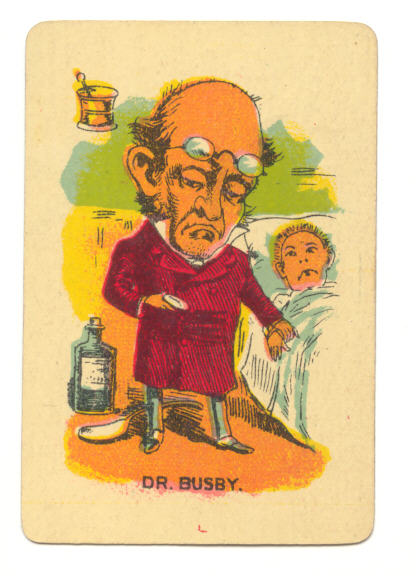
Here we have a few images from a 1905 Milton Bradley edition of “Dr. Busby.” As you may recall, he popped up earlier, making a guest appearance in an “Old Maid” deck (#33 in our survey, posted 11/13/08). Like “Old Maid,” there were many editions; this Dr. Busby is certainly a more dour practitioner than the last.
“Dr. Busby” is, I understand, one of the first children’s games published in the US. It was invented by Anne Abbott in 1843; Ms. Abbott is also credited with a children’s book, Doctor Busby and his Neighbors, and with various other games, including that old favorite, “Authors.”
There was a historical Dr. Busby: Richard Busby, headmaster of Westminster in the 17th century, mentioned by Pope in the “Dunciad.” Since that Busby was known mostly for beating and molesting his students, I do hope this is a different one.
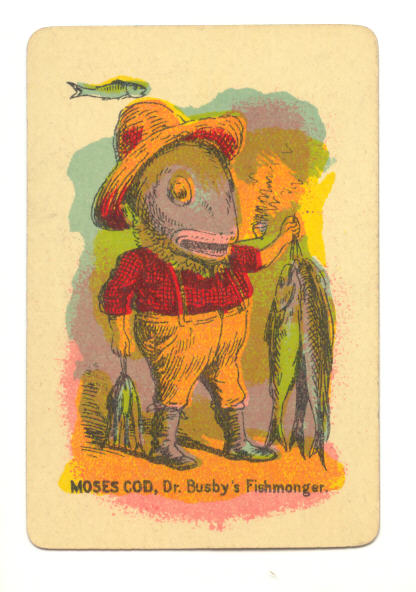
The object of the game was to match up families: the four members of Dr. Busby’s household, and the families of his various servants and retainers. Most of the early editions were 20 cards; this later version has swollen to 40. 20 of the cards are obviously from the same hand, such as this picture of Dr. Busby’s fishmonger:
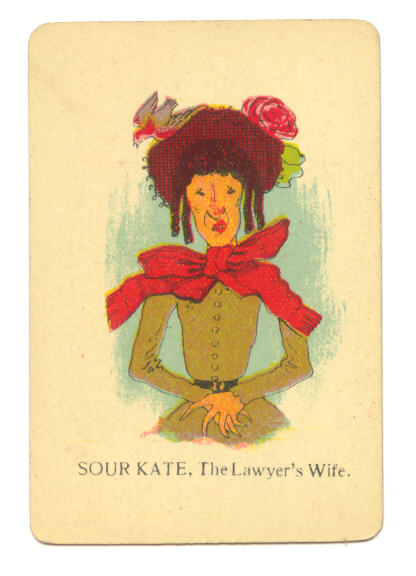
The other 20 are a mish-mash of cruder cuts, like this one:
(Posted by Doug Skinner)
Tags: Card Games · Ephemera
