We have heard reports that the Ullage Group is fixated on the past and that ullage means old things and concepts. To some extent this is true. There are many ullage topics of interest frozen in the glacier of the past. So let’s have a hot post about something new. 
The TV-B-Gone is a key chain remote, which functions as a universal off switch for most televisions. Every card-carrying member of the Ullage Group should have one at the high ready, when navigating public spaces. Broadcast television is toxic to all things ullage. It is a cultural metronome which keeps us all in consumptive lock step. To be fair, not all television is bad. Ernie Kovacs made amazing television programs, and HBO’s The Wire was superb, but television is primarily an instrument of paralysis, which sucks your life out through your eyes.
The TV-B-Gone is not new. I purchased one a few years ago. Doug Skinner and I have had much amusement pulling the media syringe out of the public’s eyes. There is a new development in TV-B-Gone technology. The TV-B-Gone Pro SHP (super high power). This new device can switch TVs off 100 meters away, and, because stealth is always desirable, the TV-B-Gone SHP resembles an iPhone. The first TV-B-Gone was a water pistol, this new device is an infrared fire hose. 
The prime target for this device is the muted public television. Why are they on? Why are they everywhere? Doug was recently eating at a diner and noticed a bizarre juxtaposition. Bing Crosby’s “It’s Beginning to Look A Lot Like Christmas” was softly playing throughout the diner as a mute TV displayed a breaking CNN report on the attacks in Mumbai.
So put a stop to this madness and buy a new improved TV-B-Gone SHP.
-posted by Anthony Matt
Tags: Belief Systems · Technology
February 27th, 2009 · 1 Comment
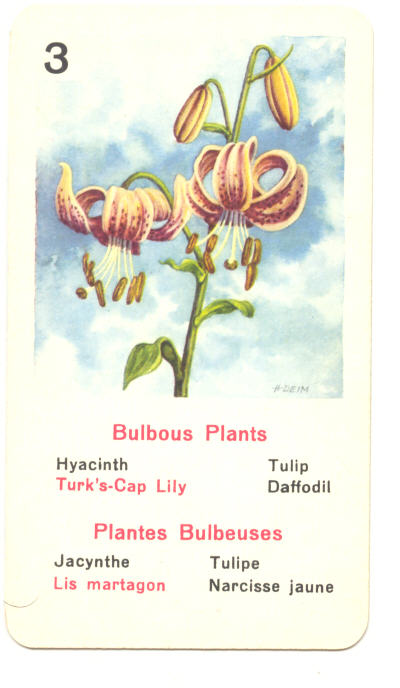
We’ll have one more specimen of “Happy Families” before we move on. This one is “Flower Families,” from Piatnik, in Vienna. There’s no date, I’m afraid. But we are, for once, given the name of the artist: Hubert Lechner, of the Vienna Academy.
This game is also somewhat unusual, in that it apparently assumes that the players are playing for money. The rules card tells us that the “player with the most fours” nets an “agreed bonus”; whereas the “player who is misinformed” is slapped with a “stipulated fine.” You’d better bone up on those bulbous plants if you want baby to get that new pair of shoes.
(Posted by Doug Skinner.)
Tags: Card Games · Ephemera
February 27th, 2009 · Comments Off on Moses Battles the Pterodactyls (3)
[We continue to mark Darwin’s bicentennial by serializing my talk on the cultural impact of his work. So far, we’ve touched on some of the popular misconceptions of his ideas, and on the flurry of legislation leading up to the Scopes Trial in the U.S.]
Meanwhile, paleontologists, like dirty little kids, had been scrabbling in the earth and digging up bones. It’s hard to realize now, after we all grew up scooting little plastic dinosaurs around the sandbox, that dinosaurs are a relatively new idea. I had a certain cultural shock when I was doing some research in newspapers of the 1870s, and came across a story that scientists had just discovered a prehistoric crocodile that hopped like a kangaroo. The word “dinosaur” itself only dates to 1841.
Soon, there were many dinosaurs, with long scientific names that children love, for some reason, and big skeletons to admire in the museums. Bones had, obviously, been found for centuries; and been called dragons and behemoths. But now there were all kinds of strange animals from the past, which, oddly enough, didn’t seem to be mentioned in the Bible.
One of the most familiar and popular dinos is the Brontosaurus, discovered with great fanfare by Othniel Marsh in 1879. Unfortunately, he was a bit hasty; and the specimen he put together was actually bits from an Apatasaurus and Camarasaurus: a sort of dinosaur jackalope.
By 1903, the Brontosaurus was officially removed from the pantheon, or whatever it is.
But let’s return to Tennessee, and to 1925. Because the Butler Bill inspired the Scopes Trial, that famous court case that took on the rosy glow of myth, as the great event that pitted evolution against evangelism.
It was, alackaday, phony from the get-go. The American Civil Liberties Union, then a mere broth of a group, announced that it would bankroll any challenge to the anti-evolution laws then sprouting up like fairy rings throughout the Bible Belt.
And so, a group of local boosters in Dayton, Tennessee, met at Robinson’s Drugstore, and decided to take the bait. The media attention, they figured, would attract visitors. Robinson’s would sell more ice cream. They could sell monkey dolls.
John Scopes was chosen as the teacher. He was, in fact, the high school football coach, not a biology teacher; but he was opposed to the law, and was young and single, so he was up for a bit of a lark. Two boys were found to testify that Scopes had once substituted for a science teacher, and had mentioned evolution. The boys then became scared that Mr. Scopes would get mad at them, and hid in the woods. A party had to flush them out and tell them Scopes said it was okay.
The trial heated up with the addition of some colorful visitors. For one, William Jennings Bryan joined the prosecution.
(Posted by Doug Skinner. We’ll join up with Bryan next week.)
Tags: Animals · Belief Systems · Education · Misconceptions · Politics
February 25th, 2009 · Comments Off on Crab Canons
We began the year with a crab canon; I had vowed to return to the subject, and here we are.
A crab canon is, simply, a palindromic canon. Or, to put it differently, a tune that harmonizes with itself backwards. They’re not necessarily hard to write: you just start from both ends, and meet in the middle. Some things work in both directions, and some don’t; you submit to those that do, and the canon then grows until you tie a bow in the middle and call it quits.
To my taste, the most satisfying crab canons are the shortest: you can hear the theme flowing back and forth, interweaving with itself, more directly when it’s brief than when it starts to spread out.
Here’s a simple example by Bach, from his prep work for the “Goldberg Variations,” where he was finding out what he could do with the bass line.
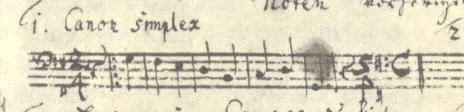
And here it is engraved, if you can’t read his handwriting.
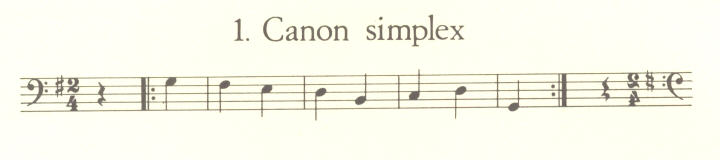
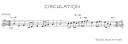
And here, too, is one of mine, in the form of a three-part round. (Click to enlarge.)
(Posted by Doug Skinner.)
Tags: Music
February 20th, 2009 · 3 Comments
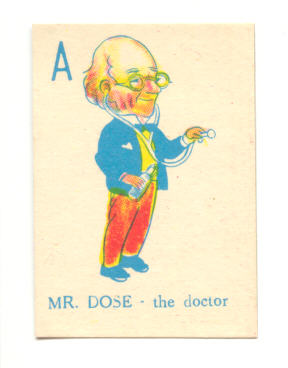
“Happy Families” is a small deck, cheaply printed, and carrying no information on publisher or date. We are only told that it was “Made in Hong Kong.” Obviously, it carries on the tradition of “Dr. Busby” (you remember him, scowling at you from #40 of this survey). The child is meant to collect the four members of the Dose family: father, mother, son, and daughter. Similar games, variously known as “Quartet” or “Seven Families,” are still sold in toy stores across Europe.
(Posted by Doug Skinner)
Tags: Card Games · Ephemera
February 20th, 2009 · 5 Comments
[We resume the serialization of my talk on the cultural hurly-burly that greeted Darwin’s theories. As we open this section, our animal friends are really going at it.]
Lions and tigers make ligers and tigons; camels and llamas make camas; antelopes give taxonomists nightmares. Mules have been known to foal baby mules; yaks, bison, and cattle pop out fertile hybrids. It’s a free-for-all out there.
Charles Fort was particularly drawn to an earlier model of evolution, orthogenesis: that all nature tends to perfection. Darwin argued instead for variation and adaptability: that all life benefits from change — of diet, climate, soil — and that life adapts to the changes, rather than clamping onto a static ideal.
For perfection isn’t perfect; because it’s static, and stasis is sterile.
For the true fundamentalist, however, change and evolution imply that creation needed overhauling, and this was not an appealing idea. That had something to do with the public outcry over Darwin, but it wasn’t the main gripe. Nor, surprisingly, was the sheer amount of sex in Darwin.
It was when he extended evolution into that chip off the old God, homo sapiens, that people really got miffed. It was fine that horses used to be smaller, or armadilloes bigger, or elephants had fur. Nobody cared. But the idea that men came from monkeys was a no-go. Those awful little animals that dance to organ-grinders! An anti-evolution tract title put it succinctly: God or Gorilla? Obviously, God was the more flattering option; you never saw him cramming his face with bananas, or masturbating in the zoo.
And, just as obviously, evolution had to be booted from the classroom. By the 1920s, states started to pass laws banning the teaching of evolution. There was some problem with this, because of that pesky Constitution, with its tiresome separation of church and state. Some states, like Oklahoma, prohibited evolution, only to repeal the law within a few years.
In Tennessee, John Washington Butler, a Baptist farmer newly elected to the legislature, introduced a bill banning evolution from schools. It passed only after his colleagues introduced farcical bills to ban teaching that the earth is round. The governor signed Butler’s bill because he assumed it was only symbolic, and he wanted support from rural voters for other programs. This was in 1925.
(Posted by Doug Skinner; to be continued.)
Tags: Belief Systems · Education · Misconceptions · Politics · The Ineffable
February 14th, 2009 · 5 Comments
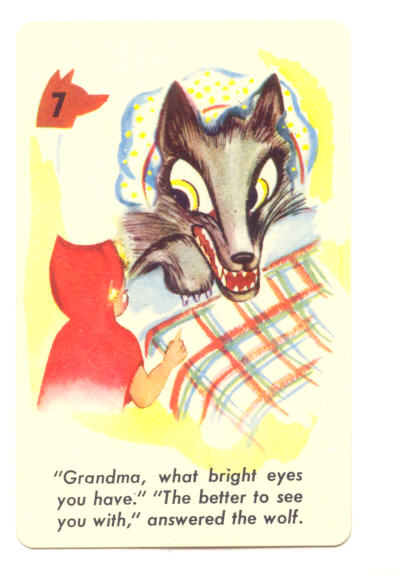
This week brings you another game based on folktales: “Story Cards: A Fairy Tale Card Game,” published in 1965 by Ed-U-Cards. Three tales are in it: “Red Riding Hood,” “Puss In Boots” and “Jack and the Beanstalk,” all illustrated in a curiously primitive and expressionistic style. It’s hard to choose; but I can’t resist offering you this memorable wolf.
(Posted by Doug Skinner)
Tags: Card Games · Ephemera
February 14th, 2009 · 1 Comment
[It’s the Darwin bicentennial; it’s time to party like primates. I’ll tip my bit into the punchbowl by serializing, sip by sip, a talk I gave at the 2006 “Fortean Times” UnCon and the 2007 INFO (International Fortean Organization) FortFest. It’s mostly about the confused interbreeding of evolution and American culture. I’ll update it a bit as I post it; it was originally dangled forth in the full fracas of the culture wars of that time. I will touch on the Scopes trial, its reworking as “Inherit the Wind,” the puzzling story of the brontosaurus, and the evolution of the caveman cartoon. Happy birthday, Charles!]
People are still squabbling over Darwin. Both Creationists and Evolutionists wax passionate on the subject — even though many in both camps have never gone near a book by the old man. He’s fought over in schools; he’s a plank in partisan politics. Inherit the Wind even popped up anew on Broadway.
So much of this furor has bupkis to do with Darwin, or even with biology. I wanted to figure out for myself what it was about. I originally unloaded the following remarks at the “Fortean Times” UnCon in London, where I was tag-teamed with Ian Simmons, who spoke on the dubious science of the “Intelligent Design” movement. He had the science angle covered, so I concentrated on the culture of the controversy.
But it’s helpful and refreshing, here at the outset, to savor some of the popular confusion about Darwin.
One is that he thumped his tub for atheism and a universe of randomness. He wasn’t a theologian; he was a biologist — and wrote on the origin of species, not the origin of life. And far from saying nature worked by chance, he stressed that it boasted predictable laws. He had enough homework cut out trying to understand those laws, and didn’t bother with speculations on first causes.
Nor did he say that all was ruled by competition. Organisms both compete and cooperate to survive: bees work together, sort of, to build hives; species aplenty benefit by interaction. Unfortunately, natural selection is often mixed up with Social Darwinism, with the idea that human behavior works by the same laws as speciation. Obviously, it doesn’t; and biologists pooh-poohed that idea long ago.
Another crucial point is that we simply can’t define what a species is. Each plant and animal has different genes; and the lines we draw between one species and another; between species and sub-species, sub-species and variety, one individual and another, is fluid and arbitrary. Nature joyfully breeds away, constantly varying and adapting; and hybrids between species, or even genera, are sometimes fertile — and there are varying degrees of fertility, too. As Charles Fort put it, we like to draw a circle in the ocean, and insist that the waves inside the circle are different from the ones outside. Nature is more interested in the breeding than in the classification.
(Posted by Doug Skinner; more to follow.)
Tags: Ancient History · Animals · Belief Systems · Education · Forteana · Literature · Misconceptions
February 8th, 2009 · 6 Comments
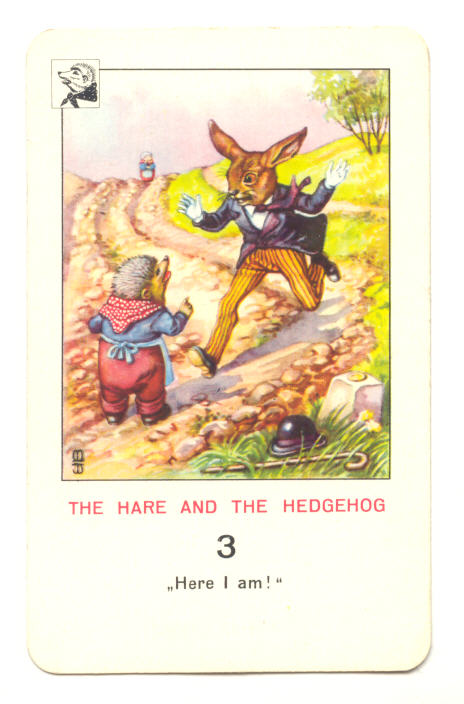
We have another example of a game based on folktales; this one, “Fairy Tale Families,” was published by Piatnik, in Vienna. The deck includes such old favorites as Red Riding Hood and Cinderella; I’ve chosen an image from this less familiar Grimms’ tale.
(Posted by Doug Skinner)
Tags: Card Games · Ephemera
February 1st, 2009 · 2 Comments
Our last digital update set me to wondering: why haven’t our hi-tek overlords marketed electronic tampons? The consumer-congregants have already been trained to crave phones that take photos. Surely there must be some way to sell them tampons rigged with needless gizmos. Perhaps sound chips could play soothing melodies, motivational slogans, or Bible verses, to ease the customers through their monthly cramps. Those who prefer to smile through their tears might be tickled by comic catchphrases or cartoon sound effects. Tyro menstruators could receive instruction or advice without having to read a text or speak with another human. And in the UK, recordings of Prince Charles reciting poetry or bits of old “Goon Show” scripts would rake in the quid.
I’m too busy here to pursue this. But I estimate it would take only a few months to teach the consumer-congregants that only losers buy dowdy old non-electronic tampons. So all of you enterprising youngsters, remember the timeless adage of product development: “Find a need and fill it.” Get to work, and make your keepers proud.
(Posted by Doug Skinner)
Tags: Suggestions · Technology