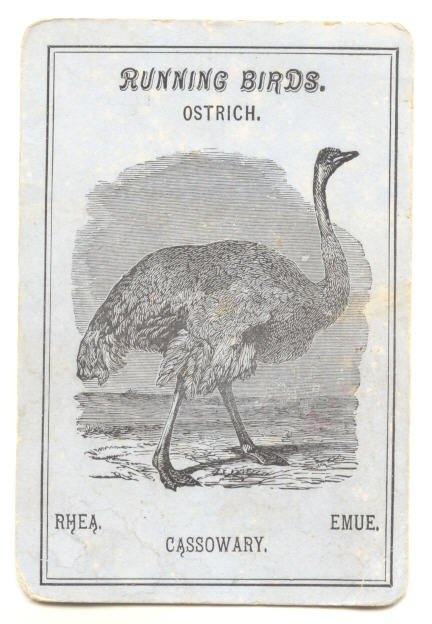
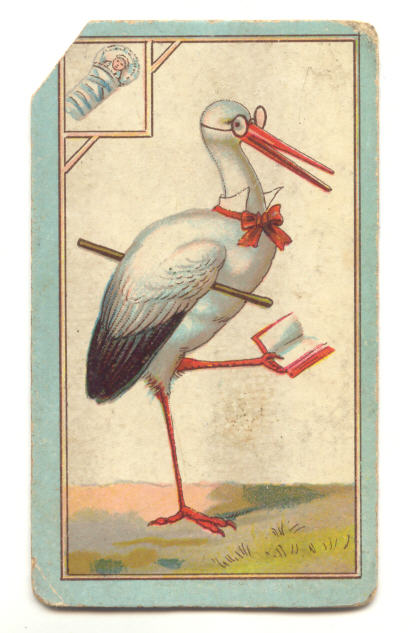
“Avilude, or Game of Birds,” was published by West & Lee in 1873. As you might expect, you collect sets of birds, thus learning some natural history as you compete.
The classification of birds is eccentric, and worth reprinting: wading, pigeon tribe, honey eaters, web-footed, birds of prey, running birds, singing birds, talking.
(Posted by Doug Skinner)
Tags: Card Games · Ephemera
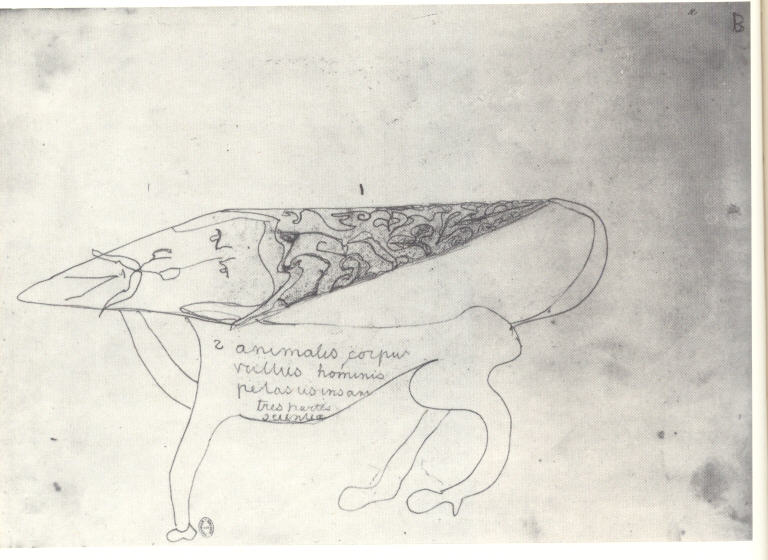
Spiritualism was all the rage in France in the 1850s; like many others, Victor Hugo and his household experimented with seances, table-rapping, and channeled communications. This intriguing drawing dates from sometime around 1854.
Hugo’s large body of graphic work may be unfamiliar to some of you: he left behind more than 3500 drawings. He had a particular penchant for romantic landscapes in ink and wash; here’s one of them, from 1866.
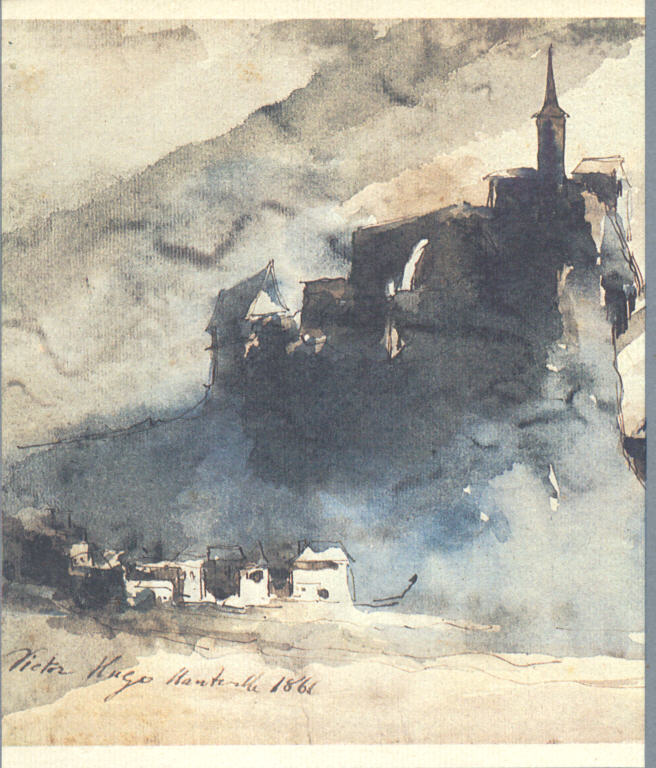
(Posted by Doug Skinner. Both of these appeared in I Disegni di Victor Hugo, Edizioni ALFA Bologna, 1983.)
Tags: Animals · Belief Systems · Diversions · Literature
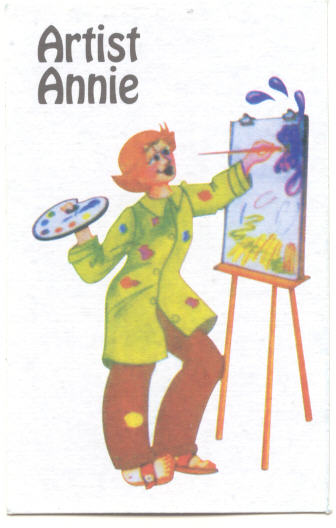
Another artist works away in another edition of “Old Maid.” This deck is contemporary; it has no indication of date or publisher; it’s cheaply printed. And here’s that Old Maid:
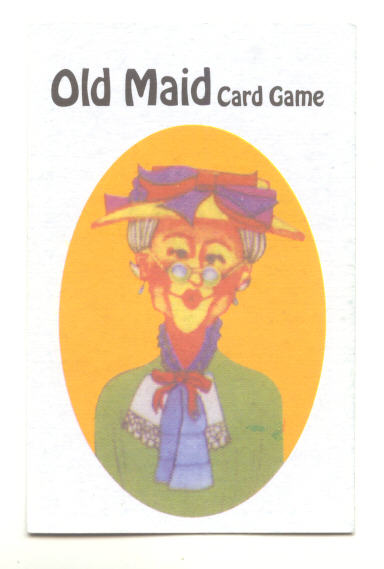
(Posted by Doug Skinner)
Tags: Card Games · Ephemera
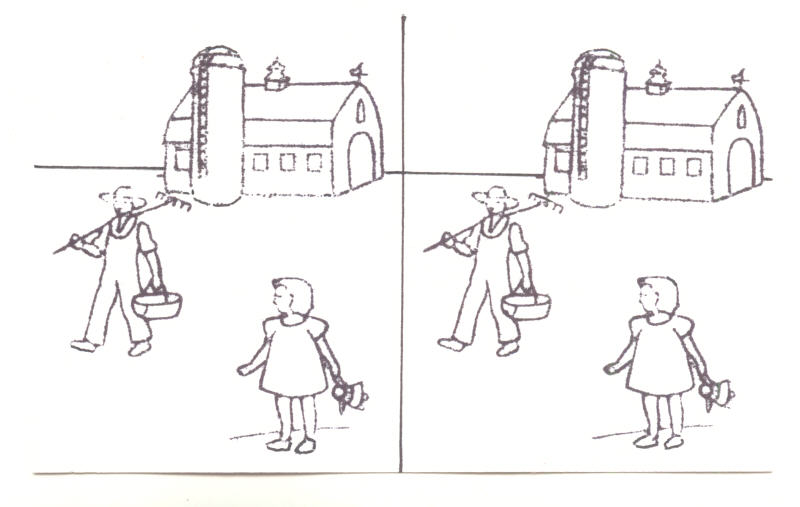
There are many ways to produce a stereo image, some more high tech than others: stereo cameras, two cameras, digital manipulation of a photo or drawing. One of the simplest is just to place two identical objects a few inches apart, and photograph them. You then get two perspectives of the same image, and you can watch it pop into relief in your stereoscope.
For quick, low tech experimentation, you can easily make simple stereo pictures with rubber stamps. You’ll need stamps, index cards, and a lightbox. If you don’t have a lightbox, sit over a desk lamp with a picture frame on your lap.
Choose two stamps, one for a close image, one for a distant. Rule an index card in half. On the left side, stamp the stamps in the position you want for your picture. This will be your reference picture.
Rule another card in half, and place it over your reference picture on the lightbox. On the left side, stamp each stamp in the same position as on the reference. Neatness counts. Then, place the right side over the reference, stamp the close image slightly more to the left, and the far one slightly more to the right.
Of course, this isn’t fully dimensional: what you’ll get is two flat images on two planes (cardboarding, we call it). But it’s fast, it works, the irregular inking causes a shimmering effect that is pleasing to the eye, and you’ll probably get ink on your hands.
And you can move on to three planes. For this, follow the same recipe, but add a third image to occupy the middle ground. On the right side, stamp that one in the same position as on the reference: close image to the left, middle one stationary, far one to the right.
The crucial part is in the positioning: too little separation produces no effect, too much will be rejected by your picky brain. You’ll see.
I find these pictures easy to view with free vision, even though I’m not too good at that. Maybe it’s because they’re small and simple. Focus on the opposite wall; hold your picture up against your nose. Move it away slowly, until your brain cooperates and gives you a blurry stereo image. Keep moving it to focus it.
If you want to use the crossed-eye method, you’ll have to cross the images: that is, on the right side, the close image must be more to the right, and the far one more to the left. Then, stare at the damn thing, cross your eyes until the images join, and stare at it some more.
Experiment, and have fun with your eyes and brain.
(Posted by Doug Skinner)
Tags: Diversions · Stereoscopy
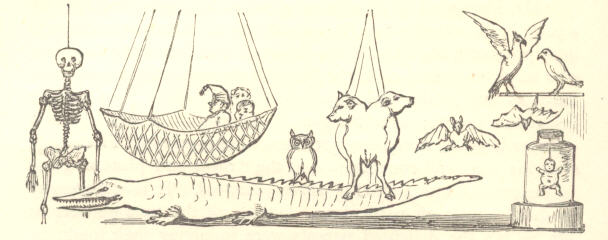
Forteana and family life don’t always mix. The sketch above is taken from Thackerayana, an 1875 compilation of the graphic work of William Makepeace Thackeray: cartoons, illustrations, travel sketches, marginal sketches. He made this one in the margin of “The Mirror,” a Scottish magazine from 1779. And here’s the passage that inspired it:
A wife is writing to the “Mirror” upon a new affliction which has attacked her husband. He happened to receive a crooked shilling in exchange for some of his goods (the husband was a grocer), and a virtuoso informed him that it was a coin of Alexander III, of great rarity and value, whereupon the good man became seized with a passion for collecting curiosities.
“His taste,” says the wife’s letter, “ranges from heaven above to the earth beneath, and to the waters under the earth. Every production of nature or of art, remarkable either for beauty or deformity, but particularly if either scarce or old, is now the subject of my husband’s avidity. The profits of our business, once considerable, but now daily diminishing, are expended, not only on coins, but on shells, lumps of different colored stones, dried butterflies, old pictures, ragged books, and worm-eaten parchments.
“Our house, which it was once my highest pleasure to keep in order, it would be now equally vain to attempt cleaning as the ark of Noah. The children’s bed is supplied by an Indian canoe; and the poor little creatures sleep three of them in a hammock, slung up to the roof between a stuffed crocodile and the skeleton of a calf with two heads. Even the commodities of our shop have been turned out to make room for trash and vermin. Kites, owls, and bats are perched upon the top of our shelves; and it was but yesterday that, putting my hand into a glass jar that used to contain pickles, I laid hold of a large tarantula in place of a mango.”
(Posted by Doug Skinner)
Tags: Forteana · Literature
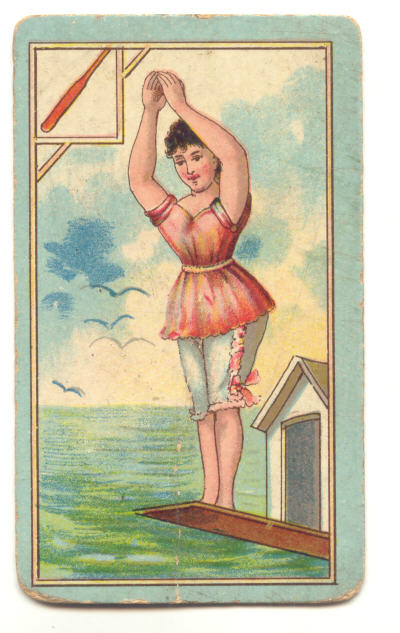
This week’s entry is an enigma, I’m afraid: an orphaned card, retrieved from a box of miscellaneous ephemera. The rather oddly shaped swimmer obviously comes from some old game, but what?
She did not arrive unescorted; this troublesome bird is clearly from the same deck.
(Posted by Doug Skinner)
Tags: Card Games · Ephemera
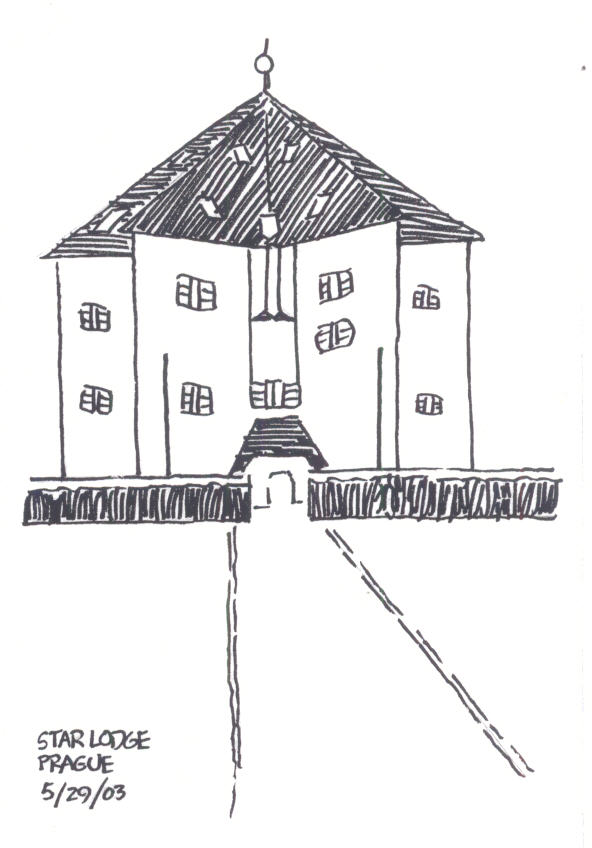
The Star Lodge, or Summer Palace, outside Prague, is another of those curious buildings that dot the Czech Republic. The Letohradek Hvezda was designed and built in 1555 by Archduke Ferdinand of Tyrol; it was supposedly a hunting lodge, but the fact that it’s shaped like a six-pointed star, with four stories, each keyed to a different color (black, white, yellow, and red), seems to indicate a more esoteric intention.
André Breton was taken with it; in his text L’Amour fou, he mentions that “A fond de l’âbime, construit en pierre philosophale, s’ouvre le château étoilé.” (At the bottom of the abyss, the star house, built of philosopher’s stone, opens.)
The Star Lodge has been the subject of speculation over the years; you’ll find some of it here. I made this sketch during a very nice trip to Prague back in 2003.
(Posted by Doug Skinner)
Tags: Eccentrics · Mysteries · Places
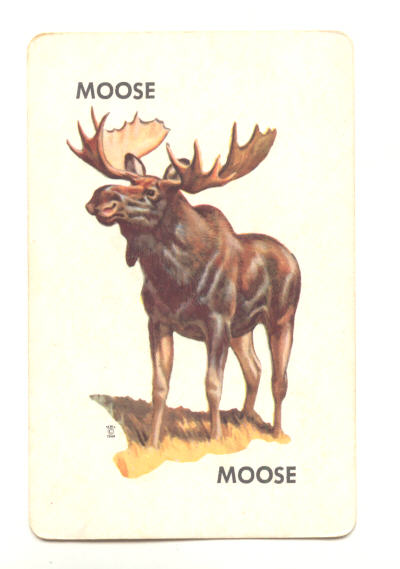
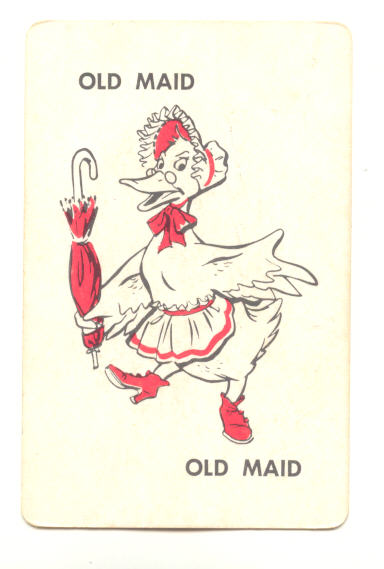
An “Old Maid, Wildlife Edition,” was published by the National Wildlife Federation at some point. It is, they tell us, “An Educational and Approved Children’s Game.” I assume they did the approving themselves; that’s how it often works. It features sober paintings of animals and plants; “Educational Notes” on said paintings; and a picture of the NWF mascot, a cartoon raccoon in a ranger hat, on the back of each card.
What image, then, did they select for the Old Maid? Here she is:
(Posted by Doug Skinner)
Tags: Card Games · Ephemera
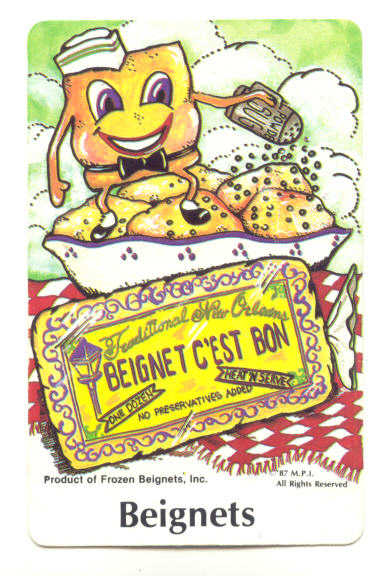
“Makin’ Groceries” was published in New Orleans in 1987, by Mel-Mar Productions. All of the cards represent local brands of food: ice cream, crab boil, red beans, potato chips, etc. The players compete to match and accumulate groceries. As the instruction card says, “We have chosen some of Louisiana’s finest and most original food products that best typify the unique quality and character of the State’s prominent food industry.” It’s essentially a collection of ads; but I like its cheerful regionalism and oddball art.
(Posted by Doug Skinner)
Tags: Card Games · Ephemera
May 29th, 2009 · Comments Off on Bulletin (7)
I’m happy to inform you that “The Puppet Show,” a vastly entertaining traveling exhibit of puppet-related art, is now at the Frye Museum in Seattle. The show includes a number of the videos that Michael Smith and I did over the years; the Frye Museum is at 704 Terry Avenue. Further particulars can probably be found here. The DVD collecting those videos is still to be had from 2nd Cannons.
Some of you may want to head down to Jalopy Theater, in Brooklyn, on Sunday, June 7, for “Comic Strip Serenade.” Comics historians Bill Kartalopoulos and Mark Newgarden have put together a program of songs based on comic strips, many never heard since they were preserved in sheet music many years ago. There will be songs about The Katzenjammer Kids, Abie the Agent, Li’l Abner, Felix the Cat, Smokey Stover, Krazy Kat, and Pogo, among others. The performers include Les Chauds Lapins, Peter Stampfel, Robin Goldwasser, John Keen, and myself. It’s at 9:00; details may be found here.
I’ll also be performing in Carmen Borgia’s long-awaited nautical musical, “South.” I’ve been cast as the mysterious, Bible-swiping Mr. Pym, and as a pirate captain; I’ll also be playing uke, cuatro, Marxoharp, cavaquinho, and other nice instruments. It’s at Dixon Place, 161 Chrystie Street in Manhattan, on June 12, 13, 19, 20, 26, and 27. There are probably more details here and here.
(Posted by Doug Skinner)
Tags: Bulletins
