September 10th, 2009 · 1 Comment
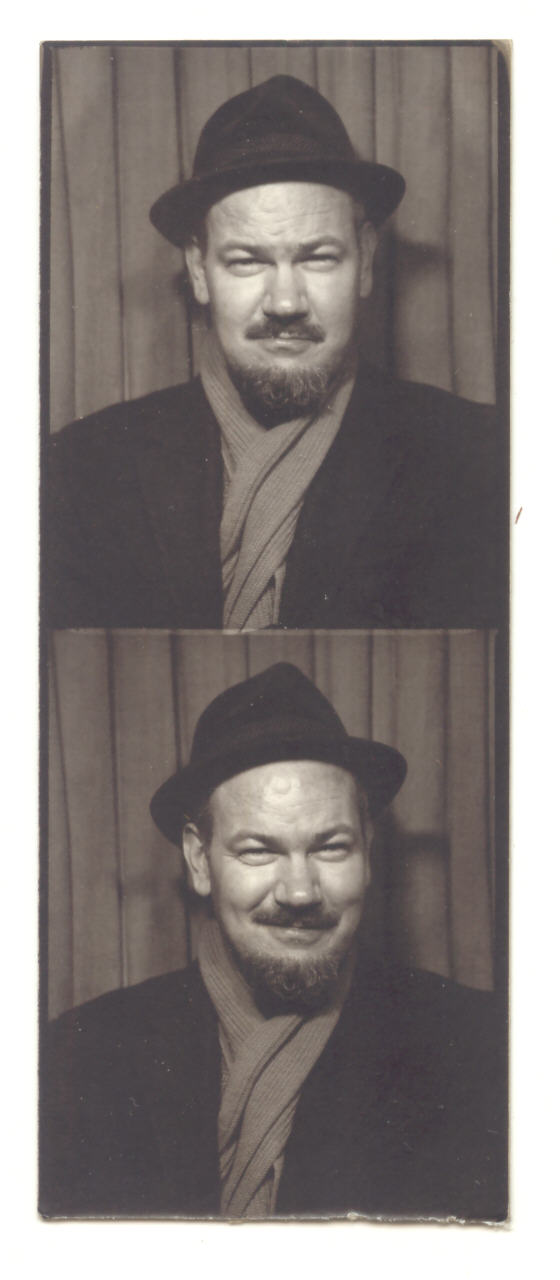
We would like to alert you to the fact that the September issue of Fortean Times contains a substantial tribute to John Keel, including memoirs by Phyllis Benjamin and myself, as well as a number of previously unpublished photos.
Anthony Matt and I have also started a tribute site to Keel, at www.johnkeel.com. There you can find a reasonably accurate biography and bibliography; I’ll be posting news, trivia, and other material on a somewhat weekly basis.
I hope you’ll remember him. And crack open a few of those books of his, from time to time.
(Posted by Doug Skinner)
Tags: Forteana
September 5th, 2009 · 6 Comments
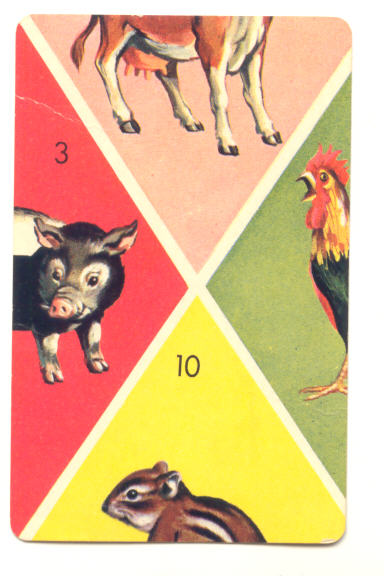
“Busy Bee” was published by Ed-U-Cards in 1959. Like a number of other games, it’s a variation on dominoes, with animals instead of dots. It makes for an unusual design, doesn’t it?
(Posted by Doug Skinner)
Tags: Card Games · Ephemera
September 5th, 2009 · 4 Comments
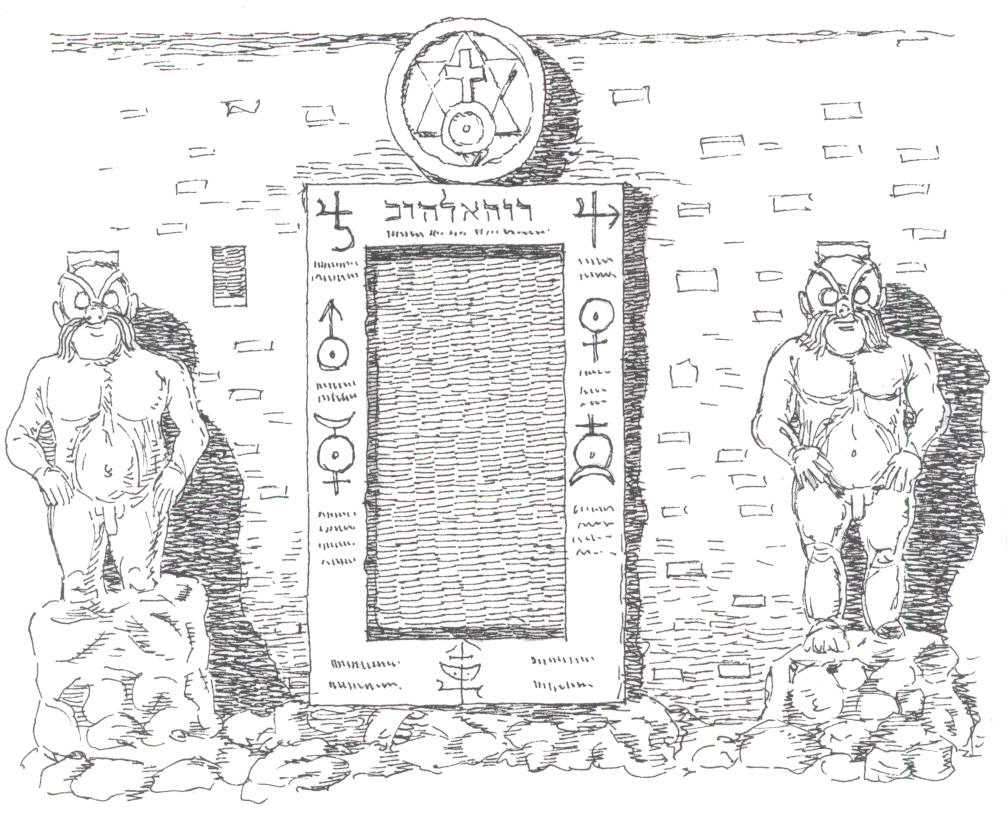
You can find la Porta Magica in Rome, on the Piazza Vittorio. It’s what remains of the villa of Massimiliano Palombara, a 17th century occultist.
There are at least two competing stories about it. One is that an archetypical mysterious stranger visited Palombara, and asked for funds and a room to test his alchemical know-how. Palombara agreed; the stranger locked himself in the room, and later vanished: leaving behind golden evidence of his success, and some cryptic phrases, which Palombara had carved into a doorway for others to ponder. The other story is that Palombara found the texts in an old manuscript, and that he and his friends tried for years to work the the Great Work with them; then left them on this door in the hope that some passerby might decipher them.
Many of the inscriptions are now too worn to read. They were, however, transcribed by earlier enthusiasts. They are, of course, in Latin, and read pretty much as follows.
Around the circle at top: “The center is in the triangle of the center.” Also: “There are three marvels: God and man, mother and virgin, triune and one.”
The Hebrew inscription, Ruach Elohim, means “Holy Spirit.” Beneath it: “A dragon guards the entrance of the magic garden of the Hesperides, and, without Hercules, Jason would not have tasted the delights of Colchis.”
There are six sigils on the jambs, each with its phrase.
Saturn/Lead: “When in your house black crows give birth to white doves, then will you be called wise.”
Jupiter/Tin: “The diameter of the sphere, the tau in the circle, and the cross of the globe bring no joy to the blind.”
Mars/Iron: “He who can burn with water and wash with fire makes a heaven of earth and a precious earth of heaven.”
Venus/Bronze: “If you make the earth fly upside down, with its wings you may convert torrential waters to stone.”
Mercury: “When azoth and fire whiten Latona, Diana comes unclothed.”
Antimony: “Our dead son lives, returns from the fire a king, and enjoys occult conjugation.”
On the base, Vitriol: “It is an occult work of true wisdom to open the earth, so that it may generate salvation for the people.”
And on the doorstep, “SI SEDES NON IS,” an ambiguous quasi-palindrome, meaning both “If you sit, do not go,” and “If you do not sit, go.”
The two statues represent Bes, a minor Egyptian deity, a protector of houses. They were added in 1888, when the door was moved and restored. And I sketched the damn thing on a trip to Rome back in 2002.
(Posted by Doug Skinner)
Tags: Mysteries · Places · Symbols · The Ineffable
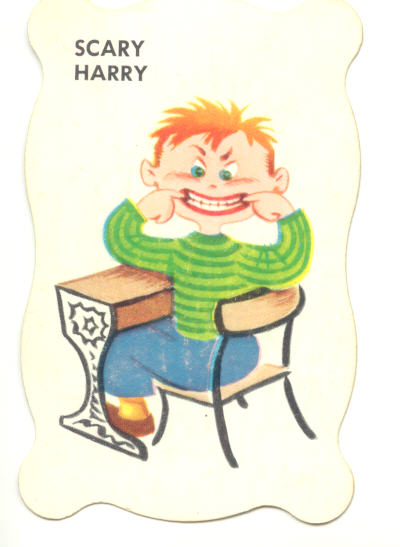
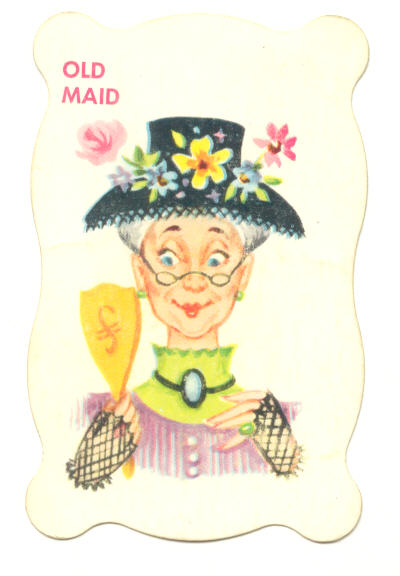
I thought we’d come to the end of this second series of “Old Maid” decks; but I’d forgotten this one. It’s a “Built-Rite Toy”: as usual, no date or other data. All of the subjects in this version are children: Fickle Frankie, Rollicking Ruth, Fancy Nancy, and other lively kids. I’ve picked Scary Harry. He seems to be enjoying himself; so does the artist.
And here’s the Old Maid.
(Posted by Doug Skinner)
Tags: Card Games · Ephemera
Looking back, some of the best sounding words were expressions of surprise or simple emphasis – basically, strategies to avoid uttering an oath. Shorthand blasphemy.
Oddsbodkins!: God’s body
Zounds!: God’s wounds
Gadzooks!: God’s hooks (those nails used in the Crucifixion)
Then there are the more secular tropes – also a kind of conversational shorthand.
A great (two-word) expression that, like all proper idioms, seemed to have no obvious connection to its meaning was “Brown Salve!”, which communicated both surprise at and understanding of whatever the hell it was someone just told you. You can consult John Camden Hotten’s Slang Dictionary (1859) for more delicious morsels.
A popular recent example is probably “Not!”. “Not!” enjoyed its heyday in the 1990s, and popped up in everything from the New Republic to commercials for dish detergent. “Not!” is not a new expression, however. In its contemporary usage, it first appeared in 1900, and I first noticed it in Ellis Parker Butler’s short story “Pigs is Pigs.” In 1908, the expression cropped up in a panel of Dreams of a Rarebit Fiend, by the pioneering Winsor McKay: “That confounded rarebit I ate last night is making me sleep lovely. NOT!!!”.[1] “Not!” is used to negate an idea for humorous rhetorical effect, but it basically operates as a means to shut down a particular line of conversation or thought. In happier times, the preferred method by which to perform this was “Quoz!”. [Read more →]
Tags: Ancient History · Diversions · Education · Language · Literature
August 21st, 2009 · 1 Comment
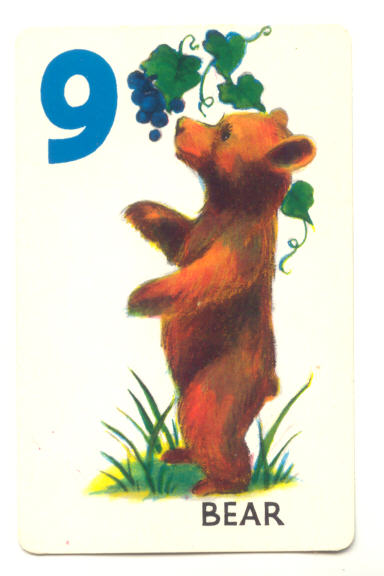
This edition of “Animal Rummy” is an Arrco “Pla-Mor” game: “Ten true to life animals of the woodlands make the all-time favorite game of Rummy more fun to play. The beaver, the bear, the squirrel, and even the skunk are mixed and matched in this new version of a great old game.” I’ve selected the bear: nice work there, I think.
(Posted by Doug Skinner)
Tags: Card Games · Ephemera
August 19th, 2009 · 1 Comment
I think my high school offered one basic course in psychology, which I did not take. Surely it dealt in stripped-down basics – the classification of emotions, some de-sexualized Freudian theory, and maybe a little Jung thrown in for the artsy kids. I’d like to think, if I’d had the opportunity to take a class like this, my life’s trajectory would have been radically different. Pet psychics are always in demand.

From yesterday’s Guardian:
From next month, potentially thousands of teenagers at schools and colleges throughout the UK will start lessons that deal with telepathy, psychokinesis, psychic healing, near-death experiences and talking to the dead. Surely the minds of the nation’s youth will be corrupted by all this mumbo-jumbo?
(Posted by Lisa Hirschfield)
Tags: 'pataphysics · Belief Systems · Education · Forteana · Hoaxes · Mad Science · Mysteries · The Ineffable
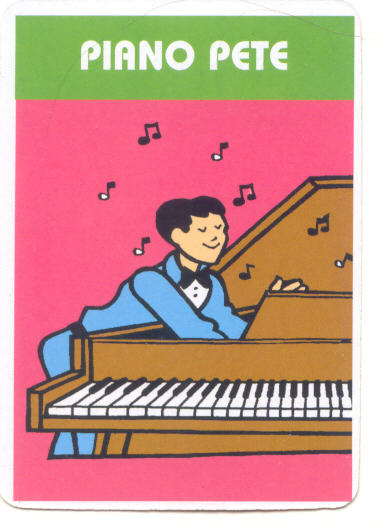
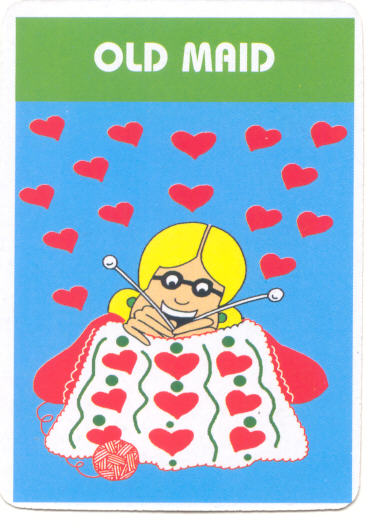
This “Old Maid” was published in 2001 by Cardinal Industries. I’m intrigued by the fact that Piano Pete seems to be playing inside the piano. Is he performing a piece using extended techniques? Or is he simply tuning — in black tie? At any rate, it’s a bold and bright design.
And here’s the Old Maid. This, by the way, will be our last “Old Maid” for a while; other designs, other games, await.
(Posted by Doug Skinner)
Tags: Card Games · Ephemera
August 1st, 2009 · 1 Comment
To most of us, the name “Tiny Tim” recalls the late Herbert Khaury, he of the uke and falsetto. We may also think of the plaintive tot in Dickens, or — if smitten with old comic strips — Stanley Link’s minuscule hero of the ’30s.
But there was another, now forgotten, yet once a familiar New York character: “Tiny Tim” Felter, who peddled his “Soul Candy” in the tearooms and coffeeshops of Greenwich Village, back in its boho heyday.
Curiously, he sounds much like the later tiptoer; so much so, in fact, that I can’t help but wonder if he inspired Khaury’s stage name. He was tall, thin, pale, with long black hair, and adopted a markedly fey persona.
Edmund Wilson chatted with him, and noted his impressions in his diary (later collected in “The Twenties”): “Soul Candy — wide-brimmed Stetson hat and green suit to match the day — “Inspiration” — said to have made such a good thing of it (May 1923) that he is able to live uptown with his wife and children — some say he merely has a house in the country — has written philosophical pamphlets, which he produces and presents to you when sufficiently encouraged — never comes out of his character, even when engaging in serious conversation… curious smiling expression which never betrayed his character.”
Clement Wood, in his booklet “Bohemian Life in N.Y.’s Greenwich Village” (issued as a Little Blue Book, #1106), was less amused: “And there was the dreadful unnamed character who would lisp and purr his way into the Greenwich Tavern and others of the eateries patronized by the slummers, who would offer for sale, in a wheedling treble, “Soul Kiss Candies,” a quarter for two or three bonbons which had cost him perhaps two cents! He would get the quarters, too, amid memories of ‘How quaint!’ ‘How adorable!'”
To my delight, Tiny Tim’s sales pitch has been preserved, in a “Souvenir Book of Greenwich Village,” by Ralph I. Bartolomew, published in 1920. And it’s worth preserving, too. Here it is:
“Every taste and every flavor has its own particular vibrations. They vibrate as truly as the sounding-board of the piano vibrates. If your ear is trained you can detect vibrations in music which the uninitiated would be unable to hear.
“One day I discovered, by the merest chance, that I am so sensitively constituted that my soul is in constant vibration with taste waves. I determined to devote myself to humanity and the manufacture of Soul Candy, which produces marvelous results in the souls of those who eat it. Would you write the world’s greatest epic, conceive a super Moonlight Sonata, paint a more perfect Mona Lisa? Then partake of this Soul Candy. I make it for altruistic reasons only. I desire no monetary reward. Eat, I pray you. It costs you nothing. In fact, money could not pay for it. You object? You are embarrassed? You decline? You are unwilling that one whom you consider a perfect stranger should thus endow your soul with lasting benefit? Money I despise, but if you insist upon it, if you will not eat without making vulgar compensation, then give me a quarter and take a bag of this Soul Candy.”
(Posted by Doug Skinner)
Tags: Eccentrics · Ukulele
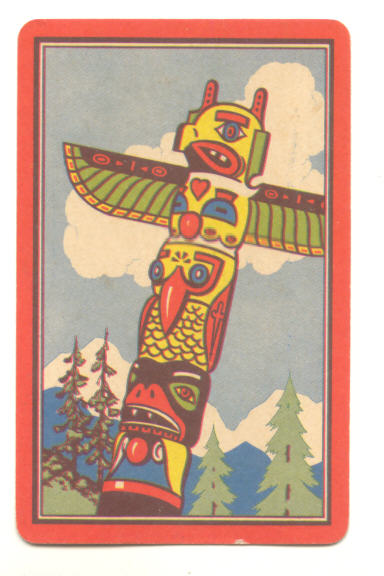
I suppose this isn’t really a game. It’s taken from a pack of “Trader’s Cards,” published by E. E. Fairchild. There are twelve cards, neatly done up in a wrapper. The copy tells us they’re “all different,” adding “You will want to get all nine series numbered 1 to 9, each containing twelve different cards.” The fact that the sets are numbered is indeed tempting; that saves trouble.
I presume the cards were traded among kids; the fact that none has any pop culture or franchise tie-in seems both quaint and refreshing. The selection also seems oddly random: a totem pole, a photo of a buttercup, a Renoir portrait, a photo of a church, a yellow and black drawing of a house, a map of Cape Cod, a colored print of a ship, a cookie jar with a decorative border, a photo of three kittens, a painting of a dog’s head, a painting of an oriole, a drawing of another kitten.
I was puzzled, until I realized: these were probably stock designs for playing card backs, repackaged as trading cards. I especially like that totem pole.
(Posted by Doug Skinner)
Tags: Card Games · Ephemera
