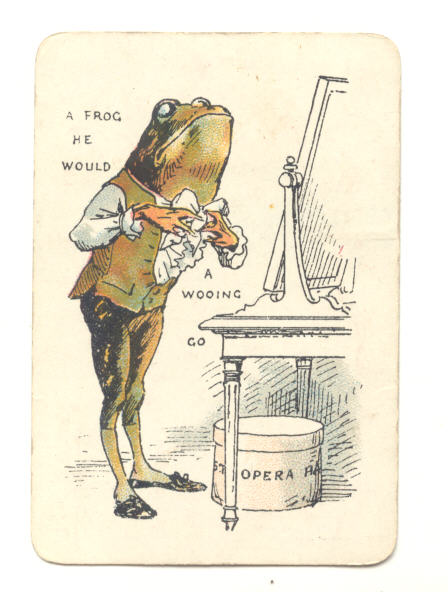
Another “Snap” deck; and another based on nursery rhymes. This one comes from Thomas de la Rue & Co., in London. Like the frog, all depict delicately colored figures against crisp black and white backgrounds. I particularly appreciate the distinctly froggy hands.
(Posted by Doug Skinner. Thanks to Angela Alverson for this one!)
While perusing eBay recently, I happened upon the work of Vernon Grant. Not Vernon Grant the wonderful graphic artist (and father of Kellogg’s Snap, Crackle, and Pop) but Vernon E. Grant the wonderful cartoonist, whose work has never been reprinted to my knowledge, and which seems to be all but unavailable. I’m not a scholar, historian, or ravenous collector of comics and cartoons, but I definitely more than like them, and I know what I more than like when I see it. Fortunately, I was able to snag (for a reasonable price) the second issue of The Love Rangers, a black-and-white ‘zine Grant self-published from 1978 through 1988.
Born in 1935 in Cambridge, MA, Vernon Grant began his professional cartooning career as a child, and later spent a year at the VesperGeorgeSchool of Art, until 1958 when he enlisted in the army. While living in Tokyo during and after his military service, Grant wrote and drew for Stars and Stripes and the Mainichi Daily News, and published several graphic novels. (He also survived two tours of Vietnam.)
Grant’s developing interest in Japanese cartooning and manga took a new direction after his introduction to The Fabulous Furry Freak Brothers; it’s all reflected in the narrative, composition, and stylistic detail of The Love Rangers. In fact, Grant is credited with introducing aspects of manga to the American underground cartoon scene.
Back in Boston, Grant started work on The Love Rangers, and later produced a line of post cards for the BostonComputerMuseum. He died a little more than three years ago, after a heart attack and fall. His wife Betsy organized a retrospective of his work in 2007.
You can find Vernon Grant’s Boston Globe obituary here.
A holiday weekend marred by beautiful autumn weather and massive transit disruptions didn’t keep the curious from turning out for the Ullage Group’s presentation, “Straight Talk About Hoaxes.” Anthony Matt’s multimedia exegesis of the 1969 “Paul is Dead” hoax was a rousing success. Original tapes of radio shows and phone calls, furnished by the DJ who started it all, along with a short slide-show of revealing album covers and persons responsible, provided fascinating and plausible evidence that Paul McCartney may indeed be alive. Doug Skinner began by showing off a trick Gideon Bible concealing rubber monkeys – a new Ullage Group endeavor that promises to astound traveling salesmen and vacationing families alike. He then entertained the audience with enlightening tales of pseudo-hoaxes, fictions taken for truth, and the generally fickle nature of belief. Running short on time, Lisa Hirschfield postponed her talk on storytelling, seduction, and Nigerian scam letters for another round of hoax-talk in the future; she will also post some of her findings on this site.
The truth is out there, always waiting to be debunked.
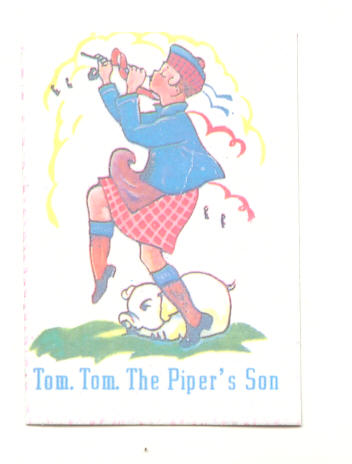
Our next “Snap” is a cheaply printed deck from China, still available in 99c stores. Each card shows a character from a nursery rhyme. Note that a couple of musical notes seem to be coming from Tom’s kilt. Has our bored artist slipped in a fart joke for his or her own amusement?
The Ullage Group excitedly presents its fifth hodgepodge, “Straight Talk About Hoaxes.” Doug Skinner will talk about pseudo-hoaxes, botched fictions, and accidental lies: stories intended as fiction, but accepted as fact by those bent on belief. Lisa Hirschfield will discuss storytelling and seduction in Nigerian love letters. Anthony Matt will discuss the intricacies of the “Paul Is Dead” radio hoax, which originated when Detroit DJ Russ Gibb played several Beatles songs backwards during a broadcast in 1969. Anthony will attempt to ruin several Beatles records by playing them backwards; and play clips from the original broadcast in the correct direction.
We will do all this, plus several surprises, some intentional, at Jalopy Theatre, 315 Columbia St., Red Hook, Brooklyn, on Sunday, October 11, at 5 pm. Admission is only $5 in real money. We hope you’ll come. We’ll treat you well.
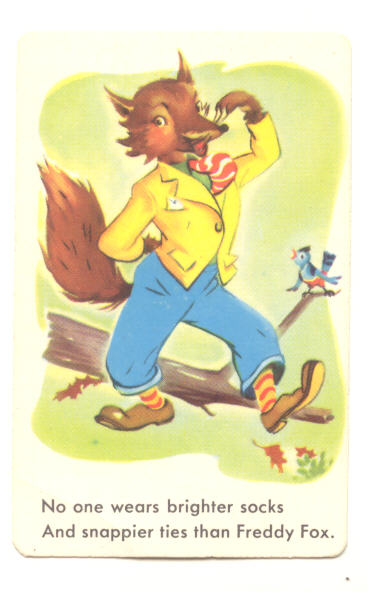
We begin here a survey of that grand old game, “Snap.” This first entry is a Whitman deck; it features storybook animals, of various degrees of anthropomorphism, all hooked in somehow to the word “snap.” Freddy is certainly snappy, and the anonymous artist rendered him with an easy charm.
September 29th, 2009 · Comments Off on Speaking Statues
The speaking statue may be a uniquely Italian custom. At any rate, I don’t know of any elsewhere.
By a speaking statue, I don’t mean one that actually talks, but one that serves as a bulletin board for diatribes, slogans, and satirical verse. An essential part of the tradition is that the statue becomes a character, and the squibs hung around its neck or pasted to its pedestal are keyed to its personality. It acts somewhat like a ventriloquial dummy: a comedian who can get away with riskier material than a “real” performer. In the case of the statue, the writer can also stay anonymous; which, given some times and places, has been much safer.
The type specimens are six statues in Rome, often known collectively as il congresso degli arguti, the assembly of wits.
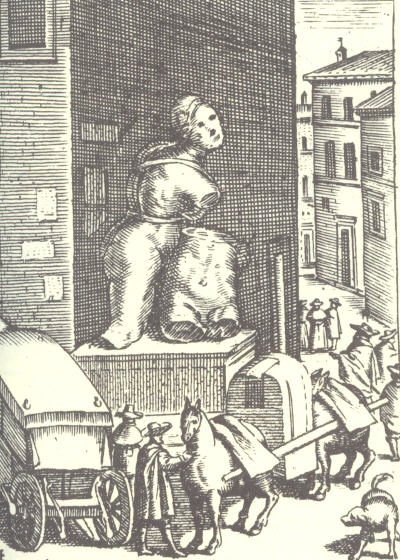
The undisputed leader is Pasquino, shown above in a 17th century engraving. He’s a fragment of classical statuary, unearthed in 1501, and, in true Roman fashion, simply posted on the sidewalk as a public ornament. Nobody is quite sure how he got his name (which, yes, gave us the word “pasquinade”): tradition variously names him after a schoolteacher, a barber, or an innkeeper. For centuries, he’s been mocking popes and politicians, and keeping up a running political commentary, often in Roman dialect.
But Pasquino is not always a monologist. He’s often teamed with a large reclining river god, Marforio (again, explanations for the name vary). They often work frankly as a comedy duo, with Marforio feeding Pasquino straight lines.
Pasquino and Marforio have sometimes angered authorities, both individually and together. They’ve been threatened with being dumped into the Tiber — although exasperated butts of mockery soon realized the river treatment would only rile up the writers.
The two statues have, however, occasionally been watched and guarded, at which times the other four have become more talkative.
Madama Lucrezia (or, in dialect, Lugrezzia) is rather inactive nowadays; but she was the only female, and often offered the woman’s viewpoint. She corresponded with the Abate Luigi, who, sadly, had his head removed repeatedly, and who played the part of an unscrupulous politico. IlFacchino (the Porter), a battered and stout geezer with a barrel, has long been identified with Martin Luther. Il Babuino (dialect for babbuino, baboon) is a particularly homely silenus, whose invective-laden babuinate had a style of their own.
There are a few statue parlanti in other cities. Milan has Scior Capera; Venezia, il Gobbo di Rialto (the Rialto Hunchback); and Florence a stately boar, il Porcellino (the Little Pig). All are local celebrities, with long and illustrious careers.
But are there examples outside Italy? Or do Italians have a particular bond with their public statuary?
Earlier this year, Roman authorities announced plans to fence off the speaking statues, to “protect” them. This hasn’t worked before. The city has offered a website as a substitute. We’ll see what happens.
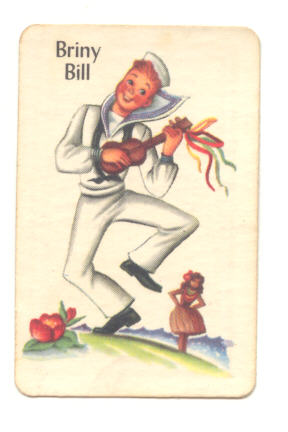
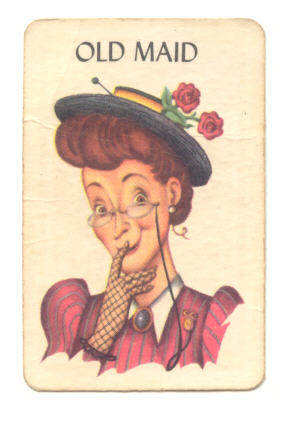
Another “Old Maid” has surfaced: I’ll add it to the roster. This one is a miniature “Peter Pan” deck from Whitman; and it boasts a rather disparate bunch: in addition to Briny Bill, you can meet Judge Grump, Pancho, Conchita, Pirate Bones, Merry Mary, Mermaid McCoy, Tubbins, and other oddballs. And, of course, the Old Maid.
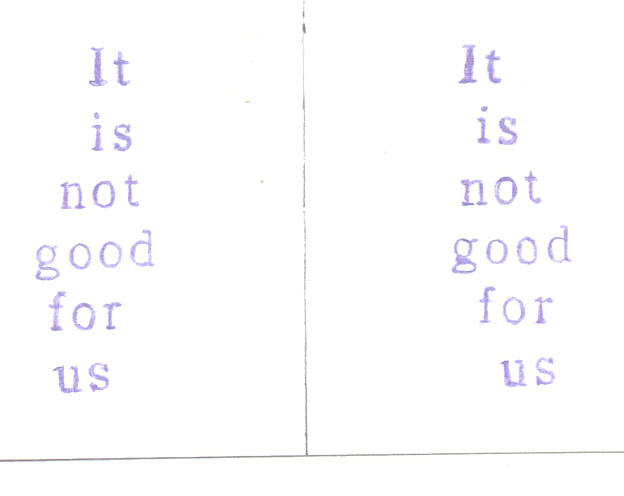
Word ladders are a relatively easy stereo effect to draw by hand. Print a phrase on a sheet of graph paper, centering one word per line. Place the sheet on a light box. Center your phrase on the left side of a card, and trace the first word. Then, trace the second word, but move it over a bit to the left. Trace the third word, moving it a bit more to the left; and so on. Repeat the process for the right half of the card; but move each word more to the right.
Place the finished card in a stereoscope, and the words will seem to get farther away; cross your eyes (without a stereoscope), and they will seem to get closer.
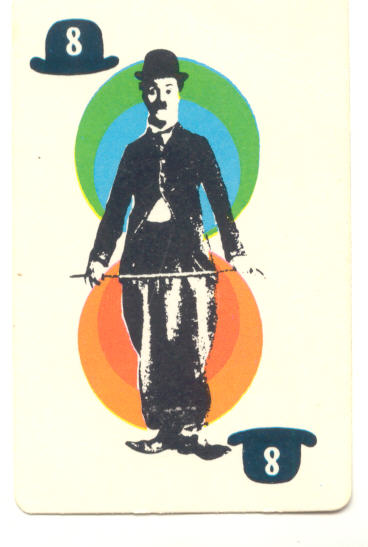
The “Charlie Chaplin Card Game” was published in 1972 by Edu-Cards. And what could be more representative of the time than high contrast photos of a silent film star, set against bright geometric backgrounds? A bit of Warhol influence in there, don’t you think?
Like many decks of Edu-Cards, the deck also had a little flip book on the backs of the cards. Once you’d finished the game, you could put the cards back in order, and watch Charlie swing his cane.