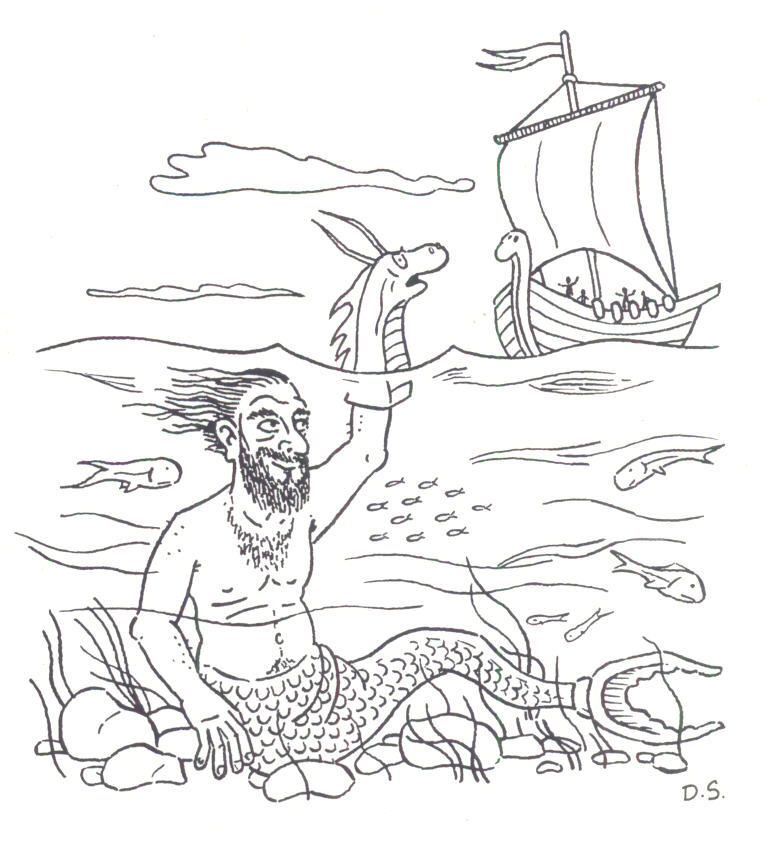
The Ullage Group excitedly presents its fifth hodgepodge, “Straight Talk About Hoaxes.” Doug Skinner will talk about pseudo-hoaxes, botched fictions, and accidental lies: stories intended as fiction, but accepted as fact by those bent on belief. Lisa Hirschfield will discuss storytelling and seduction in Nigerian love letters. Anthony Matt will discuss the intricacies of the “Paul Is Dead” radio hoax, which originated when Detroit DJ Russ Gibb played several Beatles songs backwards during a broadcast in 1969. Anthony will attempt to ruin several Beatles records by playing them backwards; and play clips from the original broadcast in the correct direction.
We will do all this, plus several surprises, some intentional, at Jalopy Theatre, 315 Columbia St., Red Hook, Brooklyn, on Sunday, October 11, at 5 pm. Admission is only $5 in real money. We hope you’ll come. We’ll treat you well.
Directions to Jalopy can be found here.
(Posted by Doug Skinner)
Tags: Bulletins · Education · Hoaxes
September 30th, 2009 · 1 Comment

We begin here a survey of that grand old game, “Snap.” This first entry is a Whitman deck; it features storybook animals, of various degrees of anthropomorphism, all hooked in somehow to the word “snap.” Freddy is certainly snappy, and the anonymous artist rendered him with an easy charm.
(Posted by Doug Skinner)
Tags: Card Games · Ephemera
September 29th, 2009 · Comments Off on Speaking Statues
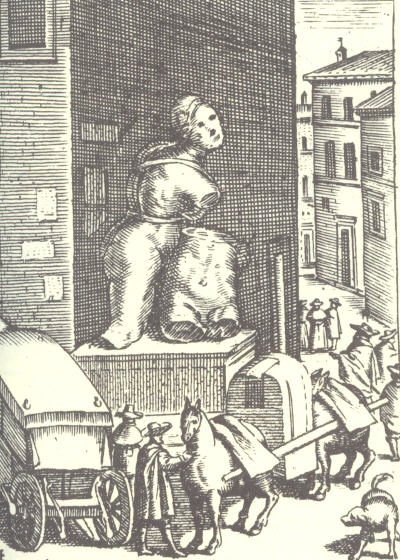
The speaking statue may be a uniquely Italian custom. At any rate, I don’t know of any elsewhere.
By a speaking statue, I don’t mean one that actually talks, but one that serves as a bulletin board for diatribes, slogans, and satirical verse. An essential part of the tradition is that the statue becomes a character, and the squibs hung around its neck or pasted to its pedestal are keyed to its personality. It acts somewhat like a ventriloquial dummy: a comedian who can get away with riskier material than a “real” performer. In the case of the statue, the writer can also stay anonymous; which, given some times and places, has been much safer.
The type specimens are six statues in Rome, often known collectively as il congresso degli arguti, the assembly of wits.
The undisputed leader is Pasquino, shown above in a 17th century engraving. He’s a fragment of classical statuary, unearthed in 1501, and, in true Roman fashion, simply posted on the sidewalk as a public ornament. Nobody is quite sure how he got his name (which, yes, gave us the word “pasquinade”): tradition variously names him after a schoolteacher, a barber, or an innkeeper. For centuries, he’s been mocking popes and politicians, and keeping up a running political commentary, often in Roman dialect.
But Pasquino is not always a monologist. He’s often teamed with a large reclining river god, Marforio (again, explanations for the name vary). They often work frankly as a comedy duo, with Marforio feeding Pasquino straight lines.
Pasquino and Marforio have sometimes angered authorities, both individually and together. They’ve been threatened with being dumped into the Tiber — although exasperated butts of mockery soon realized the river treatment would only rile up the writers.
The two statues have, however, occasionally been watched and guarded, at which times the other four have become more talkative.
Madama Lucrezia (or, in dialect, Lugrezzia) is rather inactive nowadays; but she was the only female, and often offered the woman’s viewpoint. She corresponded with the Abate Luigi, who, sadly, had his head removed repeatedly, and who played the part of an unscrupulous politico. Il Facchino (the Porter), a battered and stout geezer with a barrel, has long been identified with Martin Luther. Il Babuino (dialect for babbuino, baboon) is a particularly homely silenus, whose invective-laden babuinate had a style of their own.
There are a few statue parlanti in other cities. Milan has Scior Capera; Venezia, il Gobbo di Rialto (the Rialto Hunchback); and Florence a stately boar, il Porcellino (the Little Pig). All are local celebrities, with long and illustrious careers.
But are there examples outside Italy? Or do Italians have a particular bond with their public statuary?
Earlier this year, Roman authorities announced plans to fence off the speaking statues, to “protect” them. This hasn’t worked before. The city has offered a website as a substitute. We’ll see what happens.
(Posted by Doug Skinner)
Tags: Literature · Places · Politics
September 18th, 2009 · 2 Comments
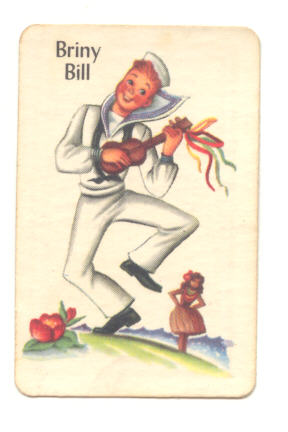
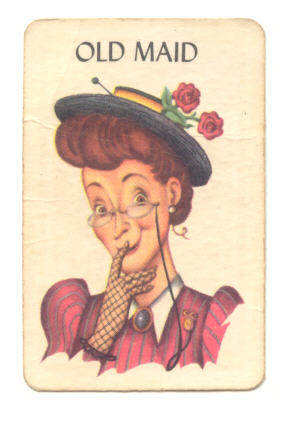
Another “Old Maid” has surfaced: I’ll add it to the roster. This one is a miniature “Peter Pan” deck from Whitman; and it boasts a rather disparate bunch: in addition to Briny Bill, you can meet Judge Grump, Pancho, Conchita, Pirate Bones, Merry Mary, Mermaid McCoy, Tubbins, and other oddballs. And, of course, the Old Maid.
(Posted by Doug Skinner)
Tags: Card Games · Ephemera · Ukulele
September 18th, 2009 · 1 Comment

Word ladders are a relatively easy stereo effect to draw by hand. Print a phrase on a sheet of graph paper, centering one word per line. Place the sheet on a light box. Center your phrase on the left side of a card, and trace the first word. Then, trace the second word, but move it over a bit to the left. Trace the third word, moving it a bit more to the left; and so on. Repeat the process for the right half of the card; but move each word more to the right.
Place the finished card in a stereoscope, and the words will seem to get farther away; cross your eyes (without a stereoscope), and they will seem to get closer.
(Posted by Doug Skinner)
Tags: Diversions · Stereoscopy
September 11th, 2009 · 4 Comments
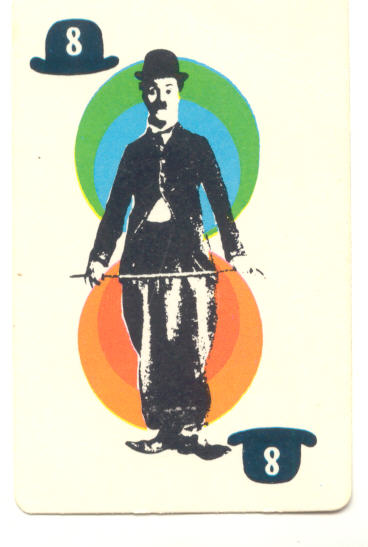
The “Charlie Chaplin Card Game” was published in 1972 by Edu-Cards. And what could be more representative of the time than high contrast photos of a silent film star, set against bright geometric backgrounds? A bit of Warhol influence in there, don’t you think?
Like many decks of Edu-Cards, the deck also had a little flip book on the backs of the cards. Once you’d finished the game, you could put the cards back in order, and watch Charlie swing his cane.
(Posted by Doug Skinner)
Tags: Card Games · Ephemera
September 10th, 2009 · 1 Comment
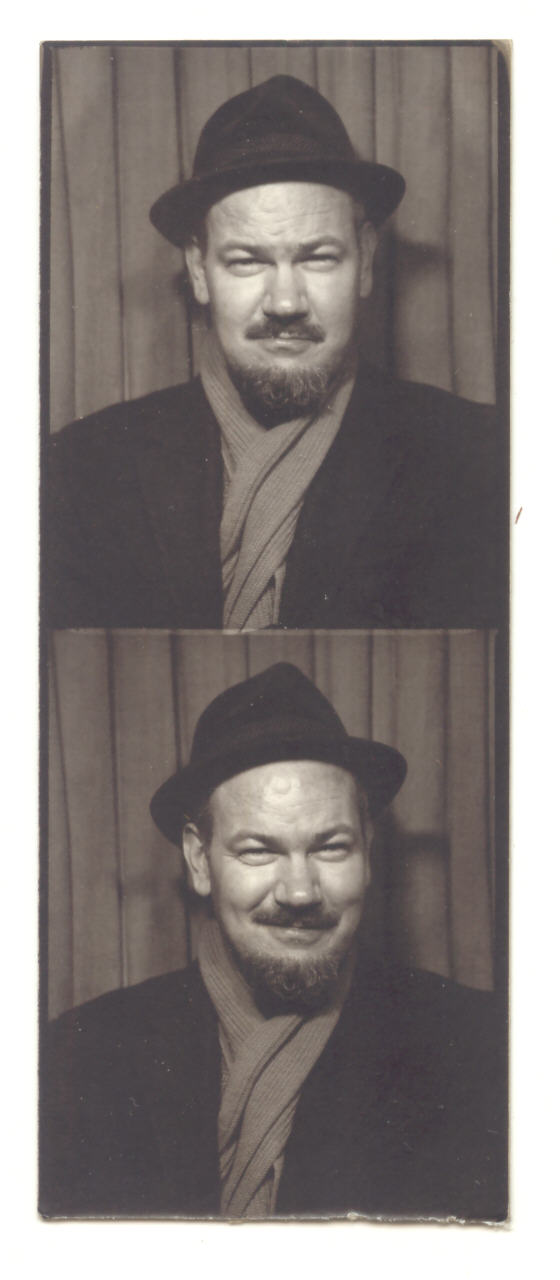
We would like to alert you to the fact that the September issue of Fortean Times contains a substantial tribute to John Keel, including memoirs by Phyllis Benjamin and myself, as well as a number of previously unpublished photos.
Anthony Matt and I have also started a tribute site to Keel, at www.johnkeel.com. There you can find a reasonably accurate biography and bibliography; I’ll be posting news, trivia, and other material on a somewhat weekly basis.
I hope you’ll remember him. And crack open a few of those books of his, from time to time.
(Posted by Doug Skinner)
Tags: Forteana
September 5th, 2009 · 6 Comments
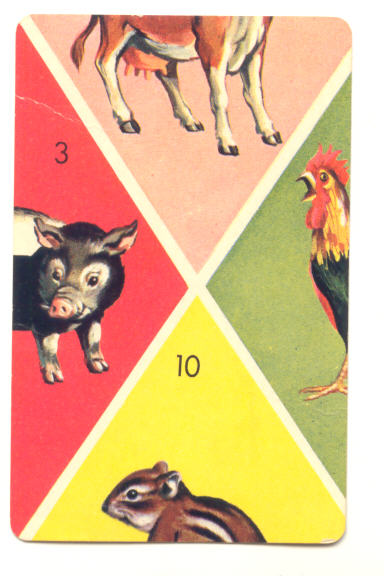
“Busy Bee” was published by Ed-U-Cards in 1959. Like a number of other games, it’s a variation on dominoes, with animals instead of dots. It makes for an unusual design, doesn’t it?
(Posted by Doug Skinner)
Tags: Card Games · Ephemera
September 5th, 2009 · 4 Comments
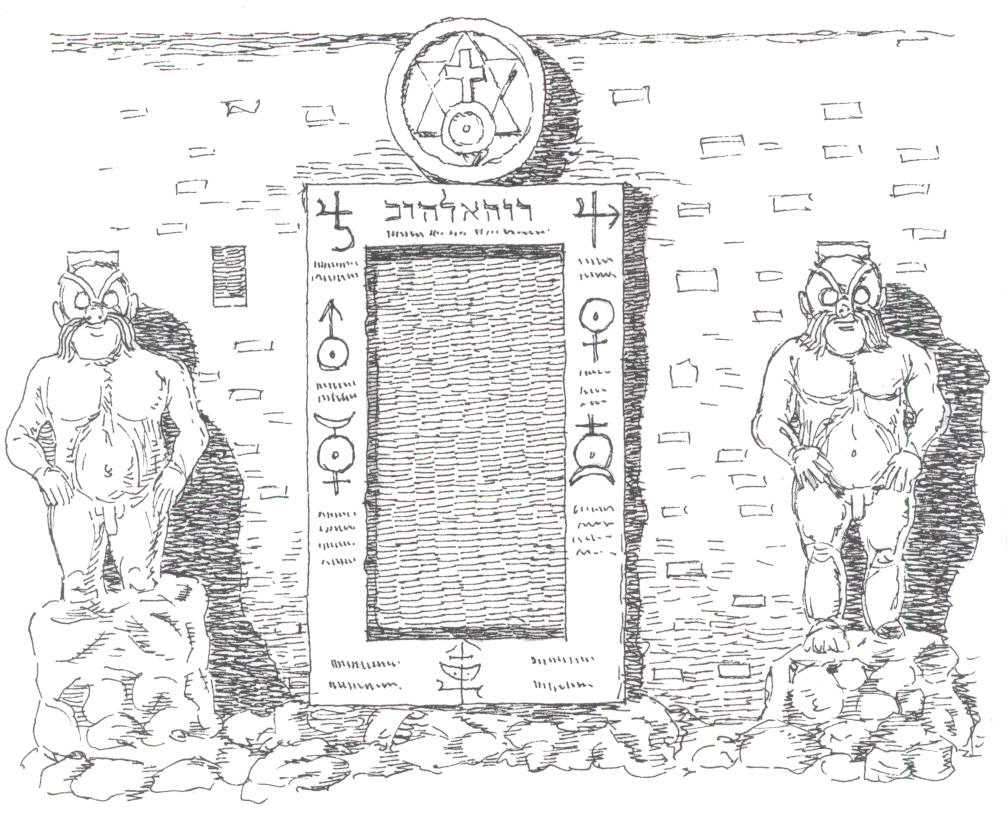
You can find la Porta Magica in Rome, on the Piazza Vittorio. It’s what remains of the villa of Massimiliano Palombara, a 17th century occultist.
There are at least two competing stories about it. One is that an archetypical mysterious stranger visited Palombara, and asked for funds and a room to test his alchemical know-how. Palombara agreed; the stranger locked himself in the room, and later vanished: leaving behind golden evidence of his success, and some cryptic phrases, which Palombara had carved into a doorway for others to ponder. The other story is that Palombara found the texts in an old manuscript, and that he and his friends tried for years to work the the Great Work with them; then left them on this door in the hope that some passerby might decipher them.
Many of the inscriptions are now too worn to read. They were, however, transcribed by earlier enthusiasts. They are, of course, in Latin, and read pretty much as follows.
Around the circle at top: “The center is in the triangle of the center.” Also: “There are three marvels: God and man, mother and virgin, triune and one.”
The Hebrew inscription, Ruach Elohim, means “Holy Spirit.” Beneath it: “A dragon guards the entrance of the magic garden of the Hesperides, and, without Hercules, Jason would not have tasted the delights of Colchis.”
There are six sigils on the jambs, each with its phrase.
Saturn/Lead: “When in your house black crows give birth to white doves, then will you be called wise.”
Jupiter/Tin: “The diameter of the sphere, the tau in the circle, and the cross of the globe bring no joy to the blind.”
Mars/Iron: “He who can burn with water and wash with fire makes a heaven of earth and a precious earth of heaven.”
Venus/Bronze: “If you make the earth fly upside down, with its wings you may convert torrential waters to stone.”
Mercury: “When azoth and fire whiten Latona, Diana comes unclothed.”
Antimony: “Our dead son lives, returns from the fire a king, and enjoys occult conjugation.”
On the base, Vitriol: “It is an occult work of true wisdom to open the earth, so that it may generate salvation for the people.”
And on the doorstep, “SI SEDES NON IS,” an ambiguous quasi-palindrome, meaning both “If you sit, do not go,” and “If you do not sit, go.”
The two statues represent Bes, a minor Egyptian deity, a protector of houses. They were added in 1888, when the door was moved and restored. And I sketched the damn thing on a trip to Rome back in 2002.
(Posted by Doug Skinner)
Tags: Mysteries · Places · Symbols · The Ineffable

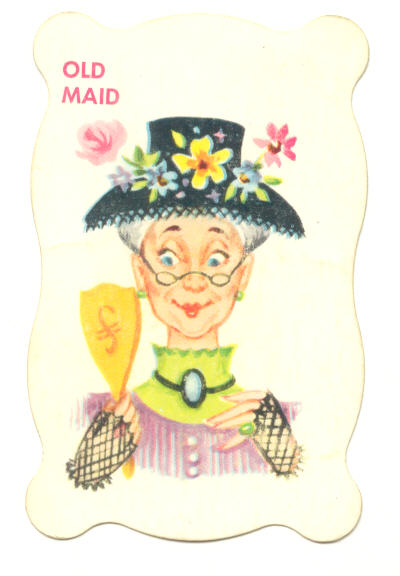
I thought we’d come to the end of this second series of “Old Maid” decks; but I’d forgotten this one. It’s a “Built-Rite Toy”: as usual, no date or other data. All of the subjects in this version are children: Fickle Frankie, Rollicking Ruth, Fancy Nancy, and other lively kids. I’ve picked Scary Harry. He seems to be enjoying himself; so does the artist.
And here’s the Old Maid.
(Posted by Doug Skinner)
Tags: Card Games · Ephemera
