September 12th, 2013 · Comments Off on Bulletin (24)
Oh boy! Oulipo Pornobongo 2 is now out, chockablock with smut and recreational linguistics. This one features work by Opal Louis Nations, Farewell Debut, D.S. Macpherson, Thaddeus Rutkowski, Giovanni Zuniga, Derek Pell, Roger Leatherwood, Eckhard Gerdes and others. I contribute a song, an acrostic about mating dachshunds, a translation of an 1885 story by Alphonse Allais, and a comic strip scripted by Derek Pell. It’s available from Black Scat Books.
Captain Cap, Volume 4: The Sanatorium of the Future, is also forthcoming from Black Scat. This will be the final volume in my illustrated translations of Alphonse Allais’s stories of the intrepid Captain.
I contributed an introduction to an upcoming collection of John Keel’s magazine articles, edited by Andrew Colvin. It will be called The Outer Limits of the Twilight Zone; watch for it!
(Posted by Doug Skinner)
Tags: Alphonse Allais · Bulletins
September 3rd, 2013 · 2 Comments
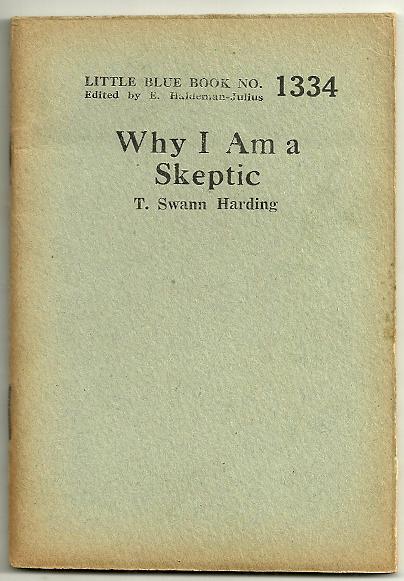
T. Swann Harding replaced Harry Elmer Barnes as a Founder of the Fortean Society. As usual, I don’t know how active he was. His papers, now in the Library of Congress, contain correspondence with Thayer, and he did contribute to Doubt, so I assume he was involved more than some of the others.
I haven’t found much about him. An internet search reveals that the T stands for Thomas, that he contributed to a number of magazines and wrote several books, and that he worked for the USDA. In his own writings, he frequently mentions his work as a research chemist.
He wrote fifteen Little Blue Books:
966: The Dawn of Rational Sex Ethics
1272: This Marriage Business
1330: Facts You Should Know about Digestion
1331: How Much Does Man Really Know?
1334: Why I Am a Skeptic
1389: The Truth About the Tobacco Habit
1390: Fact and Fiction About Health
1391: The Magic in Those Ultra-Violet Rays
1441: Do You Know How Ignorant You Are?
1562: How to Live Long
1570: Is Man a Rational Animal?
1604: The Venereal Disease Problem
1677: How the Army and Navy Fight Venereal Diseases
1678: Moral and Social Aspects of the Venereal Disease Problem
1679: Various Types of Venereal Diseases and Their Treatment
He also contributed an essay, “The Portentous Theologian and the Skeptic,” to #1307, “The Word of Satan in the Bible” (named for Louis Adamic’s piece on Ecclesiastes).

He usually wrote about two subjects: medicine and skepticism. Most of the books are collections of shorter pieces; some, maybe most, had appeared previously in the Haldeman-Julius Monthly and other magazines.
The medical works follow the usual Haldeman-Julius custom of debunking unscientific beliefs. I don’t know if ideas on health have changed materially since the ’20s, or if he’s being deliberately contrarian. Probably a bit of both. At any rate, he dismisses the childish superstition that cigarettes are bad for your health, and affirms that ventilation, fruits and vegetables, and exercise are. I haven’t been able to read his ideas on venereal disease; I hope they don’t follow suit. He sets up a few straw men: in a screed against vegetarians, for example, he claims that they’re mystics who restrict their diet in the foolish belief that it will please God. As an old vegetarian myself, I can reassure you that it doesn’t work that way.
Then again, to his credit, he also says that his own doctor took him off meat because it gave him stomach-aches.
Which brings us to his skepticism. He is, throughout these books at least, consistently undogmatic, and writes cheerfully and eloquently about the virtues of suspended judgment and the pitfalls of absolutism. “Why I Am a Skeptic” tells of his mischievous attempts to introduce actual free-thinking and “pleasant skepticism” into a venerable atheist journal. “But the editor caught me in the act! This sort of thing could not be done. At my first mild discharges certain righteous brethren were offended and wrote in discordantly, vastly annoying the genial editor.” After further discussion on the importance of avoiding dogma, he ends “And now the solemn hour approaches when an unlearned skeptic is required by his high and rigid principles to retire to the woodshed and laugh at his own pretensions for such period as will afford him immunity from the bacteria of superiority and portentousness.”
“How Much Does Man Really Know?” is particularly close to Fort (or, for that matter, the skeptical tradition going back to Sextus Empiricus), as he takes on scientific method and the dangers of subjectivity and confirmation bias. In his case, though, he credits Alfred Korzybski, later to become a fortean favorite himself. Here’s a nice bit from near the end, to give you more of the Harding flavor:
“What does all this mean? It means that living as we do in an age of science we should avoid static, finished doctrines which either will not admit new facts or else color these data before permitting them to enter. There is no warrant whatever for the supreme egotism of any individual or group which dares abstract certain selected characteristics from the universe (which is what we all do), to fashion them into an object and to label that highly abstract object universal truth for all men… For the proudest engine of doctrine may at any time be derailed by some trivial stone of fact and pride indeed goeth before a fall.”
Nicely put! And far from the simplistic scientism that is called skepticism nowadays.
You can read #1441, “Do You Know How Ignorant You Are?” online, over here. Well, do you?
(Posted by Doug Skinner)
Tags: Books · Forteana

I’ve posted the Little Blue Books of Theodore Dreiser, Ben Hecht, and John Cowper Powys. None of the other Founders (Tiffany Thayer, Harry Leon Wilson, Burton Rascoe, Alexander Woollcott, J. David Stern, Aaron Sussman, Booth Tarkington) wrote for Haldeman-Julius — except one. That was Harry Elmer Barnes.
Barnes quickly disappeared from the Founders’ roster. He was never mentioned in Doubt (that I know of, at least), and barely rates a name-check in books on Fort. He wrote fourteen Little Blue Books, all published between 1929 and 1931.
1462: Science Versus Religion as a Guide to Life
1468: How to Deal With Crime
1472: History: Truth or Propaganda?
1480: The Causes of the World War
1483: Trial by Jury: The Great Burlesque of Modern Criminal Justice
1506: How Capitalism Developed
1507: A Rational View of the Sex Issue
1511: War Guilt and the Present European Situation
1525: The Menace of the Modern Prison
1526: Peace Plans From Kant to Kellogg
1542: Who Started the World War?
1586: Were the Founding Fathers Pious Angels and Plaster Saints?
1588: Debunking the Myth of Calvin Coolidge
1653: The Fallacies of American Historians

They fall into a few categories: anti-religious tracts, screeds against the American justice system, critiques of historians, and accounts of the first World War. In addition, he took on capitalism, peace initiatives, and the public perception of Coolidge. These were all staple LBB topics, and in line with The Fortean Society’s interests — or, at least, with Thayer’s.
In many of these, his model seemed to be H. L. Mencken; in fact, he padded his pages with long quotes from Mencken. He shared Mencken’s contempt for rural America, his atheism, his taste for eugenics, and his sympathy for Germany. His principal critique of trial by jury, for example, was that jurors were too stupid to do the job properly, and that trials should be decided by trained criminologists. His style was rather pompous; he certainly lacked the Mencken verve.

The books on World War 1, however, hint at trouble to come. He argued that the true aggressors were France, which hoped to retake Alsace and Lorraine, and Russia, which wanted control of the Straits of Constantinople. I suppose you can make a case for that; I’ve never understood what that war was about. Unfortunately, the Barnes mix of revisionism, contrarianism, and sympathy for Germany gradually took an ugly turn: by the ’50s he was a full-fledged Holocaust denier. By then, the LBBs had ended, and the Fortean Society wanted nothing to do with him. His Founders’ chair, or whatever it was, was taken by T. Swann Harding. Harding too was a Haldeman-Julius writer; we’ll look at him next.
(Posted by Doug Skinner)
Tags: Forteana · Literature
August 12th, 2013 · Comments Off on Bulletin (23)
Our tribute to Les Blank was an unqualified delight. Blank’s films unfurled in all their majesty; and his sons Harrod and Beau were on hand to provide commentary and to answer questions. Our thanks to all who attended.
You can see a rare photographic portrait of me, enjoying my edition of Alphonse Allais’s How I Became an Idiot, over at the Black Scat site. If you forgot to buy a copy for some reason, you can still correct the mistake.
There will be a student recital at the Jalopy Theater this Friday, the 16th, at 6 pm. If you show up, you can see my uke student Ellie bring down the house. Jalopy is still at 315 Columbia St., in Brooklyn.
(Posted by Doug Skinner)
Tags: Alphonse Allais · Bulletins
August 5th, 2013 · Comments Off on Captain Cap, Volume 3
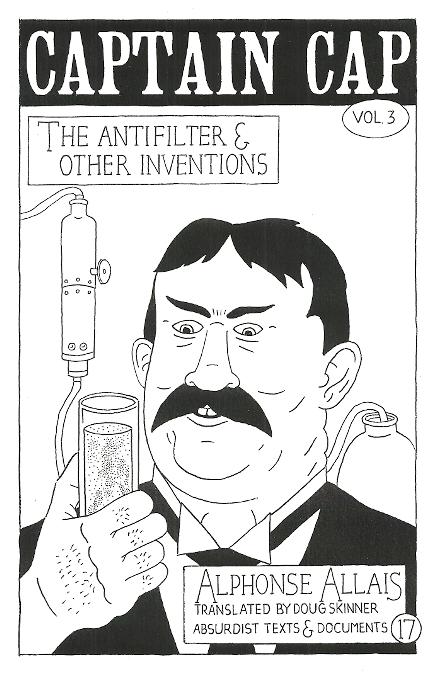
The third volume of the adventures of Captain Cap (there will be four) is now available from Black Scat Books, in a limited edition of 125. The adventures of the prototypical ‘pataphysical antihero, first published by Alphonse Allais in 1902, have been scrupulously translated, illustrated, and annotated by Doug Skinner; they appear in English for the first time. The incomparable Captain is particularly erudite in these sixteen stories: as he savors his cocktails, he elucidates the antifilter, the nonuplet, ballooning without a balloon, grandiose billiards, fecal residue in Christmas sausage, shoeing horses at a distance, and much more. To quote Albert Capus: “The humor of Alphonse Allais was a rigorous affirmation, whose gravity could not be doubted. And since it was also impossible to believe, you found yourself in a strange position which condemned you to a burst of laughter.”
And you can find it at Black Scat Books.
(Posted by Doug Skinner)
Tags: 'pataphysics · Alphonse Allais · Books

The Ullage Group is pleased to present a memorial screening of Les Blank’s short films. Sadly, Les died of bladder cancer this past April, leaving behind an astonishing film legacy that has been largely unseen due to the unconventional length and subject matter of his films. Harrod Blank will also be present to discuss his father’s work and their unusual relationship. The following films will be screened with numerous breaks for beer.
God Respects us When We Work, But Loves Us When We Dance 1968 20min. (A film about the psychedelic LA “Love-in” of 1967)
Hot Pepper 1973 54min. (a film about Zydeco king Clifton Chenier)
Stoney Knows How 1981 29 min. (a portrait of master dwarf tattoo artist Stoney Sinclair)
Marc and Ann 1991 27 min. (A film about Cajun musicians Marc and Ann Savoy)
Cigarette Blues 1985 6 min. (an anti-smoking film with Sonny Rhodes)
**As an added bonus we will also be screening Pohaku a new short film by David Silberberg about the making of a ukulele and “Get by on Your Wits” a 5 min scene with Les from Oh My God it’s Harrod Blank by David Silberberg. David is a filmmaker and long time sound man for Les.
When: 3 pm, August 11th, 2013
Where: Jalopy Theater, 315 Columbia St., Brooklyn NY 11231.
For directions to The Jalopy Theatre visit http://www.jalopy.biz
Admission will be 10$ and all the proceeds will go to The Les Blank Legacy.
Posted by Anthony Matt
Tags: Music · Ukulele
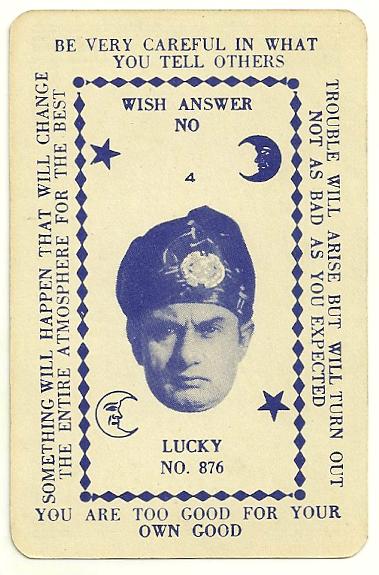
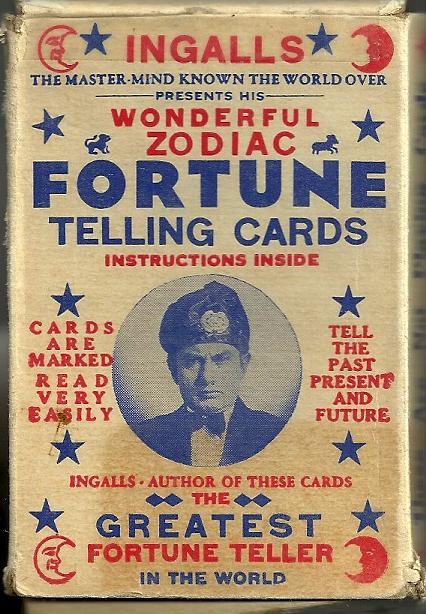
Harry Ingalls, “the greatest fortune teller in the world,” made the unusual choice to put his portrait on each card in his deck. And each of those cards, as you can see, offers a variety of fortune telling options, framing that searching gaze. The box is even busier, a sort of carnival poster in miniature.
(Posted by Doug Skinner)
Tags: Card Games · Ephemera
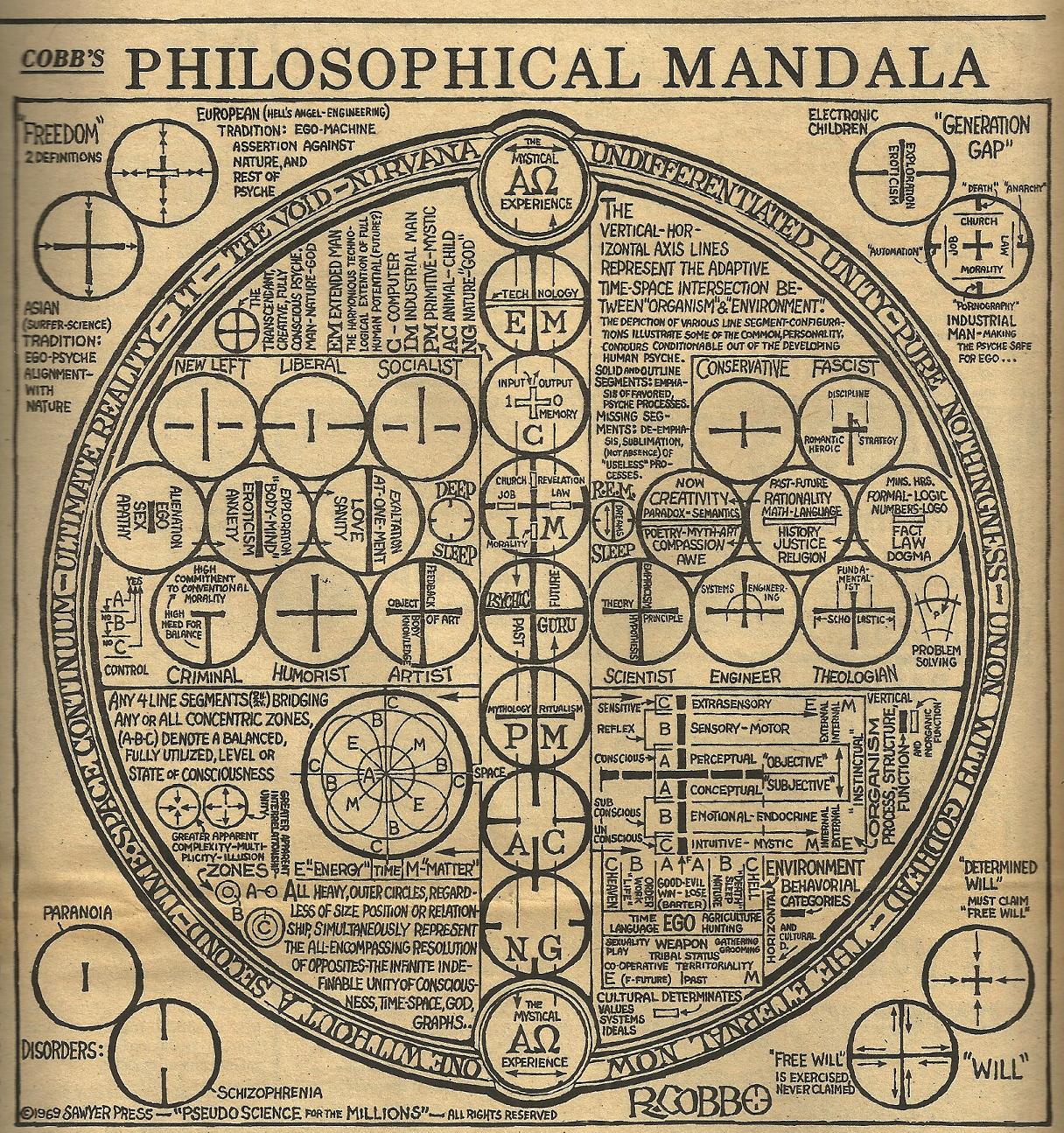
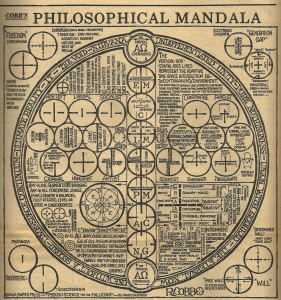
Ron Cobb is known particularly for his crisp and trenchant political cartoons, which were once a staple of the underground press. He also designed the ecology flag, contributed designs to a number of movies, and did many other things. However, this enchanting diagram, buried in a copy of the East Village Other (August 27, 1969) is something else: a splendid mandala depicting the variety of human consciousness. I don’t quite understand it yet, but will keep looking at it.
(Posted by Doug Skinner)
Tags: Cartoons · Symbols · The Ineffable

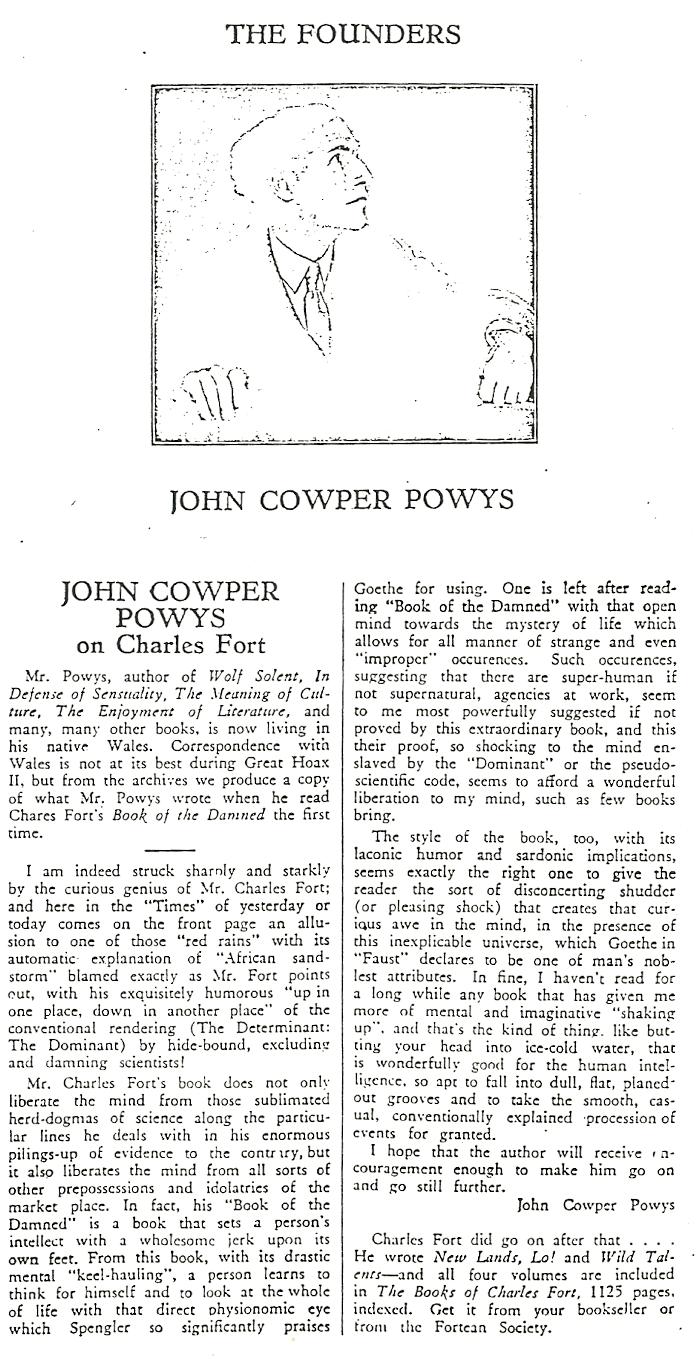
John Cowper Powys was a Founder of the Fortean Society, and professed himself delighted with Fort’s work. Although remembered today mostly for his fiction, his contributions to the Little Blue Book catalog were all essays. His first was #112, The Secret of Self Development; it was followed by #414, The Art of Happiness, and #435, One Hundred Best Books. His book of literary essays, Suspended Judgments, was split up into #448-452 (although without the chapter on Verlaine); and his last entry was #1264, The Art of Forgetting the Unpleasant.
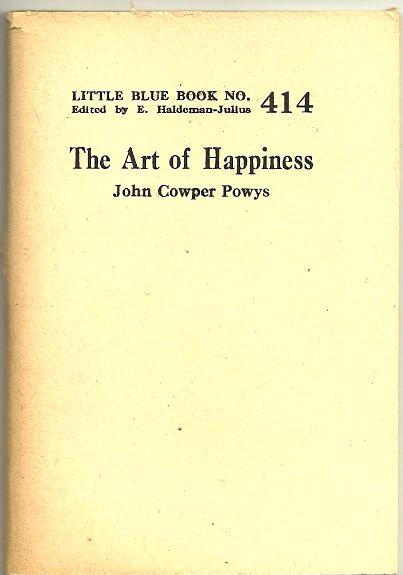
As the title Suspended Judgments indicates, Powys shared Fort’s taste for philosophical skepticism (as opposed to the pseudo-skepticism latterly popularized by The Annoying Randi and his acolytes). The literary essays are delightfully passionate and capricious: at one point he discourses on all of the trees that remind him of Emily Bronte. Probably the most Fortean of the batch is The Art of Happiness, which, curiously, seems to be a different text than the one he published later. Here, for example, is a splendid sentence near the outset, rejecting both materialism and idealism, both science and religion: “But what I would like to indicate just here, is that a certain tentative, irrational, timid, hesitant scepticism has the power sometimes of calling up, out of deep mysterious places, a vision of the universe that commits us neither to an all-seeing God nor to an all-knowing Science, a vision that is confused and infinitely perplexing, but touched all the same by the beauty that no idealism can reach or materialism destroy, the beauty that belongs to that ambiguous look — unspeakable, unutterable — which crosses sometimes the countenance of Nature itself!”
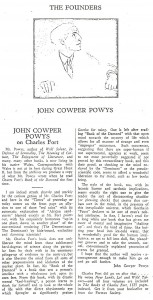
Powys’s charming tribute to Fort doesn’t seem to be available online, so here it is. It’s taken from The Fortean Society Magazine, #6, January 1942. (Please click on it for a nice legible text.)
(Posted by Doug Skinner)
Tags: Ephemera · Forteana
July 11th, 2013 · Comments Off on Fortune Telling Cards (5)
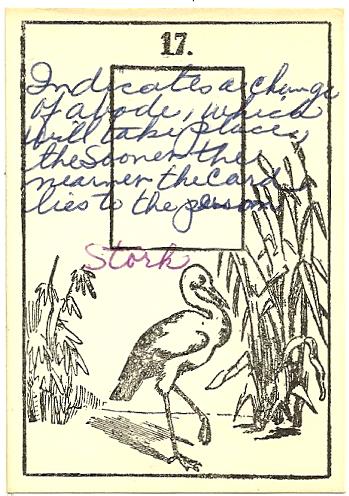
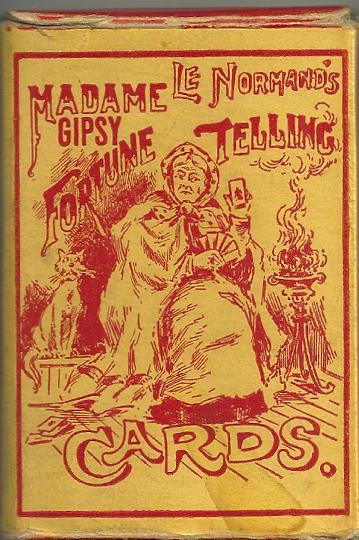
“Madame Le Normand’s Gipsy Fortune Telling Cards” bears no indication of date or publisher. Its previous owner has written the meaning of the cards over the simple black and white illustrations, thereby increasing its graphic charm. There are 36 cards in the deck, from #1: Cavalier to #36: Cross; tattered instructions in English and German were thoughtfully provided as well. Marie Anne Lenormand (1772-1843) created somewhat of a vogue for cartomancy in France; a number of decks were named after her. Here’s the box.
(Posted by Doug Skinner)
Tags: Card Games · Liminal Graphics