November 8th, 2013 · Comments Off on Fortune Tellng Cards (8)

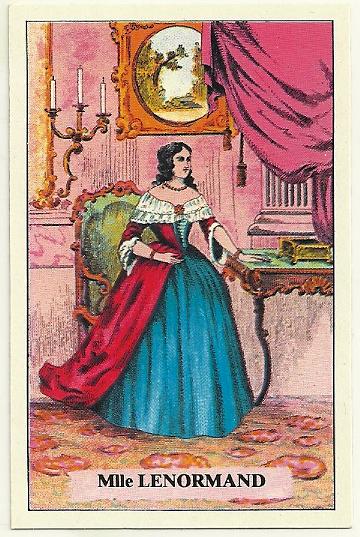
We have another deck attributed to the famous Mademoiselle Lenormand (Marie-Anne-Adelaïde Lemormand, 1772-1843). This one, “Le Petit Lenormand,” was published by B. P. Grimaud in 1976. Yes, there is also a larger version. As the instructions say, “Each card consists of symbolic and prophetic elements,” which may indicate either good or bad aspects, depending on their position in the layout. A special card, representing Lenormand, is always placed in the center to represent the consultant.
(Posted by Doug Skinner)
Tags: Card Games
November 6th, 2013 · Comments Off on Black Scat Review 5

The fifth issue of Black Scat Review is now available! This one contains “Captain Cap Plays a Trick,” an excerpt from my translation of Alphonse Allais’s Captain Cap. It also features work by Mark Axelrod, Shane Roeschlein, Patrizia Valduga, Harold Jaffe, Brett Stout, Andy O’Clancy, Samy Sfoggia, Nile Southern, Robert Hahn, and Michela Martini. And, of course, Nile Southern’s splendid cover. You can find it at Black Scat Books.
(Posted by Doug Skinner)
Tags: Alphonse Allais · Literature
November 1st, 2013 · Comments Off on Happy Halloween
Well, Happy Halloween. If, that is, Halloween is supposed to be happy. It’s a mysterious holiday. At any rate, here’s an old Galician proverb to contemplate: I don’t believe in witches, but they still exist.

(Posted by Doug Skinner)
Tags: Belief Systems
October 28th, 2013 · 2 Comments
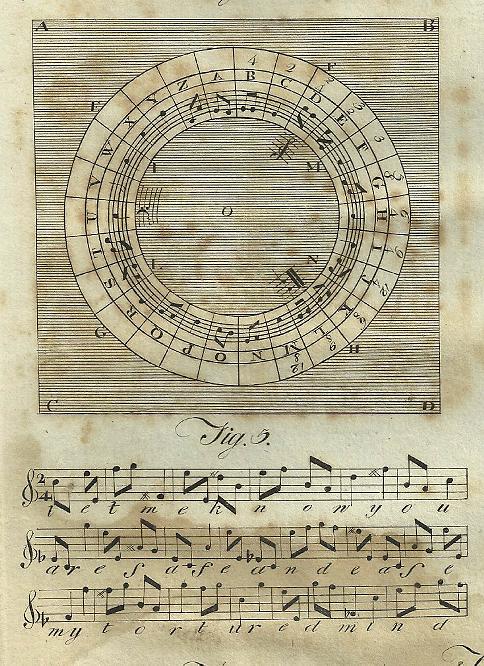
Thanks to this musical cipher, you can encode your secret messages as a rather rangy tune. Word breaks are indicated by accidentals. I found this in a box of prints at a flea market; it apparently came from an old encyclopedia, but I don’t know which.
Of course, you could also just use the wonderful musical language Solrésol. It’s nice to have options.
(Posted by Doug Skinner)
Tags: Music
October 25th, 2013 · 2 Comments

This elaborate pictorial deck was published by the venerable firm Piatnik, from Vienna and Budapest. There’s a lot of drama in this depiction of Falseness, but it doesn’t look like beneficial drama.
(Posted by Doug Skinner)
Tags: Card Games
October 23rd, 2013 · 2 Comments
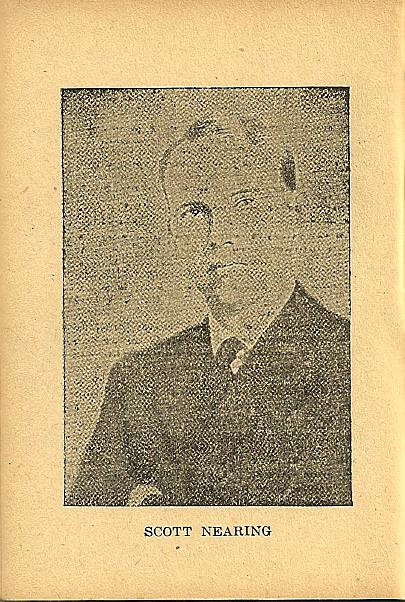
Scott Nearing became an Honorary Founder of the Fortean Society, replacing Alexander Woollcott. Woollcott had left early in 1942, presumably because he liked Fort, but didn’t get along with Thayer. Thayer’s attacks on Roosevelt may have nettled him too, as he was an FDR fan. Nearing was a very different kind of character, a life-long advocate for socialism, pacifism, and vegetarianism. Later, he became a spokesman for homesteading and a return to the land, eventually living to 100.
Nearing contributed to three Little Blue Books, each a transcript of a debate.

Little Blue Book #141, “Would the Practice of Christ’s Teachings Make for Social Progress?”, pitted Nearing against Percy Ward, a socialist activist in Chicago. As one might predict, Nearing cherry-picks the more attractive parts of the Gospels, particularly the repudiation of wealth; and Ward selects the unpleasant bits, like the hatred of family and the importance of faith. Both are eloquent, but Ward’s “Progress depends not upon dead gods, but upon living men” got my vote.
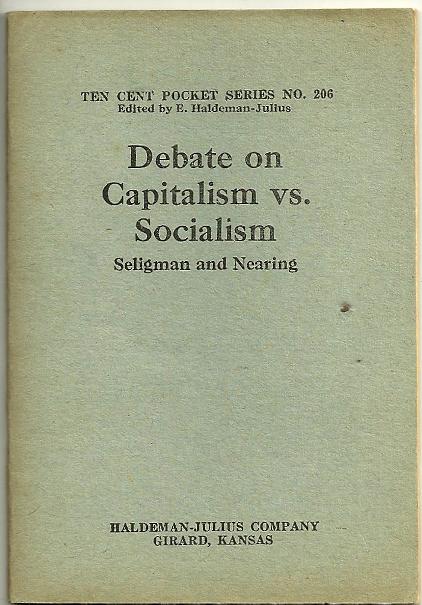
The second debate, Little Blue Book #206, comes with a bit more background. It was held at the Lexington Theater, in New York City, on January 23, 1921. The subject was “Resolved, that Capitalism has more to offer to the workers of the United States than has Socialism,” with E. R. A. Seligman taking the affirmative, and Nearing the negative. Seligman was at the time head of the Department of Economics at Columbia University, and Nearing on the faculty of the Rand School of Social Sciences. To simplify somewhat, Seligman argues that socialism in Russia was not particularly successful; interestingly, he also argues for a sort of progressive capitalism modified by insurance for the poor and taxation of the rich. Nearing pleads for self-government in economic life, to combat the growing plutocracy. They don’t really differ that much, at least according to today’s more polarized politics.

Little Blue Book 723, “Soviet Form of Government: Its Application to Western Civilization,” sets Nearing against Bertrand Russell. It also bears the subtitle “A Debate on the Subject by Scott Nearing, Affirmative, and Bertrand Russell, Negative, with an Introduction of the Subject and Speakers by Samuel Untermeyer.” It’s worth reading in full; but Russell’s main argument is that the Soviet system was developed for a more primitive and rural society, and wouldn’t suit a more developed nation. He remains socialist, but prefers a transition to a system better fit for more industrialized economies, rather than revolution. Nearing retorts, “When the crisis does come, what will be the form of the transition society, if it isn’t the Soviet form?”
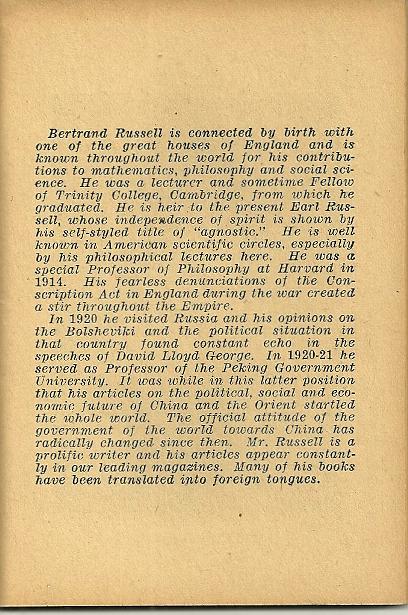
Incidentally, the booklet also contains photos and bios of Russell and Nearing. Here they both are, as of 1925. I apologize for the poor photos; Haldeman-Julius was known for shoddy printing.


(Posted by Doug Skinner)
Tags: Forteana
October 20th, 2013 · 1 Comment
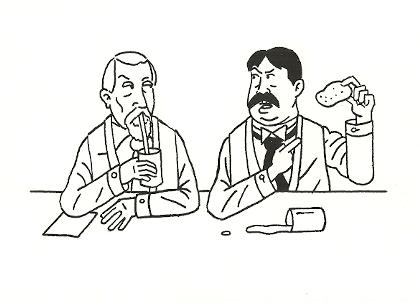
Alphonse Allais was born on October 20, 1854. We celebrate his birthday here by posting my drawings of him with his curious colleague, Captain Cap, from Captain Cap: His Adventures, His Ideas, His Drinks, available in my illustrated translation from Black Scat Books.

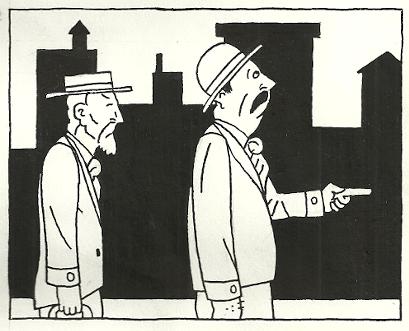
And one picture from the fourth chapbook, which didn’t make it into the collected edition. Happy birthday, Alphonse Allais!

(Posted by Doug Skinner)
Tags: Alphonse Allais · Books · Literature
October 11th, 2013 · 2 Comments
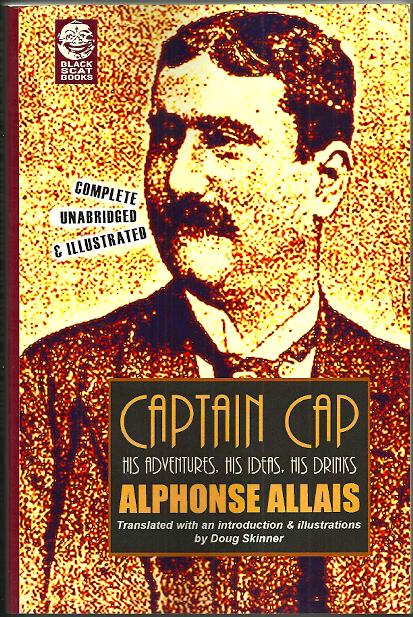
The trade edition of Captain Cap is now available! Alphonse Allais’s hard-drinking, proto-pataphysical antihero, based on his friend Albert Caperon, bullies bartenders, swindles prostitutes, travels the world, and offers such useful inventions as the smell-buoy, the kangacycle, volatile ink, the bacteria motor, and much more. This edition collects the four installments previously published by Black Scat Books, plus eight Captain Cap stories Allais published elsewhere. It’s 370 pages; it was translated by Doug Skinner, who also provided an introduction, notes, and over 50 illustrations. There’s a Cappendix of historical photos and recipes for the Captain’s favorite cocktails. And, for the first time, Caperon himself graces the cover, in Norman Conquest’s elegant design.
You can order a copy through Black Scat Books, or directly from Amazon. Bon voyage, Cap!
(Posted by Doug Skinner)
Tags: 'pataphysics · Alphonse Allais · Literature
October 1st, 2013 · Comments Off on Shaverology

Richard Toronto worked for years on a biography of Richard Shaver, the curious writer whose stories about caverns, ancient machines, and the notorious dero had such an impact on early ufology and on science fiction. The result, War Over Lemuria, has now been published by McFarland, and is racking up good reviews. So much material had to be cut, however, that he followed up with a companion volume, Shaverology. Richard, knowing that I’ve long been interested in Shaver, kindly sent me a copy.
Shaverology is not a biography, but a collection of Shaver goodies; it presupposes a familiarity with the first book, or at least with Shaver’s life. There’s much in here not only about the “Shaver Mystery,” as his stories about the caves came to be known, but on his fan club, his failed publishing company, and his obsession with picture rocks; as well as photos, letters, reprints of rare pamphlets, poetry, artwork, clippings, and much more. Ray Palmer, Shaver’s editor, friend, and sometime nemesis, is also in evidence, with chapters on his editorial hoaxes (he liked to invent contributors, complete with fake bios and photos), his predictions, his numerous magazines — even how he came to have a DC superhero named after him. I was particularly happy to see material by Shaver’s wife Dorothy, by his old friends Richard Horton and W. G. Bliss, and by his daughter Evelyn Bryant.
Both the science fiction and the UFO community have long been dismissive of Shaver; he has, unexpectedly, been more popular in the art world, with exhibits of his paintings and rock photos. As I’ve pointed out before, you need not accept his claims to find him an endearing original, imaginative and soulful.
I’ve occasionally posted about Shaver on this site; here, for example, is one of his paintings. For more on War Over Lemuria and Shaverology, please visit Richard’s website.
(Posted by Doug Skinner)
Tags: Books
September 23rd, 2013 · Comments Off on Captain Cap, Volume 4
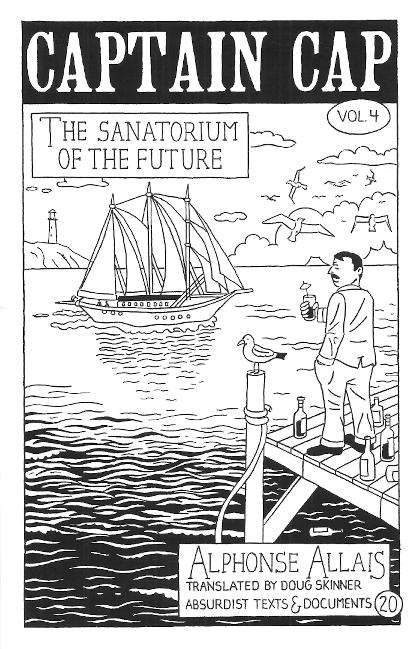
The fourth and final volume of Captain Cap is now available from Black Scat Books. In these sixteen stories, Alphonse Allais’s hard-drinking polymath proposes crocodile bridges, volatile ink, the kangacycle, smell-buoys, and much more. Captain Cap, first published in 1902, and continually popular in France, has previously been translated into Czech, Spanish, Italian, and Portuguese, but never before into English. Now, with this last volume, every last drop is available to anglophones.
This edition is translated, illustrated, introduced and annotated by Doug Skinner. It has been published by Black Scat in an edition of 125 copies. Set sail with the Captain!
(Posted by Doug Skinner)
Tags: Alphonse Allais · Literature
