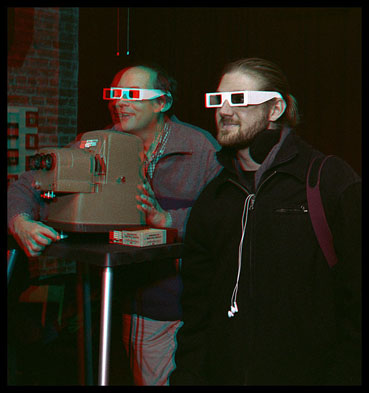
Here is a link to our new flickr page with 3D photos from our first event, “Five Sides of a Machine.” The photos can be viewed with standard red and cyan 3D glasses.
Stereoscopic photography by Mick Andreano.
(Posted by Anthony Matt)

Here is a link to our new flickr page with 3D photos from our first event, “Five Sides of a Machine.” The photos can be viewed with standard red and cyan 3D glasses.
Stereoscopic photography by Mick Andreano.
(Posted by Anthony Matt)
Comments Off on Ullage Group Flickr PageTags: Clubs and Associations · Dead Media · Stereoscopy
I have little interest in astrology. I doubt that my character is determined by the fact that some groups of stars look like animals, sort of; on the other hand, I feel no itch to denounce it as a pseudo-science, as the pseudo-skeptics do. As an old-school skeptic, I accept that my human faculties are inadequate for establishing criteria for knowledge, and so reserve judgment. I view astrology as an art based on astronomy, just as music is an art based on acoustics. I’m more interested in music than astrology, but so what? I’m still happy to lift a pint of plain with an astrologer.
True practitioners, however, would agree that the sun-sign columns in the daily papers are nothing but fungible boilerplate, with as little connection to real horoscopes as, well, CSICOP to Sextus Empiricus.
So, rather than stoop to the stale comforts of either belief or ridicule, I offer a game you can play with the daily column. All you do is remove the middle portion of the horoscope, thereby linking the first few words with the last, and revealing a new message. Here are a few examples; which I offer not as literature, but as simply a way to enjoy what is otherwise a rather dull page of print.
The time has come to draw a line under the past. No matter how important certain developments may have been they are of no importance at all when compared to what is about to occur in your life. Always look forward. Always be positive. Always believe that you are capable of doing more.
The moon’s eclipse of Mercury in your fellow Air sign of Aquarius today will make it easy for you to put your thoughts, and your feelings, into words, which in turn will help you to get others’ approval for a creative plan they might not totally believe in. Your way with words will win them round.
You start out alone, but it doesn’t last long. Your sign is always one conversation away from being in a group with common interests and feelings of solidarity. When you’re ready, reach out and start talking.
If you’ve got something to say, don’t hold back. Voice your opinion. However, keep in mind that just because you hand out free advice to someone, it doesn’t mean he is going to take it. You might wonder why people ask for help if they don’t act upon it. But it’s like the old saying: You can lead a horse to water, but you can’t make it drink!
You will be struck by an incredible idea today — in fact maybe several incredible ideas. Carry a pen and notebook with you at all times, because if you don’t write down your thoughts the moment you have them other, less important, matters will crowd them out of your mind and they may be gone forever.
(Posted by Doug Skinner)
→ 4 CommentsTags: Belief Systems · Diversions
The circle is a rich and potent symbol: of knowledge (Charles Fort’s “One measures a circle, beginning anywhere”), of divinity (the proverbial “God is a circle whose center is everywhere, and whose circumference is nowhere”), and of futility (those “vicious circles”), to name a few. I know of only one passage, however, that literally dissects the circle, and lays bare its anatomy.
It comes from an 1844 treatise on the squaring of the circle, by Jean-Pierre-Aimé Lucas, one of the “literary madmen” unearthed by Raymond Queneau. (Queneau compiled an anthology of outsider literature in the 1930s, realized it was unpublishable, and salvaged some of it in his novel Les Enfants du Limon — Children of Clay — which is about, among other things, a writer compiling an unpublishable anthology of outsider literature.)
Here, then is Lucas; the translation is mine:
“Then, I repeat, I had to imitate a surgeon, and look into the interior of the circle for its organizing principles, which I was fortunate enough to discover. Its skeletal framework can be found in the presence of four perfectly equal squares; the marrow, the most delicate part of the bone, is represented by the sections of the quadrature; the nervous and muscular parts are indicated by the tissue of the square of the quadrature; the flesh is represented by the area of the circle; the center of this curve joins its heart to its head; finally, the right angles that determine the angular sections of the quadrature are the arteries, which vivify the flesh and, consequently, refine the skin: which, as I have already noted, is represented by the perimeter.”
(Posted by Doug Skinner)
→ 1 CommentTags: Literature · Symbols
With this event, the Ullage Group begins its long and shameful career. We’ve been meeting in private; now we stand before you, unrepentant and unprepared.
First, what is ullage?
Ullage has two primary meanings: the space at the top of a bottle, and the sediment left after the bottle is emptied. But dictionaries differ, since they were written by humans who were just bluffing anyway; so there are other meanings: lack, deficiency, the fumes in an engine. It is, then, the other part, the lost bit: we take it as an emblem of all that is contrarian, forgotten, paradoxical, or stigmatized.
This doesn’t mean that we will haul out a lot of crap just because nobody wants it. All things contrary are not created equal. It’s not the same to oppose, say, crony capitalism as to oppose fuzzy kittens, since those two subjects themselves differ, in many respects. We can pick what we want, and air the ullage that we judge most useful, or amusing, or embarrassing.
We will point out, however, that we live in the USA; which means that the opportunities for ullage are so numerous and luminous that they make your head spin. It often seems — and I don’t think it’s just me — that our culture is now devoted mostly to greed, religion, guns, sex, celebrities, and xenophobia. This leaves out many things, including all arts and sciences, history, philosophy, and the rest of the world. We will have elbow room, out here in the ullage.
And we will also point out that the contrarian can be useful, if for no other reason than sparking fresh ideas. There is, for example, a lovely story about Jean-Jacques Rousseau.
One day, Rousseau was ambling down the cowpath, when he met his old friend Diderot. Diderot asked what he was working on; and Rousseau said he was writing an essay for a contest, on the subject of whether civilization had been good for mankind.
“And what will you say?” asked Diderot.
“Why, that it is,” Rousseau replied.
“Oh, everybody will say that,” said Diderot. “Argue the opposite.”
And so he did, resulting in the French Revolution, the Romantic Movement, and other developments.
Whether our activities will be fruitful or not remains to be seen. We can start, though, with the ceremonial uncorking of the ullage. We’ve chosen a bottle of Trebbiano d’Abruzzo, since it was the favorite wine of Marsilio Ficino, court scholar to the Medici, and the nice man who translated Plato and kicked off the Renaissance. Please note: once the cork is removed, the ullage is much larger.
[Here, I discovered the cork was rotten; it crumbled in extraction. The audience was quite amused, but the joke was on them, since they didn’t get any. A week later, I corked another bottle. Somebody should take this up with the Trebbiano people.]
(Posted by Doug Skinner)
→ 2 CommentsTags: Clubs and Associations · Uncategorized
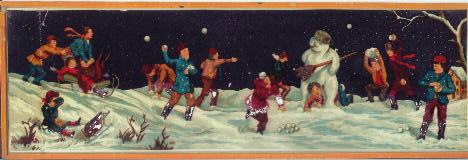
Our first event took place on the season’s first snowfall, surely an omen of some kind. A few dozen truth-seekers braved the crystals to see what we were up to. After finding niches for our brood of projectors, Doug stepped into the lights to deliver an informal keynote speechlet (given above).
Anthony followed with a few remarks on the Fortean background of our activities.
Doug returned with a presentation along these lines:
I began by explaining that we organized a survey of “dead media” because of the strong feelings technology stirs nowadays. I’ve been surprised to learn how many people I know either categorically reject all pre-digital gizmos, or ardently collect obsolete ones.
The Ullage Group is not Luddite; we enjoy both the old and the new. We do point out that all machines were made in the past: whether that was five minutes or five centuries ago is a piddling detail. At this spot on the great ring of endless light that is eternity, all past machines are also part of the present.
I revved up a Standard filmstrip projector (once in use in the schools of Kingston, NY) to show a brief filmstrip, explaining the mechanism of the magic lantern; then that formidable device, the Beseler Slide King, for some old lantern slides, mostly patriotic or masonic.
The audience was invited to admire an array of smaller devices: the Projectol, the Astrascope, and a vintage Viewmaster Theater.
I then proposed that any machine, old or new, has pros and cons in addition to its so-called “currency”; and suggested five criteria for assessing it:
1. Function: how well does it do its task?
2. Social: how stigmatized or fashionable is it?
3. Aesthetic: how beautiful is it, how well designed?
4. Economic: how expensive is it; how profitable?
5. Environmental: how harmful is it?
Lisa Hirschfield followed with a demonstration of the Radiopticon, an early opaque projector, and discussed its good and bad points.
Anthony was joined by Greg Dinkins for a program of projected stereoscopic slides, mostly taken with the Stereo Realist camera; Mick Andreano set up another system, which projects stereo picures from the rear onto a small screen, giving the illusion of peering into a diorama.
The audience lingered awhile, sipping (non-Trebbiano) wine and puzzling over the gadgets, then trudged off into the slush. There were no blown bulbs, short circuits, or other failures; the Radiopticon’s rickety stand and taped wiring did provide some welcome suspense.
More ullage will follow!
(The above image is a vintage lantern slide; it illustrates the word “snowfall” as only a lantern slide can.)
(Posted by Doug Skinner)
Comments Off on The Five Sides of a MachineTags: Dead Media · Forteana
Yes, there was a delay in getting this site up. We apologize. We resume.
(Posted by Doug Skinner)
Comments Off on The DelayTags: Bulletins · Uncategorized
What is ullage?
It has several meanings: deficiency, lack, the air at the top of a bottle, the sediment after the bottle is emptied, the fumes in an engine. The Ullage Group takes it as an emblem of the other part: the contrarian, paradoxical, lost, unpopular, and forgotten.
Our founders, Anthony Matt and Doug Skinner, have been uncorking many bottles in their search for greater ullage. There are many surprises ahead. Our first public event will take place on a Sunday afternoon, Dec. 2 at 3:00, at Jalopy, in the ullagistic neighborhood of Red Hook, in Brooklyn.
The Five Sides of a Machine” will be a celebration of projected pictures: lantern slides, filmstrips, stereo images, and whatever else we can drag in there. The founders will give keynote speeches, and uncork the ceremonial ullage. Skinner will outline the pros and cons of different machines; Matt will present various stereoscopic systems. We’ll probably have some guests; and our non-carbon-based pals will include the Astroscope, the Radiopticon, the Balopticon, and other rickety gizmos that may or may not work. It’s only $5; it will be more fun than popular culture; you’ll be unhappy if you miss it. For directions to Jalopy, see www.jalopy.biz.
→ 3 CommentsTags: Clubs and Associations · Dead Media · Technology