September 4th, 2008 · 4 Comments
We have another unexpected encounter, another fleeting kiss of incongruities. All is chaos and continuity, at least sometimes.
RICHARD SHAVER AND ALBERT EINSTEIN
Richard Shaver — the visionary pulp fictioneer and painter — and Albert Einstein — the mathematical mystic and physics pioneer — were very different men. They moved in different circles. But they were both soulful and sympathetic geezers; and I’m touched, somehow, that they corresponded. The exchange was brief, and puzzling for both, but that was probably inevitable. Shaver sent Einstein his theories on aging, and Einstein told him they were wrong. And life swirled on.
And here’s what they wrote. The letters are undated, but probably from 1944.
Dear Sirs:
I think I have discovered the cause of age. Please hear me out by reading this letter carefully.
If you admit that age has a cause — then you must admit that this cause is removed by the process of birth.
If the cause were a radioactive poison — as the symptoms of radium poisoning indicate (they are same as age, under certain conditions), then you must admit that the phenomena of birth is the phenomena of removal of this poison by filters through which the food supply of the young passes. The mother’s body remains old because the poison is retained in its fabric, in contact with the young replacement cells — aging them quickly. Since this aging takes place in every living thing, we must admit that the cause is omnipresent, is everywhere. Only the sun gets around the Earth that much. So the cause must be the sun. Since radium poisoning produces the same symptoms as age in even a young person — premature age — then we must look to the sun as a source of the radioactives which cause age.
It would be remarkable if the sun did not project such poisons as radium down upon us in a finely divided state. Well, it does. Consequently, we age. We all die in time from the cumulative radioactives from the sun finding their way into our bodies.
Now to prove that birth itself is but the protecting of the young life seed from this poison by filters in the mother’s body (long enough for the new life to get a good start), we need only place some mice under conditions which would exclude this poison did it exist — and observe how long they live. If they live longer than the natural life span of caged mice — we have done something to defeat age.
All right, I have done so. My protected mice live long, much longer, two, three, and when very special care is taken, four times longer than ordinary mice. My results are staggeringly indicative that this attack upon age is the correct one.
The experiments performed by Alexis Carrel and by some hydroponics experts, raising living cells in a protected condition, feeding them only artificially prepared food and triple distilled water to keep out all alien material, show — if so interpreted, that life so protected by filtration and distillation, does not die or even cease growing, but keeps on growing at an alarming rate.
That Alexis Carrel and others did not attribute their success in defeating age in these living bits of matter to the exclusion of some poison is only because this is a new and unusual view of the cause of age. They just didn’t happen to think of it. Their puzzlement over the cause of the immortality of their chicken heart muscle and tomato roots in nutrient solutions is apparent in their reports. When the theory of radioactives as the cause of age is applied to their experimental results, the mystery disappears.
Hoping to arouse some interest in this explanation of age and this remedy for age,
I remain, your friend
Richard Shaver
Dear Sir:
Your idea cannot be right because it does not make understandable why the sperma-cells which multiply independently from the rest of the organism through the generations do not undergo the process. The simplest case for which your theory is obviously insufficient is the unicellular organism which propogates through simple splitting of the cell. I remember also the experiments with embryonic cells of the heart which are not degenerating in a number of years much greater than the life span of the corresponding animal.
Sincerely yours, signed
Albert Einstein
(Posted by Doug Skinner. The letters are extracted from Ray Palmer’s partwork, The Hidden World.)
Tags: Belief Systems · The Ineffable
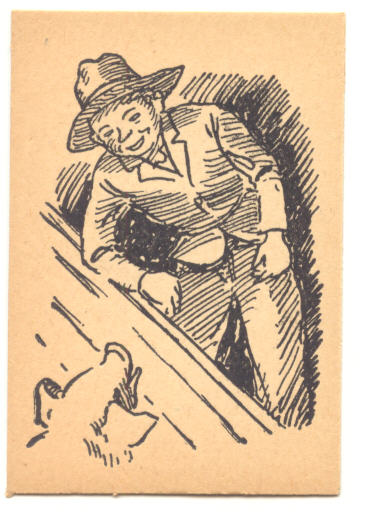
“Gris” (Piglet) is a modest little offering from Denmark. There’s no date or publisher; this must have been a low-ticket toy. The Danish kid got 16 black and white cards, each with a lovely pen and ink sketch. I’m afraid I can’t tell you how it was played.
(Posted by Doug Skinner)
Tags: Card Games · Ephemera
August 23rd, 2008 · Comments Off on Back to School (3)
Spelling Book Poetry
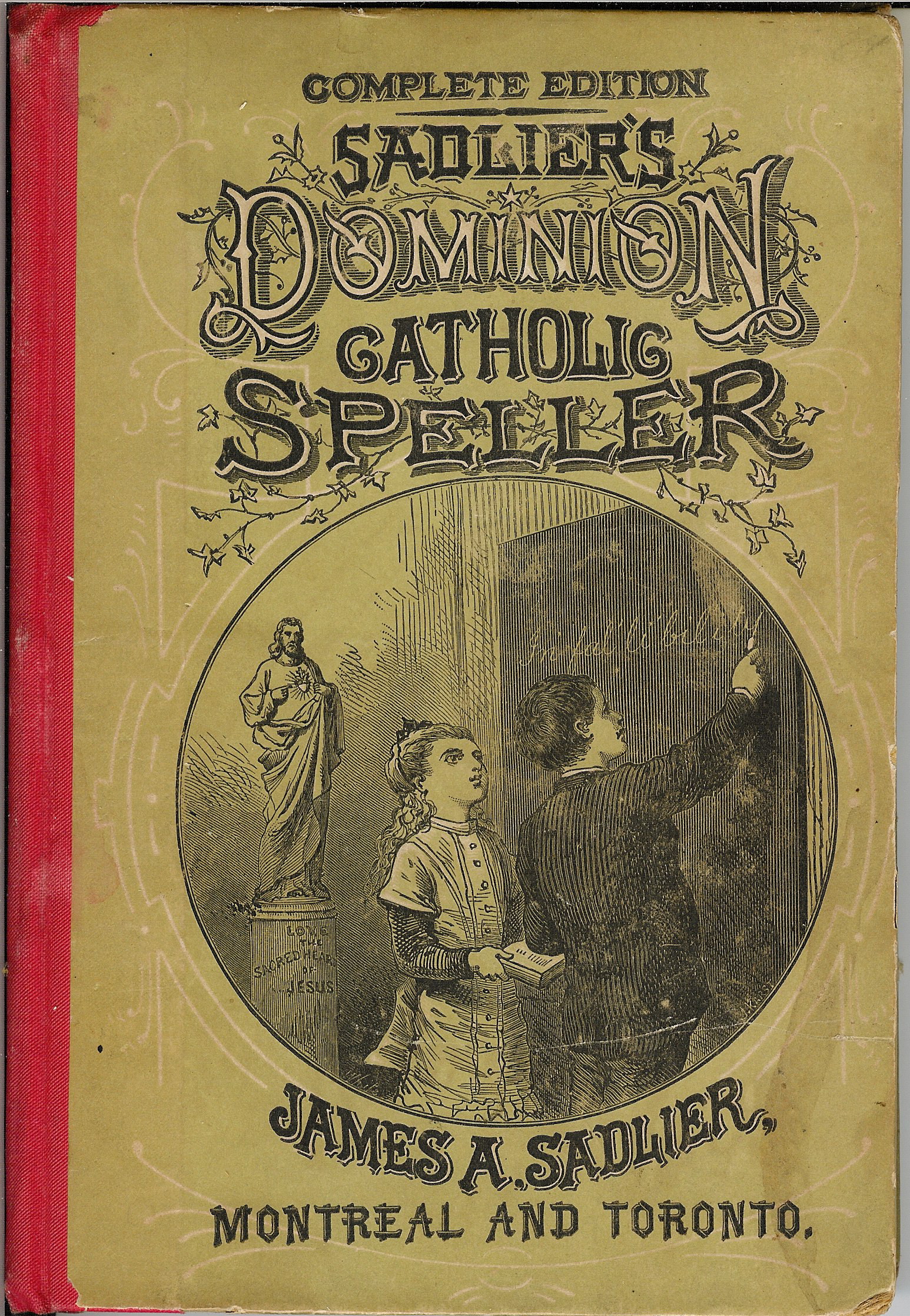
The Sadlier’s Dominion Catholic Speller (by a Catholic teacher, 1883), is much more than a spelling book. It encompasses spelling “oral and written,” including detailed explanations of phonetics, pronunciation, syllabics, grammar and syntax, Latin and Greek etymology, and common abbreviations and titles. I’ve never seen a modern speller this comprehensive – then again, it’s Canadian. I heard once that Canadians have always been notoriously good spellers.
The beautiful cover engraving depicts a young boy demonstrating his newly-acquired understanding of orthography to a young girl (his sister? a sweetheart?). Note that he has chosen the word “infallibility.
Words are listed in categories such as “Exchange and Trade” (peddler, dime, wampum, gamble, forgery); “Provisions”(shad, nutmeg, hogshead, bullets, marmalade); “Vegetable Kingdom” (anther, twining, delicious, rootlet, mangrove); and “Words Relating to War” – quite a lot of these (ramrod, bulwark, chevron, pension, watchword).
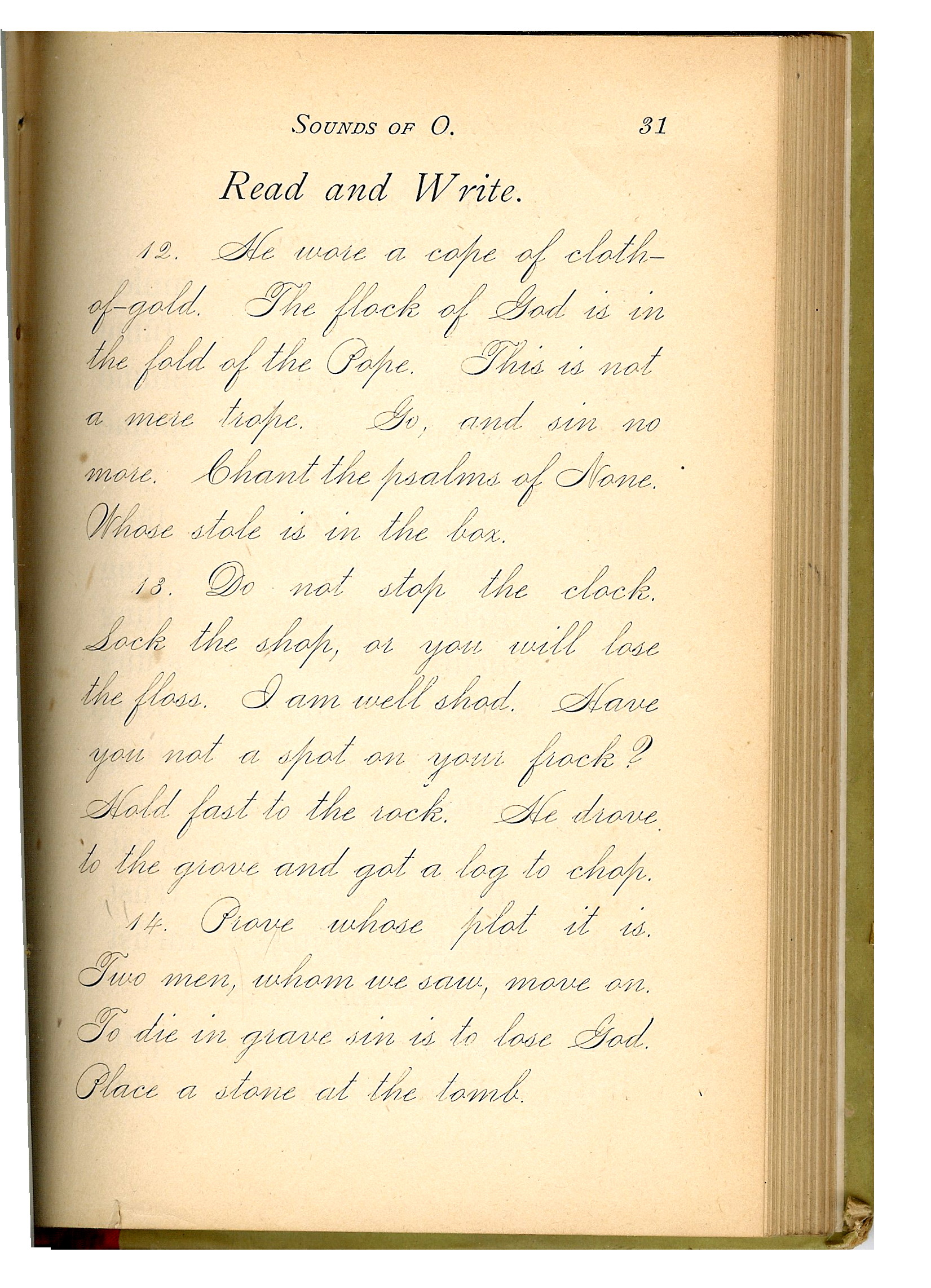
Both the “Dictation Review” and “Read and Write” sections drill students in various vowel sounds by using as many words as possible with a particular vowel in each sentence. The result is oddly poetic, if somewhat nonsensical at times.
12. He wore a cape of cloth-of-gold. The flock of God is in the fold of the Pope. This is not a mere trope. Go, and sin no more. Chant the psalms of None. Whose stole is in the box.
13. Do not stop the clock. Sock the shop, or you will lose the floss. I am well shod. Have you not a spot on your frock? Hold fast to the rock. He drove to the grove and got a log to chop.
14. Prove whose plot it is. Two men, whom we saw, move on. To die in grave sin is to lose God. Place a stone at the tomb.
(Posted by Lisa Hirschfield)
Tags: Belief Systems · Education · Ephemera
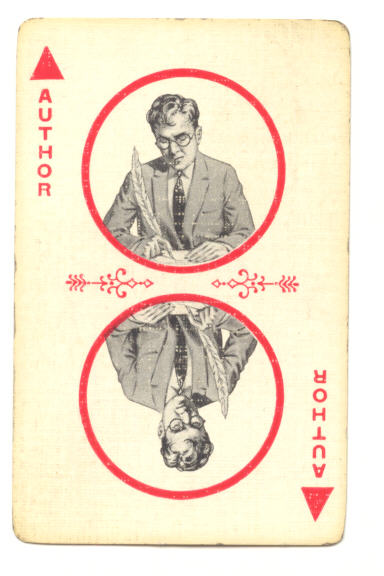
From 1928 comes “Kam-ra! A Motion Picture Card Game.” It’s credited to Josephine O. Miranda, and published by the Kam-ra Card Company in Hollywood. The other face cards are: Star, Hero, Producer, and Director. I’m not sure why our author is batting out that screenplay with a quill pen, but good luck to him.
(Posted by Doug Skinner)
Tags: Card Games · Ephemera
August 21st, 2008 · Comments Off on R.I.P., Bigfoot Body
Like many, I was disappointed by the quick fizzle of the Bigfoot Body hoax in Georgia. I suppose I should wax explicit, and carefully explain that no, it’s not because I think Bigfoot is a real flesh-and-blood beastie, or because I was expecting, or even wanting, evidence. The stories are real enough; and have their roots deep, deep in many cultures. For whatever reason, homo sapiens tells tales of big hairy bipeds: Amerind sasquatches, Aussie yowies, Chinese yeren, Tibetan yetis. That’s what hooks me.
The hoax is a delicate art; and, in the right hands, a thing of beauty. Some hoaxes are just jokes — like Hugh Troy’s student stunt of stamping rhino prints around the Cornell campus. Others are satirical, like the many mock “avant garde” poems and paintings by conservative artists. But perhaps the richest genre is ostension.
Ostension — the manifestation of a myth — is part of the folk tradition: telling a story by action, rather than words. The best of them — crop circles, photos of UFOs and lake creatures — are beautiful in themselves, and stir the magical thinking that feeds the myth to begin with. The “thought photos” of Ted Serios are so lush and oneiric that you wish they were genuine. The crop circles were so well designed and executed that many people insisted they couldn’t have been done by humans — even after multiple confessions.
The myth of Bigfoot (and his multi-culti counterparts) is that of primordial man: the wild man, the mountain man, the apeman. It’s a romantic story. The Patterson-Gimlin film pushed the right buttons: a few seconds of a free and elusive being; you wanted more. So did the footprints in the snow of Mt. Everest. So did an earlier Bigfoot Body, the Minnesota Iceman: frozen in a cake of ice, like a Siberian mammoth, glimpsed now and then in traveling carnivals.
But a gorilla suit, stuffed with offal and crammed into a jumbo cooler? It was ugly; it was no fun to look at. You didn’t want it to be true, and that’s fatal to a hoax.
So — I was disappointed. It’s been a rough month; I was looking forward to a nice artful hoax. Maybe next time.
(Posted by Doug Skinner)
Tags: Animals · Belief Systems · Forteana · Hoaxes

This stylish edition of the old game “Slap Jack” was published by Russell in 1935. It was “A Big-Little Card Game,” and measured 1 5/8″ x 2 2/3″. That must have called for precision slapwork.
(Posted by Doug Skinner)
Tags: Card Games · Ephemera
August 10th, 2008 · Comments Off on Back to School (2)
Facts Can Be Fun!
Interactive gadgets and gizmos to aid learning have been popular for decades, perhaps longer. Often used for the basics – ABCs, vocabulary, numbers, math, music, spelling, verb conjugation, and foreign languages, for example – they have been packaged as calculators and electronic devices, paper wheel charts, games, puzzles, wooden blocks, and computer software. For the most part, however, fact acquisition was until recently the province of simple mnemonics: multiplication tables, flashcards, and acronyms like ROY G. BIV (the seven colors of the rainbow); KPCOFGS (the Linnaean system of classification), and Oh Be A Fine Girl, Kiss Me (classification of stars).
Here is a neat little gizmo with which one could learn some basic facts about George Washington, “Father of his Country,” while also puzzling out how it worked: ultimately a dual lesson in history and simple physics. Can you guess how?
(click to enlarge the image)

To use this as a learning device, one must:
1) Open the card and read the informative fact-filled text on the inside left panel, keeping in mind the goal, which is to learn something about George Washington.
2) Test what you’ve learned. Turn and point the blue arrow on the right panel to a question of your choice. (In this case, “What was George Washington’s first job?”)
3) Try to answer the question on your own.
4) Check your answer by closing the card. The pointer will indicate the correct answer. Amazing!

Most facts of this kind – unless they are directly related to a conscious learning process – have now become reclassified as trivia. Maybe this is just as well; when will the fact that Washington became a surveyor when he was 16 ever come in handy? Then again, who can say where and when a fact that became lodged in the brain will spur the imagination?
Now that you know one more thing about George Washington, have you figured out the secret mechanism of the card?
n.b. This was a birthday gift from Doug Skinner, who knows how much I like low-tech educational gizmos.
(Posted by Lisa Hirschfield)
Tags: Belief Systems · Dead Media · Education · Ephemera · Technology

It’s Friday; another children’s card game comes from the box for your aesthetic pleasure. “Crazy Faces,” a variation of that old favorite, “Crazy Eights,” was published by the E. E. Fairchild Corporation. It apparently came in two editions: one with the kid-TV host Captain Kangaroo on the cover, and one without. All of the faces do, indeed, look crazy.
(Posted by Doug Skinner)
Tags: Card Games · Ephemera

Let me add that the stories meant to amuse children often teach different lessons than the textbooks and tracts. This toy magic lantern slide, for example, has an unusual moral: no dinner until you destroy the furniture. Your teachers do not want you to emulate the pig; but every child will admire its inventiveness, envy its contentment, and prefer it as a role model to the dittoheads in the primers.
I don’t even think those apples belonged to the pig. They do now.
(Posted by Doug Skinner)
Tags: Animals · Belief Systems
August 2nd, 2008 · Comments Off on Back to School (1)
As a prelude to the Ullage Group’s next event, “Through the Blackboard,” and because we are entering the Back to School season, I’m presenting some education-themed ullage for your consideration. For me, the phrase “Back to School” always heralded the few short weeks when a kind of premature nostalgia for a summer gone too soon did battle with a growing excitement and eagerness for the new – new people, new experiences, new knowledge – just around the corner. In the blistering-hot Central Valley of California, the prospect of cooler fall weather (even though it never failed to arrive until the end of October) added to the pleasures of anticipation.
(School days long behind me, I still feel this way; I think it must result from 12 years of institutional conditioning, with an extra seven thrown in for good measure. This of course is the result of a 10-month school year. I’d be interested to know if people who had year-round schooling experience something similar.)
The promise of “new knowledge” can sometimes become a threat, of course. Ask any teacher: these days, curriculum and pedagogy are often rivers you can never step in twice. In the long view, the basics of what we are taught probably hasn’t changed much in the last couple of centuries, in theory anyway: the difference between right and wrong, the 3R’s, and Good Citizenship. But the specifics of what we learn, where we learn it, and how we learn it are always up for review. In public schools, after what turned out to be merely a hiatus, Creationism has returned to the stage as Intelligent Design; New Math and Phonics continue to vie with Back to Basics; and Multiculturalism and Language Immersion remain topics of controversy, to say nothing of Sex Education. Experiential Learning and Information Technology would seem to be the new kids on the block but group play has always provided the means to explore the imagination, build confidence, increase physical skills, and learn about cooperation, sharing, and who to steer clear of in the schoolyard. And, there have always been new gadgets and techniques for access to and retention of information: the slate, the primer, the slide-rule, the crib-note, and – let us not forget – the text book. (Most of these, however, didn’t promise eventual access to an unlimited source of porn.)
On that note, here is a prophylactic to more benign temptations in an early form, probably intended for home or Sunday school use. Click on the link below if you’d like to read the text.

the-moral-picture-book


(Posted by Lisa Hirschfield)
Tags: Belief Systems · Dead Media · Literature · Memories



