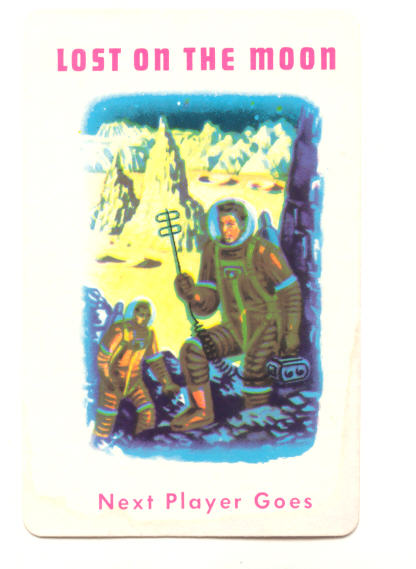
“Space Race” was published by Edu-Cards in 1969. Among its scenes of outer space excitement was this doleful predicament. I do hope they have a compass or something.
(Posted by Doug Skinner)

“Space Race” was published by Edu-Cards in 1969. Among its scenes of outer space excitement was this doleful predicament. I do hope they have a compass or something.
(Posted by Doug Skinner)
→ 1 CommentTags: Card Games · Ephemera
I’m not a pet owner; I shrink instinctively from such responsibility. But, these days, I am tending a friend’s cats while he’s abroad (and perfect angels they are, too). And that has led me to contemplate cat food more than I have before.
Cats and humans are different species, and have different diets. Homo sapiens is a great ape, and, like the other apes, an omnivore. We aren’t picky. Nevertheless, the natural diet of cats tends to entrées not popular with the American consumer: rats, mice, small birds, insects, their own dead offspring, and other cats’ vomit.
Of course, some of these items are standard fare to other cultures. (The subject of cultural food taboos is a rich one; I recommend Harriet Ritvo’s fascinating study of animal classification, The Platypus and the Mermaid.) Americans’ taste in meats is mostly restricted to domestic ungulates, some poultry, and a changing roster of fish, crustaceans, and molluscs. Rodents and insects, to be acceptable, must be blended into sausage filling, or masked by the brown and oily paste of chocolate or peanut butter.
Still, I’m struck by the fact that commercial cat food features little of the natural, locavore feline diet, and specializes in foods cats would not usually eat, like cattle and tuna. I understand that it’s the homo sapiens that do the shopping, and that they wouldn’t buy “Roach ‘n’ Robin Feast,” “Rat Grill,” “Household Pest,” “Puke of the Litter,” or “Stillborn Kitten.” Even tie-ins to popular cartoon characters like Tweety Pie or Mickey Mouse would probably do poorly.
And so a compromise is struck. The American shopper feeds his cat only those foods palatable to both of them. Perhaps this is because he eats much of it himself — which would explain why manufacturers add poultry seasoning to the turkey.
I’m a vegetarian, myself; but see no reason to impose my own preferences on anyone else — even when lectured at by intolerant burger buffs. I certainly wouldn’t dream of forcing my own diet on another species. But then, that’s why I’m up here in the ullage, finding fresh air where I can.
ADDENDUM
Has anyone seriously pursued the “cats and rats” idea? In this model business, cats are butchered and fed to rats; rats are butchered and fed to cats; and the pelts are sold to discriminating furriers: clear profit with little overhead. If this appeals to any of you entrepreneurs in this troubled economy, let me suggest that some rat parts could be set aside to test the market for locavore cat food. I offer the brand name “Scaly Tales.” Poultry seasoning and an attractive label might make it viable.
(Posted by Doug Skinner)
→ 3 CommentsTags: Animals · Dietary Mores · Suggestions
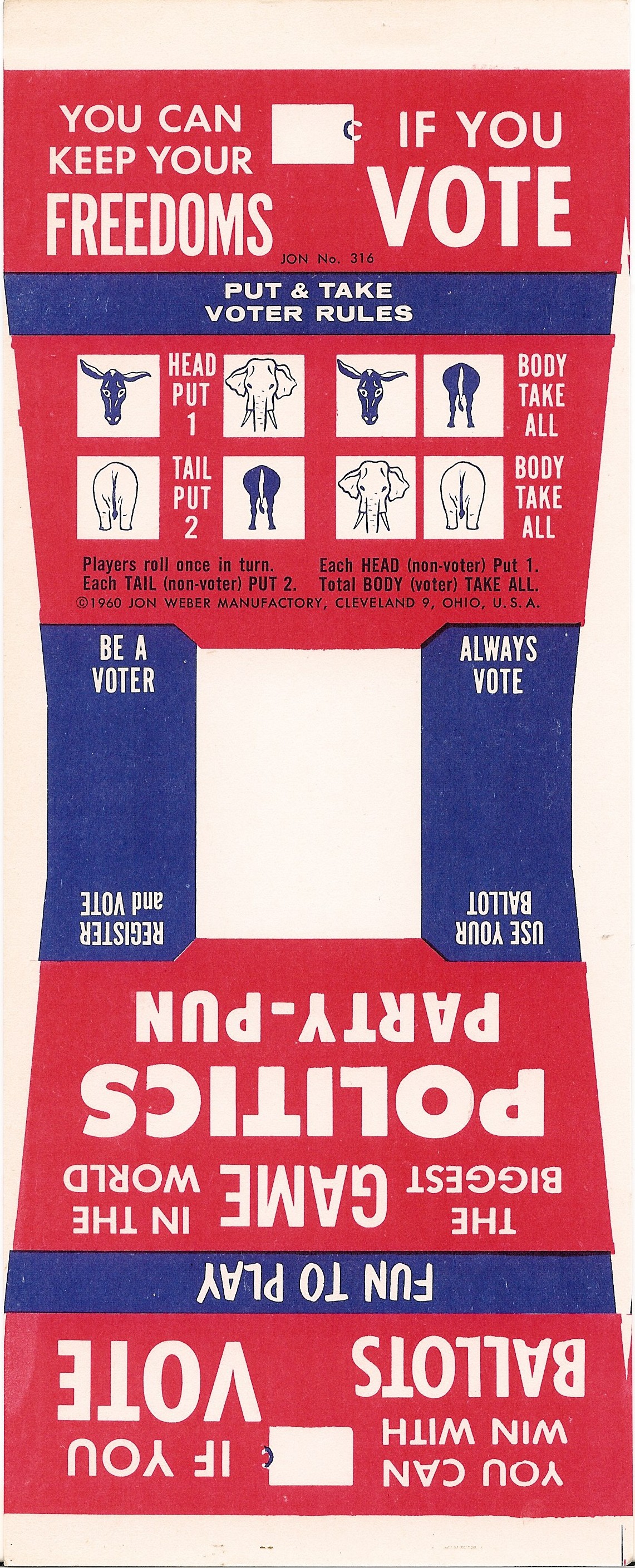
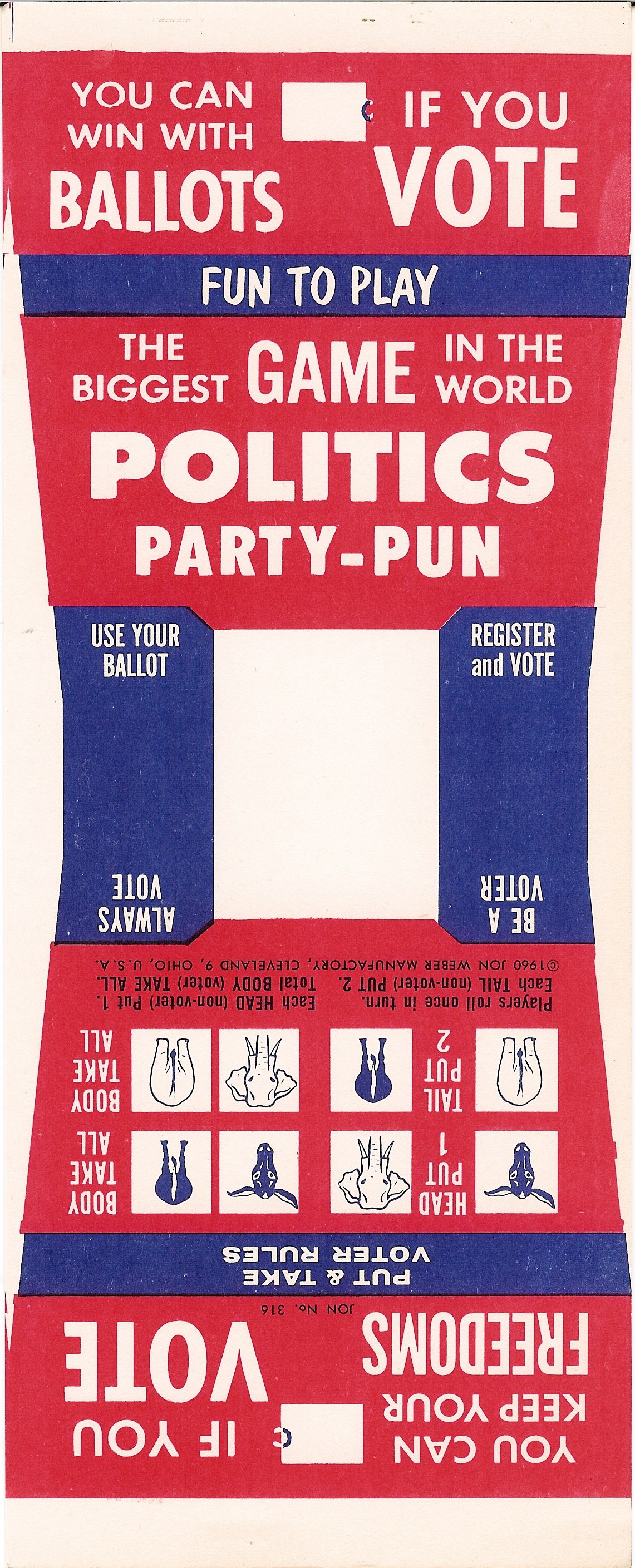
If you’re still undecided as to how to celebrate your God-given American Freedoms – in this case, when voting next Tuesday – you’ve always got Politics Party Pun to choose for you. Yes folks, this is indeed “the biggest GAME in the world.”
Like a cross between, Old Maid, craps, dreidel, and gambling, this game involves matching images, throwing dice, and pure luck – plus it requires every player bring money to the table.
So with all this in mind, why not get in the mood for D-Day with a little game of Politics Party Pun? The object is to match the head and tail of either an elephant or a donkey with each roll of the dice. An entire animal allows you to take the pot. Non-matching dice – say, an elephant head and a donkey tail – make you a “non-voter,” (appropriate penalties apply). It doesn’t specify what two asses’ asses make you, but I shudder to think.

In spite of what we learned in 2000, this game assures us that “You Can Win with Ballots … if You Vote.” Maybe this year.
Personally, I’ve always favored constitutional monarchies.
(posted by Lisa Hirschfield)
Comments Off on The Biggest Game in the WorldTags: Belief Systems · Clubs and Associations · Diversions · Ephemera · Politics · Suggestions
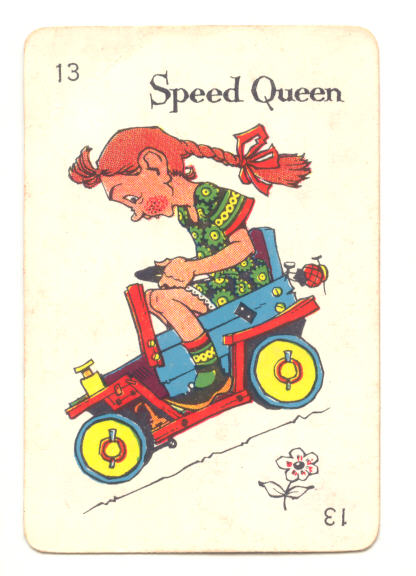
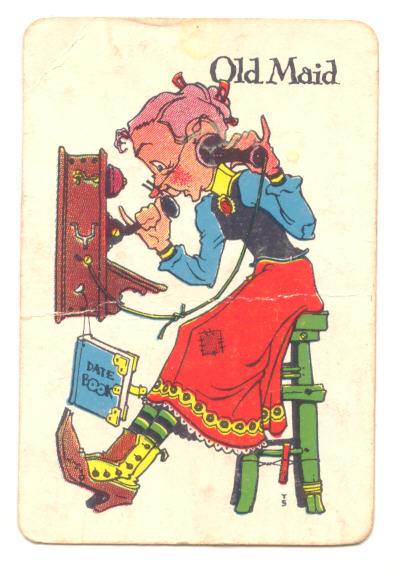
We continue our survey of “Old Maid” with this breezy deck from Somerville. No date is given, as usual; I’d guess the ’40s. The artist seems fond of triangular eyes, large ears, and pointed noses, giving all the citizens here a decidedly elfin cast.
And here’s the Old Maid. From the look of that date book, she’s not a lonely one.
(Posted by Doug Skinner)
→ 1 CommentTags: Card Games · Ephemera
Edgar Wilson “Bill” Nye (1850-1896) was, in his time, a popular humorist, both as journalist and lecturer. He’s not much read now, but I suggest that he’s still worth a look. Here, for example, is a slice from an essay on the future. Edison, by the way, was indeed working on a thought-recording machine.
“In fact, Mr. Edison has now perfected, or announced that he is on the way to the perfection of, a machine which I may be pardoned for calling a storage think-tank. This will enable a man to sit at home, and, with an electric motor and a perfected phonograph, he can think into a tin dipper or funnel, which will, by the aid of electricity and a new style of foil, record and preserve his ideas on a sheet of soft metal, so that when anyone says to him, ‘A penny for your thoughts,’ he can go to his valise and give him a piece of his mind. Thus the man who has such wild and beautiful thoughts in the night and can never hold on to them long enough to turn on the gas and get his writing materials, can set this thing by the head of his bed, and, when the poetic thought comes to him in the stilly night, he can think into a hopper, and the genius of Franklin and Edison together will enable him to fire it back to his friends in the morning while they eat their pancakes and glucose syrup from Vermont, or he can mail the sheet of tinfoil to absent friends, who may put it into their phonographs and utilize it. In this way the world may harness the gray matter of its best men, and it will be no uncommon thing to see a dozen brainy men tied up in a row in the back office of an intellectual syndicate, dropping pregnant thoughts into little electric coffee mills for a couple of hours a day, after which they can put on their coats, draw their pay, and go home.
“All this will reduce the quantity of exercise, both mental and physical. Two men with good brains could do the thinking for 60,000,000 of people and feel perfectly fresh and rested the next day. Take four men, we will say, two to do the day thinking and two more to go on deck at night, and see how much time the rest of the world would have to go fishing. See how politics would become simplified. Conventions, primaries, bargains and sales, campaign bitterness and vituperation — all might be wiped out. A pair of political thinkers could furnish 100,000,000 of people with logical conclusions enough to last them through the campaign and put an unbiased opinion into a man’s house each day, for less than he now pays for gas. Just before election you could go into your private office, throw in a large dose of campaign whisky, light a campaign cigar, fasten your button-hole to the wall by an elastic band, so that there would be a gentle pull on it, and turn the electricity on your mechanical thought supply. It would save time and money, and the result would be the same as it is now. This would only be the beginning, of course, and after a while every qualified voter who did not feel like exerting himself so much, need only give his name and proxy to the salaried thinker employed by the National Think Retort and Supply Works. We talk a great deal about the union of church and state, but that is not so dangerous, after all, as the mixture of politics and independent thought. Will the coming voter be an automatic, legless, hairless mollusk with an abnormal ear constantly glued to the tube of a big tank full of symmetrical ideas fashioned by a national bureau of brains in the employ of the party in power?”
(Posted by Doug Skinner)
→ 1 CommentTags: Belief Systems · Education · Literature · Technology
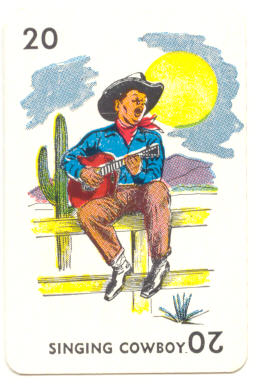
I don’t know why westerns were so popular in the 1950s. But they were; and those curious ephemeral artifacts, children’s card games, reflected the fashion. This example comes from a miniature deck published in 1951 by Russell. It’s called, with artless simplicity, “Wild West Game.”
(Posted by Doug Skinner)
→ 2 CommentsTags: Card Games · Ephemera
The computer is a useful tool. We all use it regularly. The fact that I post here should make it clear to the impartial that I have no beef with these gizmos.
But this is a puritanical culture; and many of our fellow citizens view the non-digital with the same dogmatic intolerance with which the Pilgrims eyed non-Pilgrims. Many is the time some zealous asshat has upbraided me for buying pen and ink, braying “Don’t you have a computer?”; or preached a hellfire sermon at me for my sin of indulging in the pleasures of gramophone, projector, piano, or paintbrush.
Puritans are never much fun; those whose social skills have atrophied from too many hours staring at a screen are even skankier.
But I’ve been noting a cheery trend, away from the iron rule of the Digitaliban. Younger folk, in particular, are realizing that “living online” is an oxymoron. They’re opting out of the social networking sites, after learning that said sites are time-suckers, and make personal info handier to marketers, spammers, and stalkers. Some offices have set up email-less days, and find employees communicate better face to face, and work better without the distraction of checking the inbox. There’s a resurgence, too, of interest in making crafts, playing acoustic music, making things that are real, rather than virtual.
We’ll be watching this trend here. Our first event celebrated “dead media”; there will be others. Meanwhile, I’ll clink to the fun and virtues of the computer, then go out to gaze at the stars.
(Posted by Doug Skinner)
→ 2 CommentsTags: Belief Systems · Dead Media · Eccentrics · Technology
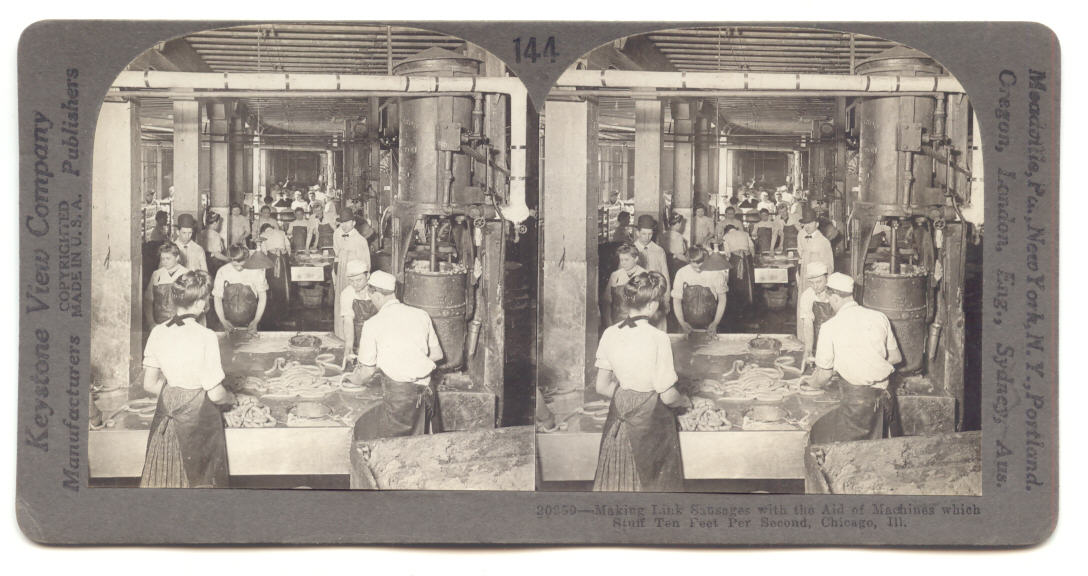
It’s been said that the two things you should never watch being made are laws and sausages. This vintage stereo card shows one of the above.
The observation is usually credited to Bismarck; a check of the www reveals multiple versions of it, and no definite source. Huh. The image can be safely ascribed to the Keystone View Company; it’s one of the educational scenes Anthony selected for “Through the Blackboard.”
(Posted by Doug Skinner)
→ 3 CommentsTags: Animals · Dietary Mores · Mysteries · Stereoscopy · Symbols
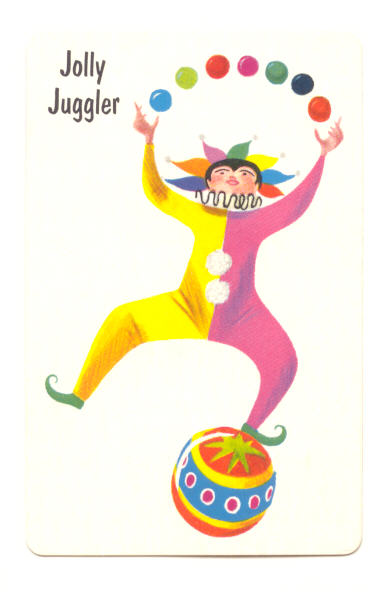
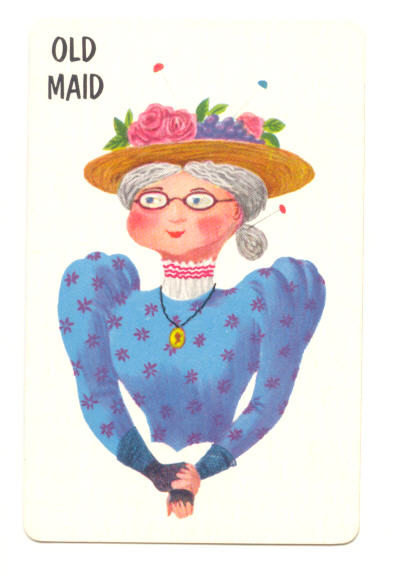
We have another circus-themed edition of “Old Maid,” this time in an undated deck from Whitman. Quite the breezy design, isn’t it? And here’s the Old Maid.
(Posted by Doug Skinner)
→ 4 CommentsTags: Card Games · Ephemera

An article in this Sunday’s New York Times celebrates an organization dedicated to the historical documentation of local ullage (in this case, “local” meaning the 1/3 of the nation comprising the West).
TWAIN HARTE, Calif. — Strange where a road trip can begin: a dorm room, a bar stool or Page 283 of the W.P.A. Guide to California. Among the sites given plaques by California members of E Clampus Vitus are the grave of the unknown prospector on a lonely stretch of Route 395 near Mono Lake.
It is on Page 283 that a reader can find the barest mention of The Order of E Clampus Vitus, one of the oldest and oddest entities in a state known for having a few, a Gold Rush-era organization whose goofball sensibilities are offset by a single, serious pursuit: a tendency to plaque all things historical, an obsession that continues to this day.
The Western states seem to get short shrift when it comes to documenting the odds and ends of history.
Sometimes, among easterners and westerners alike, I sense a misconception they hold in common: that history begins “way out west” sometime in 1848. In contrast to eastward-leaning regions of the US, the West’s relatively recent (European, non-missionary) settlement, its expanses of – still, miraculously – sparsely-populated and rarely traversed land, and stubborn myths such as that California is a personal tabula rasa for the taking or that, as Gertude Stein put it, “there is no there there,” perhaps help to perpetuate this bias (whether that’s a good thing or a bad thing is another matter). And the unique people, places, and events that once helped to define the Western Experience would have remained lost, overlooked, and forgotten, if it weren’t for the efforts of dedicated individuals* and organizations like the Order of E Clampus Vitus.
Unfortunately for the likes of me, women (it would seem) cannot join the Order. The issue of gender parity among para-professionals in the ullage field is certainly something to consider in depth. But for now, I’ll just raise a mug of Moose Milk, and thank the Clampers from the bottom of my Californian heart.
(Posted by Lisa Hirschfield)
Comments Off on Moose Milk … and Cookies?Tags: Ancient History · Belief Systems · Clubs and Associations · Eccentrics · Memories · Misconceptions