April 1st, 2009 · Comments Off on Alfred Jarry in the Medical Museum
Jarry? In the medical museum? It’s a funny place to find him, but there he is: the following prose poem, “Les Cinq Sens” (“The Five Senses”), is taken from his first book, Les Minutes de sable mémorial (Minutes of memorial sand, 1894). In it, the narrator makes his way through a natural history museum into a medical museum; according to my edition (Gallimard), the former is probably the one at the Jardin des plantes, and the latter the Dupuytren.
Whether Jarry actually worked there, I can’t say. But I can offer a caveat. Those unfamiliar with Jarry, or who know him only through that splendid and heraldic monarch, Ubu, may be flummoxed by the burlesque and gothic symbolism of his early work. Don’t fuss: take him with a grain of the proverbial (or, better yet, with a swig of intoxicant), and watch him go.
The translation, as usual, is mine.
(Posted by Doug Skinner) [Read more →]
Tags: 'pataphysics · Literature · Places · The Ineffable
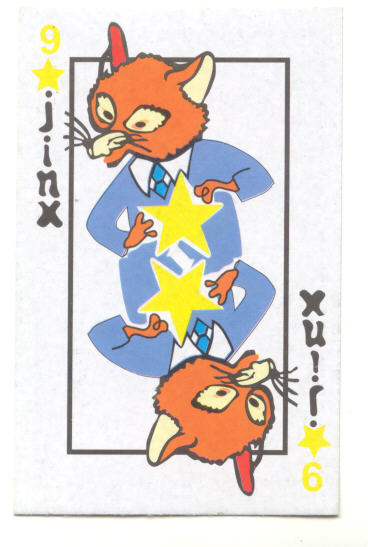
Our last specimen of the venerable game of “Hearts” is a deck currently on sale in toy stores. It tells us no date or publisher, only that it was made in China.
Most “Hearts” decks have four suits; this one, for some reason, has only three: clovers, hearts, and horseshoes. The 9 of stars, the jinx, is the only star card. The fox is dapper; his paws are odd; one ear is redder.
(Posted by Doug Skinner)
Tags: Card Games · Ephemera
March 27th, 2009 · Comments Off on Moses Battles the Pterodactyls (7)
[Yes, Virginia, there is a Charles Darwin; and we continue to fete his bicentennial by serializing my talk on the impact of his theories on American culture. Have a seat.]
A few days after the Scopes trial had pooped out, Bryan died. Mencken exulted, “We killed the son-of-a-bitch,” and ran a rather nasty obituary, calling him a yap and a mountebank. Almost immediately, a Bible College was founded in Dayton in his honor (Bryan’s, that is).
Darrow went on to write and lecture, and toured the country debating prohibition, capital punishment, free will, and other controversies. His sparring with Bryan was published as a Little Blue Book. Scopes became a geologist. Joe Mendi evolved into a chimpanzee. And one of Scopes’s prosecutors, who had the unusual name of Sue Hicks, became a judge; and later inspired the hit song “A Boy Named Sue” when Shel Silverstein saw a newspaper story about him.
In the wake of the Monkey Trial, there were a couple of cultural fads that squarely hit the Darwinian sore spot. One was Tarzan, who had begun his long career as Apeman in 1914 as a book; and by the 1930s had branched out into movies, radio, comics, everything. He tapped into the national appetite for the primitive man, composed of equal parts of feral child, noble savage, and Ubermensch.
And he had been preceded in 1913 by Joseph Knowles, soon to be dubbed the “Yankee Tarzan.” Knowles was an outdoorsman and wildlife painter, who, to give an interesting story to the “Boston Post,” stripped naked one August morn, and strode off to live in the Maine woods. He planned to leave birch-bark journals at drop-off points, and return two months later, well fed and clothed. His stunt was seen as both a snub to modern life and a vindication of it: civilization still produced manly men fit to survive in the wild. Unfortunately, he broke some game laws in the process, and had to stay ahead of game wardens; and was suspected of sneaking meals in a friend’s cabin. Nevertheless, he emerged at last, tanned and healthy, sporting a stinky bearskin. He went on to tour vaudeville; and was a popular speaker in girls’ schools, where students lined up to stroke his weathered skin.
And there was King Kong, a sort of dinosaur-sized man-ape, a Tarzan in reverse; who could vanquish brontosauruses, but not New York actresses.
And we had World War II, which was rather complicated. Nevertheless, the popular idea was that God was rooting for Uncle Sam, and science was helping. The Cold War that followed, however, brought back the traditional tangle between science and religion. The government became more overtly pious; in 1956, the national motto was changed to “In God We Trust” to counter atheistic Communism. But when the Soviets launched Sputnik, and started eying the moon, Americans worried that they were falling behind, and beefed up the science classes. The double-pronged revival was sometimes contradictory.
Since the Scopes Trial had become the symbol of science clashing with religion, but really wasn’t written very well, it had to be redone. So Jerome Lawrence and Robert E. Lee reshaped it into a play, “Inherit the Wind,” that was much tidier than reality.
(Posted by Doug Skinner. More next week…)
Tags: Belief Systems · Education · Literature · Misconceptions · Politics
Today is the birthday of John Keel, the author of Jadoo, The Mothman Prophecies, and many other books close to the heart of the Ullage Group. For those of you who are counting, he’s now 79. Anthony Matt and I visited him Sunday: we took him out to lunch, helped him shop for groceries, and gave him small birthday gifts that would not take up too much room in his famously cluttered apartment. Anthony gave him a lively UFO drawing by a street artist. I gave him a “Spotter Deck”: a pack of playing cards with silhouettes of Allied and Axis aircraft, distributed to GIs in World War II (Keel is a lifelong aviation buff).
He’s in rather poor health these days; we know he has many fans out there, and so we post this to let you know that he’s still reasonably okay, and enjoying his presents. Happy Birthday, John Keel!
(Posted by Doug Skinner)
Tags: Animals · Forteana · Literature · Mysteries
March 20th, 2009 · 1 Comment
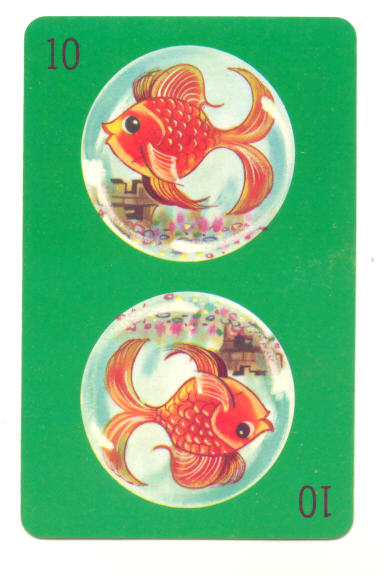
We continue our gallery of the game of “Hearts” with an undated deck from the E. E. Fairchild Corp., of Rochester, N.Y. And a vibrant color scheme they’ve given us, too.
(Posted by Doug Skinner)
Tags: Card Games · Ephemera
[The serialization of my talk on Darwin’s odd cultural impact marches forward. We take a break from the Scopes Trial to ponder the history of caveman cartoons — and the curiously tenacious popularity of the brontosaurus.]
Well, the legal news is always engrossing, but let’s turn for a moment to the funny pages. It’s as good a place as any to savor some popular images of early man — which, curiously, often owed little to either Darwin or the Bible.
Coincidentally, the cartoon that many historians consider the first newspaper comic strip was a gag about evolution, by Richard Outcault, creator of “The Yellow Kid” and “Buster Brown.” It appeared in 1894, under the grand title “Origin of a New Species, or The Evolution of the Crocodile Explained.” A clown and his dog picnic in the woods, apparently oblivious to a huge snake a few feet away. The snake eats the dog; and the clown then cleverly cuts holes in it for the dog’s legs, confecting a crocodile.
But the peculiar genre of the caveman cartoon had already begun a few years earlier in “Punch.” Edward Tennyson Reed’s series, “Prehistoric Peeps,” already bore the earmarks: cavemen with clubs who co-existed with fanciful dinos, parodying modern life.
In the States, another pioneer cartoonist, Frederick Opper, launched “Our Antediluvian Ancestors” shortly afterward. Note the Biblical title: cavemen were situated in a “stone age” sometime between Eden and the ark. In this specimen, the poor brontosaurus is no match for that stock villain, the mother-in-law.
“Alley Oop” soon followed, with elegant draftsmanship, a Popeyesque caveman, and blissfully unreal dinosaurs. Its creator, V. T. Hamlin, was a a great fan of both Christianity and Science; which meant that he seldom made a public statement without invoking God, and that he often drew sidebars about real dinos.
Among his imitators were Frank Engli’s “Looking Back,” with the Milestone family, and Mal Eaton’s “Peter Piltdown.” Once Piltdown Man was exposed as a dastardly hoax, Peter had to be rechristened “Rocky Stoneaxe.”
Walt Kelly’s “Pogo,” which became so popular in the 1950s, was about swamp animals, not cavemen. But he did team up with writer John Reilly for a playful children’s book about evolution, The Glob, which traced the development of glob to caveman. A full-page illustration of the eponymous Glob meeting a brontosaurus was slated for the cover of “Life,” but had to be moved inside because Queen Elizabeth was coronated that week. Poor Kelly was quite disappointed. He must have enjoyed drawing dinosaurs, for he later sent the cast of “Pogo” to the land of Pandemonia, which was either part of Australia or Mars, and was crawling with both cavemen and dinos.
But the most enduring caveman cartoon has to be “The Flintstones.” The formula was simplicity itself: “The Honeymooners” with dinosaurs. And, of course, Fred’s favorite dish was a nice juicy Bronto Burger.
And we conclude by nodding to Johnny Hart’s “B.C.” Again, there’s the familiar formula of cavefolk and giant prehistoric fauna — although it became even more anachronistic when Hart started loading in some Christian messages.
This survey wasn’t meant to be exhaustive — just a sample of the fossil record. But it does show that, for over a century, a consistent, fictional image of prehistoric man has been dinned into us. In it, groups of fur-wrapped Caucasians — never Chinese or Hispanic, for some reason — live in caves — never in huts or fishing villages. They co-exist with dinosaurs, particularly that lovable oaf, the brontosaurus. All in fun, of course, but still curiously consistent. It’s what kids learn.
(Posted by Doug Skinner. More next week…)
Tags: Ancient History · Belief Systems · Education · Politics
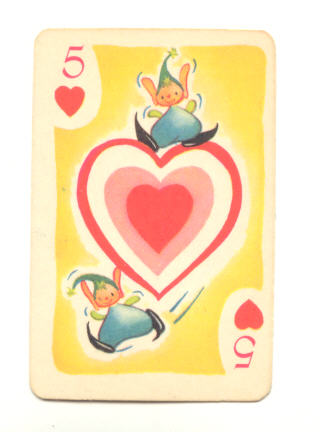
And we have another round of “Hearts.” Like our last, this deck was published in 1951 by the Whitman people. It’s a miniature deck, and features strange little beings.
(Posted by Doug Skinner)
Tags: Card Games · Ephemera
March 14th, 2009 · Comments Off on Moses Battles the Pterodactyls (5)
[Open wide, for another tasty dipperful of my talk on the apparently ceaseless squabble between Darwinians and anti-Darwinians. I gave this talk at a couple of Fortean conventions a few years back; I’m posting it here to celebrate Darwin’s bicentennial. See the earlier dippersful for more details; meanwhile, the Scopes trial is in progress.]
The Scopes trial was a national sensation. As it keyed up, a song by the cowboy songwriter Carson Robison was released. You can hear it sung by Vernon Dalhart here.
It didn’t take long for a jury of Daytonites to convict Scopes. He was fined $100, which both Bryan and the ACLU offered to pay. But the trial was nullified on a technicality: the judge had set the fine, rather than the jury. Scopes never testified; and had to turn down $50,000 to lecture on evolution on the vaudeville circuit, because he didn’t know enough about the subject. The Dayton drugstore conspirators declined to pursue the case. Their plan hadn’t turned out well. Robinson’s did indeed sell a truckload of soda pop; and the local tailor, whose name happened to be Darwin, got to put up a sign touting his clothes as the fittest. But national coverage, especially Mencken’s, ridiculed Dayton as a backward town stocked with medieval yahoos; and photos showed that it was so hot that everybody was sweating very unattractively and constantly fanning themselves. Not quite alluring for the tourist trade.
Near the end, though, America got what it really wanted: the spectacle of Darrow and Bryan, two of the savviest showmen on the hoof, locking horns and bellowing over the evergreen topic of Biblical literalism. The temperature had topped 100 degrees, and the overcrowded courthouse was developing scary cracks, so the show was moved out onto the lawn, under the trees. And there began the great national debate between science and religion, between the old and the new; the pterodactyl swooped down on Moses as he swatted it with his Pentateuch. And it was enacted by a politician and a lawyer.
The debate had, really, nothing to do with the case; Jonah and his celebrated whale were, after all, merely innocent byswimmers. But both Darrow and Bryan wanted it, and so, really, did everyone else. Bryan showed that he was rather foolish, and Darrow that he was rather rude, but neither brought any particular expertise to the subject. Bryan did declare that man was not a mammal, which Mencken had great fun with. Nevertheless, the Scopes trial, particularly that digression, entered American mythology as the great theological smackdown. Obviously, at some point it would need to be rewritten to make it more dramatically satisfying.
(Posted by Doug Skinner; more to come.)
Tags: Belief Systems · Education · Misconceptions · Politics
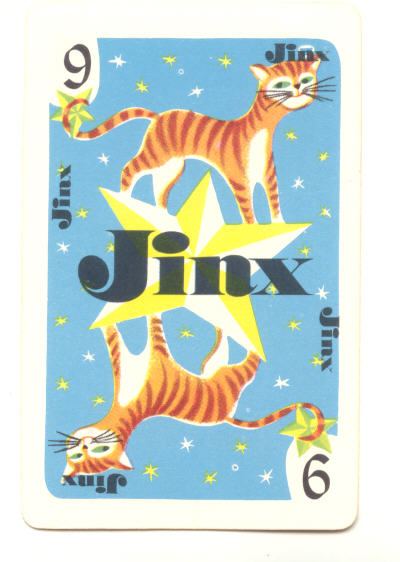
It’s high time we had a round of “Hearts,” that simple and charming card game that became a staple for the kids. This edition was published by Whitman in 1951. The player with the least points wins; and that Jinx card adds 11 to your score. Beware that sly cat, Hearts players!
(Posted by Doug Skinner)
Tags: Card Games · Ephemera
[We continue to mark Darwin’s bicentennial by doling out my talk on his cultural wallop. So far we’ve run through some misconceptions, the melancholy tale of the brontosaurus (to whom we will return), and the background of the Scopes trial. We’re ready to meet some of the principals.]
Bryan is such a complex character that it’s a pity to squeeze him into a nutshell. But, nutshell it is: former three-time presidential candidate, former Secretary of State, legendary orator. His politics were populist and progressive: he was against expansionism, imperialism, and unbridled capitalism; and for prohibition, women’s suffrage, and pacifism. He was a loud and lusty fundamentalist, a champion of small-town values, and one of the busiest campaigners against Darwinism.
His gripes were social, not biological; he was convinced that natural selection showed Nature working “by the operation of the law of hate — the merciless law by which the strong crowd out and kill off the weak.” Social Darwinism was militant, anti-labor; the creed of colonialists and robber barons. As a sample of Bryan’s scientific reasoning, I offer his argument that man could not have evolved from apes, because apes still exist. All of this, obviously, had more to do with Bryan than Darwin.
To the defense then sprang Clarence Darrow, another complicated specimen. Darrow was a disturbingly successful lawyer, committed to defending unpopular clients: blacks, labor agitators, even Leopold and Loeb. He was also a noisy agnostic, given to writing booklets like “Absurdities of the Bible.” He agreed to defend Scopes for free, hoping to lose so he could appeal to a higher court. And he was itching to take on Bryan.
The “Baltimore Sun” made things livelier by sending H. L. Mencken — an extraordinary reporter, critic, and stylist, and an ardent Nietzschean famously hostile to religion, democracy, and rural America.
Also on hand were Emanuel and Marcet Haldeman-Julius, publishers of the Kansas socialist paper “The Freeman.” They also produced the popular “Little Blue Books,” five-cent booklets on every topic they could think of, including many titles on socialism, atheism, and evolution. Thanks to them, you could pick up Darwin for a nickel at Woolworth’s. They also published many debates and articles by and about Darrow; in fact, their first title was Darrow’s essay on the Rubaiyat of Omar Khayyam.
And, of course, Dayton also welcomed the celebrated Joe Mendi, a performing chimp available to pose for reporters.
(Posted by Doug Skinner; to be continued.)
Tags: Belief Systems · Education · Misconceptions · Politics
