April 27th, 2009 · 1 Comment
One of the grand old men of British forteana, John Michell, died on April 24. I only met him a few times; he was always kind and gracious. The last time I saw him, we discussed our common fascination with the number 5040 (Plato’s ideal population for the Republic, among other things). He was a fine writer and painter, endlessly curious (in both senses of the word), and will be missed by many. Fare thee well, John Michell.
(Posted by Doug Skinner)
Tags: Forteana · Literature · The Ineffable
April 27th, 2009 · Comments Off on Medi-Vaudeville: The Report
About forty fine citizens assembled at Jalopy for our fourth event, eager to see how the Ullage Group would screw up this time.
I performed the ceremonial ullage-uncorking, and poured out a shot of chianti for our host, Geoff Wiley; and invoked the Italian proverb “Chi beve it vino prima la minestra, saluta il medico dalla finestra” (“He who drinks wine before the soup greets his doctor from the window”). I then introduced our resident medico, Dr. Mamie Caton, who demonstrated the properties of chianti by sipping some.
Mamie and I discussed evidence-based medicine, alternative medicine, and scientific methodology; the audience chimed in with questions. I’ll post an outline separately. Read it if you like; there will be no test.
Lisa sang a tasty batch of songs with medical themes, including broadside doctor-mockery (“Infallible Doctor” and “Dr. Jeremy Snob”), a vaudevillian patent medicine jingle (“Good Luck to Beecham’s Pills”), and a lilting waltz touting the camphorated poultice Thermogene.
Anthony concluded with notes, both historical and personal, on the unorthodox light therapy machines of Royal Rife and Dr. Dinshah Ghadiali. He also demonstrated a vintage Violet Ray Generator, a miniature Tesla coil that delivered heat and electrical shocks to crucial parts of the body. It’s unwise to operate the Renulife when wearing metal; some of the audience were afraid that Anthony might forget to remove his Ullage Group lapel pin, and fall to the floor, engulfed in flames. But he remembered.
We have more medical curiosities in our files; perhaps we’ll mount a sequel. Thanks again to Jalopy, and to our attendees; and stay healthy!
(Posted by Doug Skinner)
Tags: Bulletins · Education · Technology

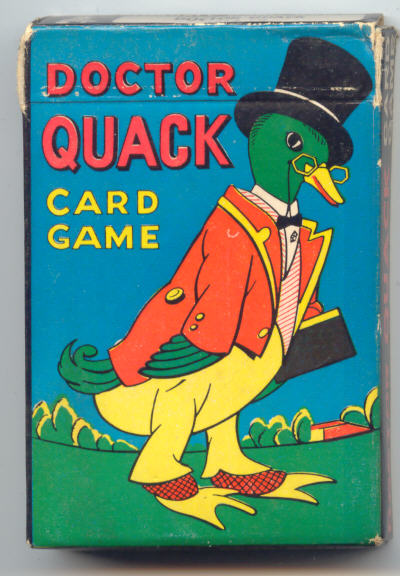
In keeping with the medical theme of our upcoming event, “Medi-Vaudeville,” we offer “The Comical Game of Dr. Quack.” It’s not, strictly speaking, a game: more of an amusement. One player reads the rollicking doggerel about Dr. Quack’s wedding to Miss Hen; others draw cards bearing nouns to be inserted in blanks in the story.
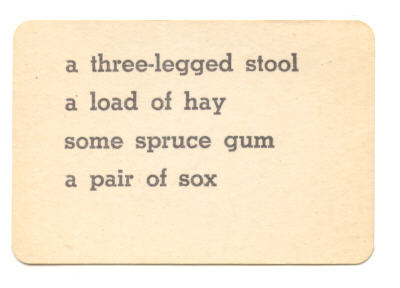
Like the earlier “Peter Coddle,” or the later “Mad Libs,” it’s all about the non sequiturs. This version is from Russell, probably sometime in the ’30s. And here’s the doctor in 1960, again from Russell.
(Posted by Doug Skinner)
Tags: Card Games · Ephemera
The Ullage Group offers its fourth afternoon of cultural curiosities, “Medi-Vaudeville.” The title refers to the book that Charles Fort planned to write, during his final days in the hospital; for, this time around, it’s all medical.
Doug Skinner and Dr. Mamie Caton will talk about alternative medicine, evidence-based medicine, and the difficulty of applying scientific methodology to medical procedures. Lisa Hirschfield will present a selection of medically-themed ditties, ranging from 18th century satirical broadside ballads to 20th century patent medicine jingles. Anthony Matt will speak about turn of the century non-invasive medical technologies, which claimed to cure everything from hair loss to cancer by projecting various spectrums of light onto an ailing patient. His talk will explore the medical pursuits of Nikola Tesla, Royal Rife, and Dr. Dinshah Ghadiali. He will also demonstrate a working vintage violet ray generator.
All of this will take place on Sunday, April 19th, at 5 pm, at Jalopy Theatre, 315 Columbia St., Red Hook, Brooklyn. We charge a pittance, $5, to cover our expenses. We would like to point out that you may also hobnob with fellow ullage fanciers, and purchase stimulating beverages; and that the benefit to your overall health and happiness cannot be quantified. And you don’t need to make an appointment!
For directions to Jalopy, look here.
(Posted by Doug Skinner)
Tags: Bulletins · Diversions · Education
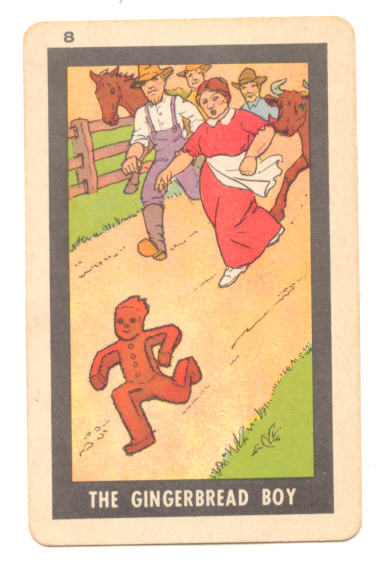
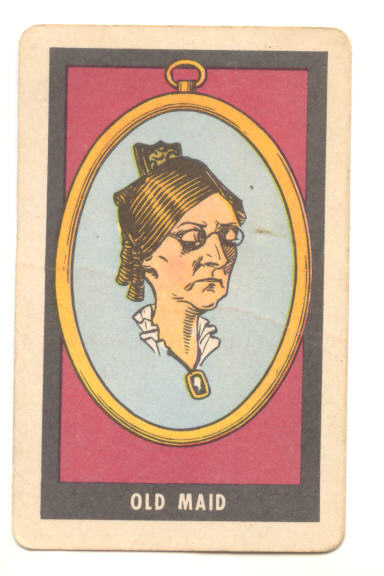
The Old Maids return! We shall have whole brigades of Old Maids! For our last batch, leaf back to September through December of last year; again, we’ll alternate them with other graphic delights.
This deck, from E. E. Fairchild, pairs delicately rendered storybook scenes, including “Mary Quite Contrary,” “Robinson Crusoe,” “Snow White,” and other perennials.
And here’s the Old Maid.
(Posted by Doug Skinner)
Tags: Card Games · Ephemera
April 10th, 2009 · Comments Off on Ben Hecht on American Men
Ben Hecht was the first “Fortean”: he coined the word, and staked his claim. Like the other founders of the first Fortean Society, back in 1931, he had no particular interest in scientific anomalies; he just enjoyed the exuberant and provocative books Charles Fort wove from them.
I plan to paste in snippets from those founders, from time to time: the Society played a lively part in the history of American freethought; its iconoclasm still offers a welcome breath of fresh ullage in the prevailing stink of bovine excretion. And — most crucially — they were colorful writers, still fun to read.
Here, for example, is a clip from a Hecht piece mocking the American male for its obsession with freakishly large breasts. It’s a cheery piece, meant “to offer to the genuine female with normal bosom the small assurance that at least one man knows the score.” But you may find this salvo even cheerier:
This newly hatched American infantilism is not confined to cooing over large bosoms. It shows itself in the way the new American buys things. His home has become a play pen full of useless objects, or objects he could do without; and he must keep dithering for more. It shows itself, also, in in his response to the new barrage of television advertising. He listens to the commercials with the glassy, pacified eye of infancy. He dotes on reiteration. The success of television advertising — the most successful raid on our piggy banks since the Mississippi Bubble — is based on the American’s babyish delight in hearing and seeing unvarying grimaces and sounds repeated over and over.
I am certain when our inwardly tattooed citizen dreams idly in his warm tub, no poetry or memories of art or even of love and adventure drift through his noggin. He sees, instead, beer bottles, deodorant bottles, hair-dye bottles, iceboxes, lipsticks, aluminum pots, cake mixers, cigarette packages, polished automobiles — with their chin-chucking slogans echoing around them. A genuine infant in its warm tub is similarly preoccupied with the wonders of its rubber duck and whatever other material objects are dear to the dawning soul of babyhood.
(Posted by Doug Skinner. This is taken from Esquire’s World of Humor, 1964. The date and title of Hecht’s piece have been shaved off for some editorial whim. Go figure.)
Tags: Forteana · Literature · Technology
On a recent bus trip from upstate NY, back to the forlorn isle of Manhattan, a woman somewhere behind me indulged in a long cell phone chat. For a full, voluble half-hour, she kept her yakmate abreast on where the bus was: every freeway exit, toll booth, and road sign we met on our perilous journey was described in detail. Even our bus’s triumphal entry into Port Authority was annotated: first her alarm that we were on 40th St., although she had been told that the station was on 42nd; then the enumeration of each gate number that we passed; then a color commentary on a tire change in front of us. We arrived, by the way, on time at the proper gate; it’s not as if she needed to alert her friend of any delay. Cell phones are convenient, but I often wish my fellow citizens went without them.
(Posted by Doug Skinner)
Tags: Belief Systems · Technology
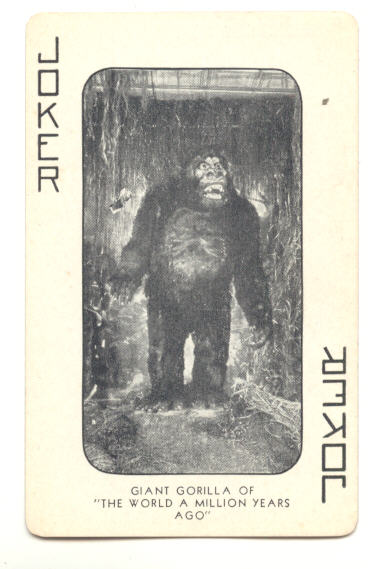
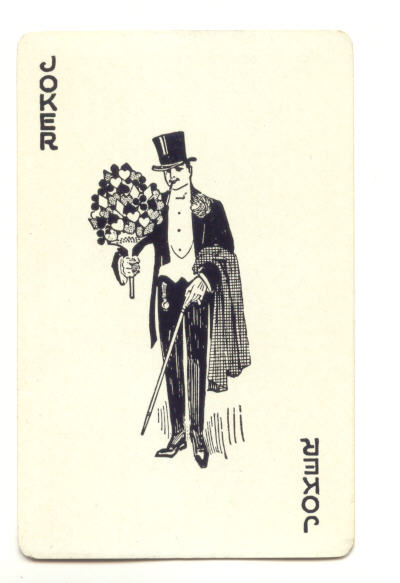
We’re up to #53. If this were a deck of cards, it would be the joker. Let’s mark the occasion, then, with a splendid joker from a souvenir deck of the 1933 Chicago World’s Fair. It’s not really a children’s game, but I’m sure the whole family can enjoy this giant gorilla from a million years ago.
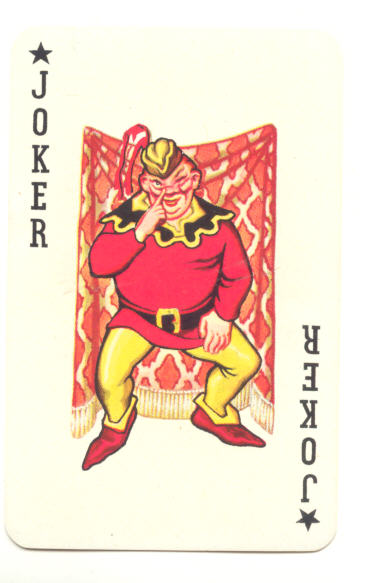
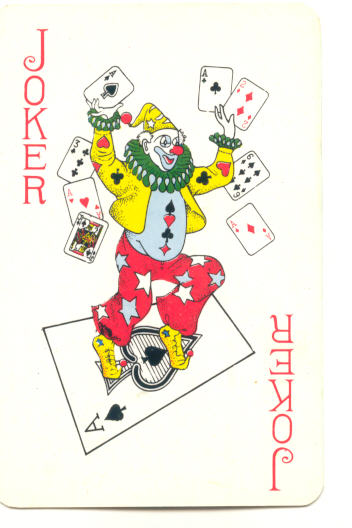
And here are a few scattered jokers as well, from unsung designers.
(Posted by Doug Skinner)
Tags: Card Games · Ephemera
April 5th, 2009 · Comments Off on Moses Battles the Pterodactyls (8)
[Darwin continues to munch on a birthday cake with 200 candles; and we continue to cheer him on with my talk on his cultural impact. We’re now in the full cry of the Cold War, watching the Scopes Trial be rewritten as “Inherit the Wind.” Oh dear.]
In fact, “Inherit the Wind” departed so much from the record that the names had to be changed. Scopes became a young man torn between his ideals and his love for the preacher’s daughter. Bryan was depicted as an obese buffoon. Mencken was turned into a smug, effete dandy. Darrow was magically converted from a rude and salty agnostic into a kindly philosopher, who ended the play by quoting the Bible, and reverently carrying off both scriptures and Darwin.
The play was a hit on Broadway, and turned into an even more successful movie. And it’s now the version of the Scopes Trial that most people know. Back then, in the heat of the Cold War, a script with such a pro-scientific agenda was welcome, even though it demonized evangelicals.
But evolution was entrenched in American society; so much so that another apeman franchise, The Planet of the Apes, could riff on it to highly commercial purpose. Today, I doubt Hollywood would touch it.
Bryan admitted during the trial that the seven days of creation weren’t necessarily literal. The judge conceded the same point to Marcet Haldeman-Julius when she asked him. Despite the claims of many anti-religionists, it’s not Biblical literalism that drives many creationists.
One of the objections to The Descent of Man lies in the doctrine of atonement. If Jesus is supposed to have suffered on the cross for the sins of Adam and Eve, then they need to be real.
Another — and this one surprised me — is the need to assert man’s dominion over the other animals. A friend of mine visited an evangelical mega-church, and was puzzled to encounter a sermon against vegetarianism and animal rights — which the preacher compared to Satanism. By this reasoning, God set man above the other animals, and to treat them as equal, or even as biologically related, is blasphemy. The good neo-Christian is not ascetic, but stuffs himself on Bronto Burgers; he doesn’t preach to birds, but slaughters them. But evolution sets man among the animals, not over them. That’s no fun.
Evolution also holds that different races came from a common ancestor, which annoys segregationists who insist the races were created separate and unmixable.
But it’s the issue of morality that most inflames the creationists. Many invoke the massacre at Columbine, because one of the students wore a t-shirt reading “Natural Selection.” This proves, then, that Darwin leads to mass murder. If God didn’t create Adam and Eve, there is no divinely ordained morality, and that’s something they crave, so Darwin must be false. In this view, the terrible atheistic hoax that Darwin cooked up turned men into lawless apemen; and humanity no longer lived in the Christian peace and harmony that characterized Medieval Europe.
(Posted by Doug Skinner; we bring it on home next week.)
Tags: Animals · Belief Systems · Education · Misconceptions · Politics
April 1st, 2009 · Comments Off on Bulletin (6)
The Ullage Group is hard at work on its next public appearance, “Medi-Vaudeville.” The title is taken from the book Charles Fort planned as his next; we hope to cover a number of medical topics. It will take place on April 19 in Brooklyn’s gem-like Jalopy Theatre; details will follow. Meanwhile, we’ll stimulate your appetite with a few medical posts.
Many curiosities are fermenting in the Ullage cellar, awaiting their decantation. Among them are squibs on the fake Joan of Arc, good riddance to newspapers, the Faust House, the cult of Judas Iscariot, and the other Tiny Tim. Our “Children’s Card Games,” an ongoing rumination on collection and anonymous graphic design, will continue; a fresh platoon of Old Maids is at the ready. Some of them look pretty frisky.
(Posted by Doug Skinner)
Tags: Bulletins
