Just do your work and don’t be lazy,
Like Giambattista Piranesi.
The only drawback of vegetarianism is always being preached at by ghouls.
All human speech is monkey chatter;
It makes no sense; it doesn’t matter.
A woman recently upbraided me for writing a song that didn’t rhyme. I tried to explain that not all verse needed to rhyme, but she didn’t listen. “It could have rhymed,” she snapped, “if you’d spent more time on it.”
The swan looks graceful on the lake;
Don’t drink the water in her wake.
Why are you taking a shower? That won’t pay your rent. What do you really do?
Although Filippo Marinetti
Wrote diatribes against spaghetti,
He still was known to fill his belly
With great amounts of vermicelli.
For strict consistency eludes
Those men containing multitudes.
Project: a phenakistascope made with bas-relief clay modeling, so it looks like claymation when spun. Or: simple basswood carvings (maybe painted).
My family kept feral cats in the yard. My mother refused to spay or worm them, since she believed they wouldn’t hunt mice if she did. Sometimes they hid under the car, and were killed when she pulled out of the driveway. She once told me brightly, “I’m surprised I don’t run over more of them.”
colliding calliopes
For all philosophy’s palaver,
We still end up as some cadaver.
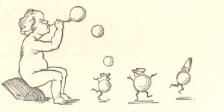
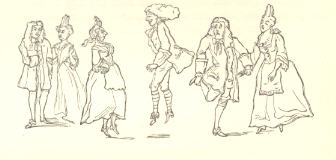
(Posted by Doug Skinner. The sketch is by Thackeray.)
Tags: Dietary Mores · Education
June 26th, 2010 · Comments Off on The Non-Cinema Rubric (2)
One of the unpleasant aspects of cinema is its passivity. The movie is blasted at you, and there’s nothing to do. You don’t have enough room to move, enough light to read, or enough quiet to carry on a conversation. Alcohol — even a harmless beer — will be confiscated. Food is available, but little that appeals to adults.
There are a number of gambits you can use if you do happen to find yourself trapped in a theatre. One, of course, is to sleep. In the classic radio show “Vic and Sade,” the writer, Paul Rhymer, has Vic defend the practice to Sade: “I had a good time. My dreams were pleasantly embroidered with the speeches of the people talkin’ on the screen. ‘I adore you, Everett.’ ‘Try to understand, mother, that I can’t live without Cynthia.’ ‘Hands off that girl, Bernard Breen, or I’ll forget you only got one leg.’ The theatre was dark, my chair was comfortable, an’ the sweet breezes from electric fans bombarded me deliciously. I got value for my twenty-five cents.”
Another technique was suggested by Robert Benchley, in the essay “Block That Plot!”, from his collection After 1903 –What?: “In order to play the game it is necessary to come into the theatre in the middle of the picture… The idea is to take a quick look at the characters on the screen, listen to what they are saying, and reconstruct what has gone before, along the most improbable lines… You’d be surprised how often it works out to make sense. At least, it keeps you guessing.”
Following these examples, I have some potentially useful suggestions for ludic interaction with the dialogue.
You could, for example, feign paranoia, and take each line as a personal message to you from God, or from some cartel of conspirators. Along similar lines, you could imitate the remarkable Louis Wolfson, whose mental illness made him so hate his “mother tongue” that he had to translate all English words that he heard into cognate forms in other languages. Or, you could adapt the exercise in Aleister Crowley’s LIBER III vel Jugorum, and slash your forearm with a razor whenever you hear the word “I” (or another word of your choosing). This has nothing to do with Crowley’s original purpose, but will help to pass the time.
Devotees of General Semantics might also try de-Aristotlizing the dialogue by suppressing the verb “to be,” and rephrasing it all subjectively — silently, of course, so as not to wake your neighbors.
You could also work your visual imagination by picturing to yourself what the scene would look like if all the actors were fifty years older, or bears, or robots; or what might happen if a small pig trotted across the set, or ice crashed through the ceiling, or one of the actors started yawning uncontrollably.
I hope these ideas will be useful in your hour of need; best of luck.
(Posted by Doug Skinner)
Tags: Non-cinema

The “Bowling Card Game” (Ed-U-Cards, 1962) let you enjoy the sport without getting any exercise. And you could enjoy some colorful early ’60s graphics as well.
(Posted by Doug Skinner)
Tags: Card Games · Ephemera
You should always wash the hand which
You will use to hold the sandwich.
There are two kinds of people in the world: those who joke that there are two kinds of people in the world, those who divide the world into two kinds of people, and those who don’t; and those who don’t.
My father made breakfast with a stopwatch; so that the eggs, toast, and coffee would all be done at exactly the same time.
Consider the lilies of the field, how they grow: they toil not, neither do they quote the Bible.
The moth cannot resist the light;
Its children eat your pants at night.
A woman approached me on the subway platform. “Is that a ukulele?” she asked. “Yes,” I said. “Oh,” she said, “that’s a good instrument for children, or for people who find the guitar too daunting.” I explained that I preferred the uke to the guitar. “Oh,” she sneered, “maybe you should learn to be more tolerant.”
Recently, I went with friends to a bar, only to encounter a bouncer who wanted two forms of ID, which he also wanted to scan, so there would be a record of who was in the bar and when. We went elsewhere.
How convenient that the alphabet is in alphabetical order!
Excuse me, sir; I beg your pardon:
Please don’t do that in my garden.
Actually, it’s not “Notre Dame”; it’s “Votre.”
A harpy cannot play the harp,
Because her talons are too sharp.
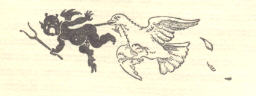
(Posted by Doug Skinner. The drawing is by Frank C. Papé.)
Tags: Education · Ukulele

Built-Rite is responsible for the “Zoo Fun Card Game.” There is no date, I’m afraid: just pictures of birds, fish, and mammals: on “New shaped cards — to fit the hands – easier to hold.”
(Posted by Doug Skinner)
Tags: Card Games · Ephemera
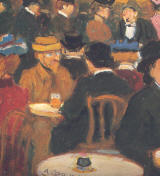
Sometimes mechanical reproduction is not the most accurate. In the 1890s, the composer Erik Satie bought seven identical velvet suits, and wore nothing else for seven years. In photos, they look gray: his biographers duly noted that; a record of his music was even entitled “The Gray Velvet Gentleman.” Later, scholars unearthed several color sketches by his friend Grass-Mick that showed the outfit as yellow: it just photographed as gray.
Here comes jolly Mr. Sun!
Won’t you wake me when he’s done?
picnics for nitwits
I never met a man who never met a man he didn’t like that I like.
Why did St. Francis have to preach to the birds? Did it ever occur to him that he might learn from them?
On one occasion, I visited my family out in Oklahoma; and my father wanted to know what kind of beer I drank. I said Guinness, only to learn that he’d never heard of it. In fact, none of my family had; and they were quite hostile to me for drinking some weird foreign beer that nobody had even heard of.
When you cross that busy street,
Don’t forget to move your feet.
Project: a row of geared phenakistascopes, facing a long mirror.
Won’t someone help poor Dionysus?
He’s out of wine, and that’s a crisis.
Today, I heard a newscaster call Arlington Cemetery “Arlington Seminary.”
How very noisy is the bigot!
To hear him bellow, turn his spigot.
(Posted by Doug Skinner)
Tags: Education · Music
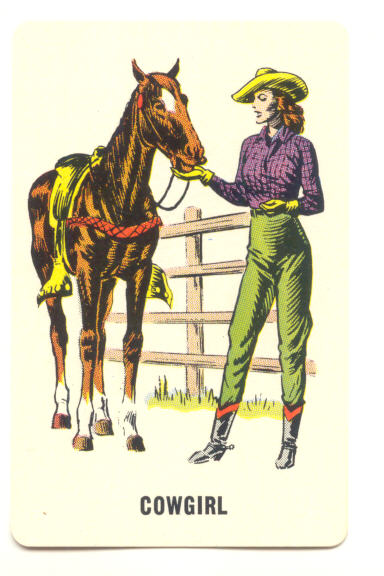
“Cowboys and Indians” was published by Ed-U-Cards in 1960. It featured soberly rendered illustrations of cowboys and Indians, six-shooters and tommyhawks — and one cowgirl.
(Posted by Doug Skinner)
Tags: Card Games · Ephemera
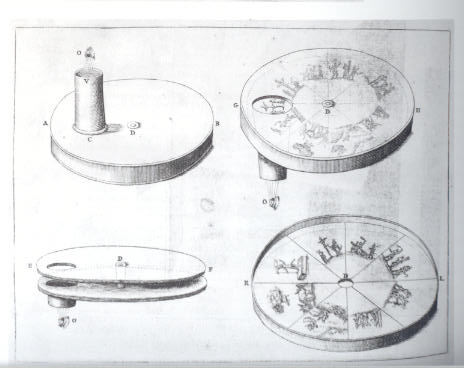
I recently obtained a copy of Joscelyn Godwin’s book Athanasius Kircher’s Theatre of the World (Inner Traditions, 2009). I mention it here so that I can plug it: it’s a wonderful overview of the 17th century savant, studded with 400 examples of his charts, maps, inventions, and other illustrations. There’s been somewhat of a Kircher revival recently; this trove will fuel it.
Here, for example, is Kircher’s Parastatic Microscope: a glass disc, painted with small images, mounted in a wooden case. The disc rotates; the images are viewed through a lens. As Godwin points out, it’s much like a modern slide viewer. And it comes close to providing a moving picture: all it needs is a shutter (like a film projector), or slits broken up with blackness (like a zoetrope or phenakistascope) to separate sequential pictures and trigger the persistence of vision.
(Posted by Doug Skinner)
Tags: Diversions · Literature · Technology
Your butt in back, in front your face:
That’s how you move through time and space.
I once found a salamander in my family’s yard. Salamanders are harmless; still, my father’s immediate reaction was “Kill it!”
Maybe we can spend the meeting
Arguing about the seating.
If you pay attention, you may notice an increasing stigmatization of cash. Credit and debit cards are the norm; cash is now sometimes called “the underground economy,” and branded as somewhat skeevy, the tender of drugs and prostitution. Obviously, people pay cash only if they don’t want their identities tracked. I recently paid dollar bills for batteries in Radio Shack, and the clerk insisted on getting my name and address — which was, apparently, Elmer Hoohah of 23 Bedspring Boulevard.
Project: a stereoscopic flipbook
It is better to curse the light than the darkness; that way, you can see what you’re doing.
On the morning of my sister’s wedding, I stepped outside and saw a feral cat eating the head of its dead kitten.
When in public, don’t make peepee:
Other people find it creepy.
Print up cards urging people to read Matthew xx: 38.
Newscaster flub: “sewer loser” for “sore loser.”
Clarence Darrow, an avowed pessimist, was asked why he didn’t just commit suicide. “I don’t have to,” he explained, “I’m going to die anyway.”
(Posted by Elmer Hoohah. The sketch is by Thackeray.)
Tags: Education
A few members of the Ullage Group convened this week to experiment with another foodstuff unfamiliar to the dominant American culture. The subject was chestnut honey: an Italian varietal markedly darker, earthier, and less sweet than the common domestics. The participants in the study were Doug Skinner, Dr. Mamie Caton, and her associates Susan and Michelle.
A preliminary taste confirmed the complex flavor of the subject; the team particularly enjoyed its subdued sweetness and bitter undertones. The following traditional recipe was prepared.
Slices of Italian bread were topped with thin slices of pecorino romano cheese and thin slices of pear (d’Anjou). Several specimens were also prepared with gorgonzola instead of romano, a common variation. The specimens were placed in a moderate oven (350 degrees F, 177 degrees C) for ten minutes: the objective being to heat and soften the ingredients, not to melt or cook them. They were then removed from the oven, and drizzled with the chestnut honey.
The team judged the results positive. The combination of crusty bread, salty cheese, fresh pear, and musky honey was pronounced significantly tasty. The gorgonzola was assessed as particularly effective.
Those wishing to replicate the procedure should be apprised that earlier researchers have reported excellent results by omitting the bread, and simply using a bisected pear; and with substituting similar darker honeys, such as acacia or silver fir.
(Posted by Doug Skinner)
Tags: Dietary Mores
