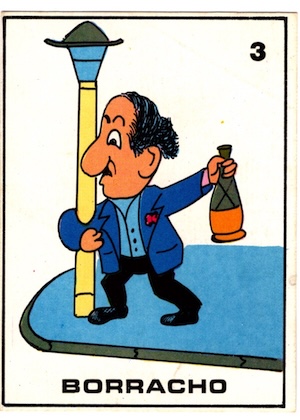
“Descon??? Fiado???” was published by Industria Argentina. There’s no date, and the typewritten instruction sheet indicates that it probably comes from a small company. I suppose the title could be translated as “Un??? Trustworthy???” The object is to collect and discard cards to be left with the minimum of points, although I admit I can’t read all of the Spanish instructions. In addition to the probably untrustworthy Borracho, the cards are Detective, Ladron, Linyera, Cazador, and Soldado, all drawn in this appealingly naive style.
(Posted by Doug Skinner)
Tags: Card Games
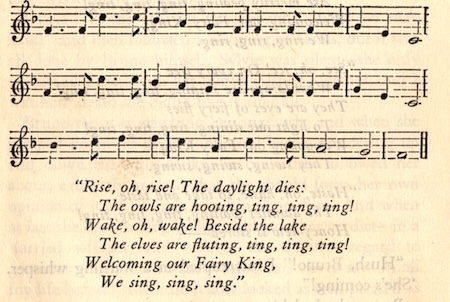
Lewis Carroll wrote two pieces of music that I know of. One was printed in his 1889 book Sylvie and Bruno; it was sung by Bruno in the 15th chapter.
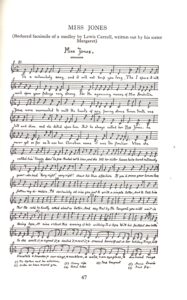
The other was a medley of tunes called “Miss Jones,” for which Carroll provided new words. Here’s the first page, as notated by his sister Margaret (please click to enlarge).
(Posted by Doug Skinner)
Tags: Literature · Music
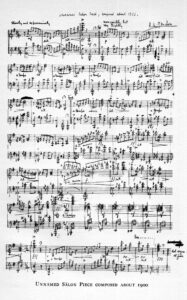
The journalist, critic, and peerless prose stylist H. L. Mencken was also a pianist. He regularly played chamber music with his friends in Baltimore, and in his youth, he had aspirations as a composer. Isaac Goldberg, in his 1925 biography The Man Mencken, mentions a number of early pieces: a “Two-Step” from 1892, a “March” and “Easy Waltz” from 1893, a number of other waltzes, and a setting of William Watson’s poem “April.” He reproduces the following untitled salon piece, from about 1900, when Mencken was about 20.
(Posted by Doug Skinner)
Tags: Literature · Music
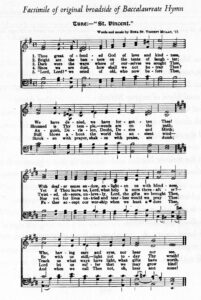
I wasn’t surprised to learn that Edna St. Vincent Millay was musical, but I didn’t expect to find that she actually composed something. Here, though, is a “Resurrection Hymn” written for a performance at Vasser in 1917. The harmonization is rather odd, which I suppose is in character. Calling the tune “St. Vincent” is facetious–there’s a traditional hymn tune called “St. Vincent,” written by the prolific Austrian composer Sigismund Ritter von Neukomm, but her tune is different.
(Posted by Doug Skinner)
Tags: Literature · Music
Many composers have also been excellent writers: Charles Ives, Erik Satie, Virgil Thomson, and George Antheil, for example. And some writers have pursued ambitious careers in music that rivaled their literary careers: Paul Bowles, Anthony Burgess, and Jean-Jacques Rousseau, for example. And for centuries, songwriters have written both music and lyrics. Under this rubric, however, I’ll post another category: music by writers who only composed sporadically, often with surprising results.
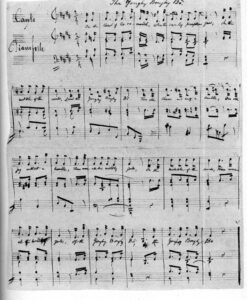
The first one is Edward Lear. Lear wrote music for two of his verses, “The Pelican Chorus” and “The Courtship of the Yonghy-Bonghy-Bò,” both with the help of a certain Signor Pomé. Here’s the latter, from August 1, 1876.
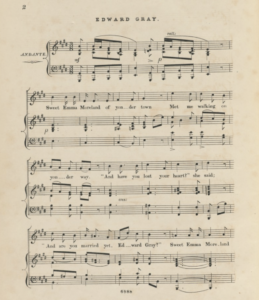
Lear also composed settings for twelve poems by Tennyson, with the assistance of Edward Francis Rimbault. Here’s the beginning of one of them, “Edward Gray,” from 1871. Lear sang them for Tennyson, to the latter’s approval.
(Posted by Doug Skinner)
Tags: Literature · Music

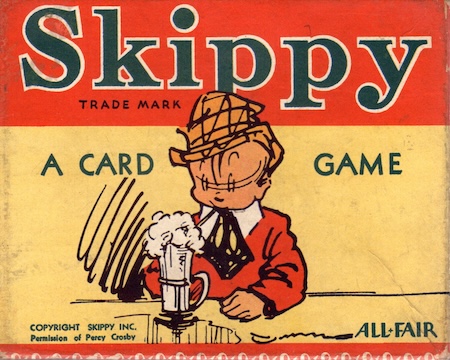
There have been many card games that invite the player to collect the panels of a comic strip. This one features Skippy, by Percy Crosby, and was published by E. E. Fairchild in 1932.
Here’s the back:

And the box:
(Posted by Doug Skinner)
Tags: Card Games
L. Frank Baum developed the Land of Oz in a series of books, which were continued after his death by Ruth Plumly Thompson. This definitive map was drawn by John R. Neill for the endpapers of the 1939 Ox book Ozoplaning with the Wizard of Oz. It’s not very detailed, but it does help orient the reader.

(Posted by Doug Skinner)
Tags: Books · Literature
The map below traces André Breton’s walks through Paris in October and November 1926, as described in his 1928 novel Nadja. It’s taken from the wonderful Guide de Paris mystérieux, edited by François Caradec and published by Tchou in 1966. Tchou published a series of “Guides Noirs” that are full of intriguing things.

(Posted by Doug Skinner)
Tags: Books · Literature
Raymond Roussel’s novel Locus Solus (serialized in 1913 and published as a book in 1914) takes place on the estate of the wealthy inventor Martial Canterel. The 1965 edition by Jean-Jacques Pauvert includes, as an appendix, maps and diagrams by Jean Ferry. Here’s Ferry’s depiction of Canterel’s estate.

(Posted by Doug Skinner)
Tags: Books
December 4th, 2025 · 2 Comments
The Dell mapbacks were not confined to mysteries. Here, for example, is the map intended to guide the reader through P. G. Wodehouse’s Leave It to Psmith. Perhaps the presence of jewel thieves made the book enough of a mystery to warrant it.

More surprisingly, Edgar Rice Burrough’s Cave Girl, in which a modern collegiate must become a savage fighter to win the love of the eponymous cave girl, also required a map. The plot, essentially a series of fights, isn’t hard to follow, but the map is attractive anyway.

(Posted by Doug Skinner)
Tags: Books · Literature
